Let us return to our initial question of finding stronger conditions than continuity. With the \(\varepsilon\)-\(\delta\) criterion this is possible in the following way.
Definition 4.7 • Uniform continuity, Lipschitz continuity
Let \(D \subseteq {\mathbb{R}}\) and \(f:D \to {\mathbb{R}}.\)
The function \(f\) is called uniformly continuous, if for every \(\varepsilon > 0\) there exists a \(\delta > 0\) such that for all \(x,\,\widetilde{x} \in D\) it holds that \[| x- \widetilde{x}| < \delta \quad \Longrightarrow \quad | f(x) - f(\widetilde{x}) | < \varepsilon.\]
The function \(f\) is called Lipschitz continuous, if there exists an \(L > 0\) such that for all \(x,\,\widetilde{x} \in D\) it holds that \[|f(x) - f(\widetilde{x})| \le L \cdot |x - \widetilde{x}|.\]
Remark 4.5
In order to understand the difference between continuity and uniform continuity, we formulate both conditions with the help of quantifiers. We obtain \[\begin{aligned} f \text{ continuous}\quad :\Longleftrightarrow \quad &\forall \widetilde{x}\in D\;\forall \varepsilon > 0 \; \exists \delta > 0\;\forall x \in D: \\ & |x- \widetilde{x}| < \delta \;\Longrightarrow \; |f(x) - f(\widetilde{x})| < \varepsilon; \\ f \text{ uniformly continuous}\quad :\Longleftrightarrow \quad &\forall \varepsilon > 0 \; \exists \delta > 0\;\forall \widetilde{x}\in D\;\forall x \in D:\\ & |x- \widetilde{x}| < \delta \;\Longrightarrow \; |f(x) - f(\widetilde{x})| < \varepsilon. \end{aligned}\] Both definitions only differ in the order of the quantors. But this has consequences: In the case of continuity, \(\delta\) depends on both \(\widetilde{x}\) and \(\varepsilon\) while for uniform continuity, \(\delta\) only depends on \(\varepsilon.\) Thus, in the latter case, if \(\varepsilon > 0\) is fixed, \(\delta\) can be chosen to be the same in the entire domain \(D.\) This explains the word “uniform” in the definition.
For \(D \subseteq {\mathbb{R}}\) and \(f: D \to {\mathbb{R}}\) we have the following implications: \[\begin{aligned} f\text{ Lipschitz continuous} \quad &\Longrightarrow \quad f \text{ uniformly continuous} \quad \\ &\Longrightarrow \quad f\text{ continuous}. \end{aligned}\] The second implication follows from the considerations in i. The first implication can also be easily inferred because the Lipschitz continuity implies uniform continunity for \(\delta = \frac{\varepsilon}{L},\) so \(\delta\) depends only on \(\varepsilon.\)
Uniform continuity and Lipschitz continuity are global properties because they take the entire domain \(D\) into account. In contrast to that, continuity is a local property since it is defined over the continuity in all \(a \in D\) individually.
Theorem 4.13 • Heine-Cantor theorem
Let \(f:[a,b] \to {\mathbb{R}}\) be continuous. Then \(f\) is uniformly continuous.
Proof. Assume that \(f\) is not uniformly continuous. Then there exists an \(\varepsilon > 0\) such that for every \(n \in {\mathbb{N}}\setminus \{0\}\) and \(\delta_n := \frac{1}{n}\) there exist two points \(x_n,\,\widetilde{x}_n \in [a,b]\) such that \[|x_n - \widetilde{x}_n| < \delta_n, \quad \text{but} \quad |f(x_n) - f(\widetilde{x}_n)| \ge \varepsilon.\] Since \({(x_n)}_{n \ge 1}\) is a bounded sequence, the Bolzano-Weierstraß theorem (Theorem 2.12) implies that there exists a convergent subsequence \(\big( x_{n_k} \big)_{k \in {\mathbb{N}}}\) with limit \(x:= \lim_{k\to\infty}x_{n_k} \in [a,b].\) Since \(|x_n - \widetilde{x}_n| < \frac{1}{n}\) we also have \(\lim_{k \to \infty} \widetilde{x}_{n_k} = x.\) Using the continuity of \(f\) we obtain \[\lim_{k \to \infty} (f(x_{n_k}) - f(\widetilde{x}_{n_k})) = f(x) - f(x) = 0.\] This is a contradiction of \(|f(x_{n_k}) - f(\widetilde{x}_{n_k})| \ge \varepsilon\) for all \(k \in {\mathbb{N}}.\) Thus, our assumption is false and \(f\) is uniformly continuous.
Video 4.9. Heine-Cantor theorem.
The concept of Lipschitz continuity plays an important role in the theory of ordinary differential equations. More precisely, with the help of this condition we can show existence and uniqueness of solutions of such equations.
4.5 Exponential and Logarithm Functions
In this section we will define the inverse function of the exponential function and based on that, general exponential functions. An important auxiliary tool is the continuous inverse theorem for which we will need a new term.
Definition 4.8 • Monotonicity of functions
Let \(D \subseteq {\mathbb{R}}\) and \(f:D \to {\mathbb{R}}.\) Then \(f\) is called
monotonically increasing, if for all \(x,\,\widetilde{x} \in D\) it holds that \[x \le \widetilde{x} \quad \Longrightarrow \quad f(x) \le f(\widetilde{x});\]
strictly monotonically increasing, if for all \(x,\,\widetilde{x} \in D\) it holds that \[x < \widetilde{x} \quad \Longrightarrow \quad f(x) < f(\widetilde{x});\]
(strictly) monotonically decreasing, if \(-f\) is (strictly) monotonically increasing.
Theorem 4.14 • Continuous inverse theorem
Let \(I \subseteq {\mathbb{R}}\) a (not necessarily finite) interval and let \(f: I \to {\mathbb{R}}\) be continuous and strictly monotonically increasing (or strictly monotonically decreasing). Then the following statements are satisfied:
The set \(f(I)\) is an interval and \(f:I \to f(I)\) is bijective. (This implies that the inverse function \(f^{-1}:f(I) \to I\) exists.)
The inverse function \(f^{-1}:f(I) \to I\) is continuous and strictly monotonically increasing (resp. strictly monotonically decreasing).
Proof. W. l. o. g. assume that \(f\) is strictly monotonically increasing, otherwise consider \(-f\) instead.
By Corollary 4.10, the set \(f(I)\) is an interval. Moreover, \(f\) is injective, since \(x \neq \widetilde{x}\) implies \(f(x) \neq f(\widetilde{x})\) due to the strict montonicity. Hence, \(f:I \to f(I)\) is bijective.
Step 1: We show the strict monotonicity of the inverse function. Let \(y,\,\widetilde{y} \in f(I).\) Since \(f\) is (strictly) monotonically increasing, it holds that \[f^{-1}(y) \ge f^{-1}(\widetilde{y}) \quad \Longrightarrow \quad y = f\big(f^{-1}(y)\big) \ge f\big(f^{-1}(\widetilde{y})\big) = \widetilde{y}.\] By contraposition we obtain \[y < \widetilde{y} \quad \Longrightarrow \quad f^{-1}(y) < f^{-1}(\widetilde{y}).\]
Step 2: We show continuity of \(f^{-1}.\) Let \(y \in f(I)\) be arbitrary and let \({(y_n)}_{n \in {\mathbb{N}}}\) be an arbitrary sequence in \(f(I)\) with \(\lim_{n \to \infty} y_n = y.\) We have to show that \[\lim_{n \to \infty} f^{-1}(y_n) = f^{-1}(y).\] Assume that this is not the case. Then there exists an \(\varepsilon > 0\) such that \(|f^{-1}(y_n) - f^{-1}(y)| \ge \varepsilon\) for infinitely many \(n \in {\mathbb{N}}.\) Let \({\mathcal{N}}\) be the set of such \(n \in {\mathbb{N}}\) and define \[\begin{aligned} {\mathcal{N}}^+ &:= \big\{ n\in{\mathbb{N}}\; \big| \; f^{-1}(y_n) - f^{-1}(y) \ge \varepsilon \big\}, \\ {\mathcal{N}}^- &:= \big\{ n\in{\mathbb{N}}\; \big| \; f^{-1}(y_n) - f^{-1}(y) \le -\varepsilon \big\}. \end{aligned}\] Then \({\mathcal{N}}= {\mathcal{N}}^+ \cup {\mathcal{N}}^-\) and since \({\mathcal{N}}\) has infinitely many elements, this is also the case for at least one of the sets \({\mathcal{N}}^+\) or \({\mathcal{N}}^-.\) Let w. l. o. g. \({\mathcal{N}}^+\) contain infinitely many elements, the other case is analogous. Then for all \(n \in {\mathcal{N}}^+\) we have \[f^{-1}(y_n) \ge f^{-1}(y) + \varepsilon > f^{-1}(y).\] This implies \(f^{-1}(y) + \varepsilon \in I.\) Because of the monotonicity of \(f\) we obtain \[y_n = f\big(f^{-1}(y_n)\big) \ge f\big(f^{-1}(y) + \varepsilon\big) > f\big(f^{-1}(y)\big) = y \quad \text{for all } n\in {\mathcal{N}}^+.\] Hence, \[|y_n - y| \ge \widetilde{\varepsilon} := f\big(f^{-1}(y) + \varepsilon\big) - y > 0\] for infinitely many \(n \in {\mathbb{N}}.\) But this is a contradiction to the convergence of \({(y_n)}_{n \in {\mathbb{N}}}\) towards \(y.\) Thus \(f^{-1}\) is continuous in \(y\) and since \(y \in f(I)\) is arbitrary, the continuity of \(f^{-1}\) follows.
Video 4.10. Continuous inverse theorem.
Example 4.13
We prove the continuity of the root function. Let \(k \in {\mathbb{N}}\) with \(k \ge 2\) and consider the function \(f:[0,\infty) \to {\mathbb{R}},\) \(x \mapsto x^k.\) Then \(f\) is continuous and strictly monotonically increasing. Because of \(\lim_{x \to\infty} f(x) = \infty\) we have \(f([0,\infty)) = [0,\infty).\) By Theorem 4.14, the inverse function \[f^{-1} :[0,\infty) \to [0,\infty)\] exists and is strictly monotonically increasing and continuous. Obviously, \(f^{-1}(x) = \sqrt[k]{x}\) for all \(x \in [0,\infty).\) (The root function is an example of a uniformly continuous function that is not Lipschitz continuous.)
Let us return to our original goal and define the inverse function of the exponential function.
Theorem 4.15
The exponential function \(\exp:{\mathbb{R}}\to {\mathbb{R}}\) is continuous and strictly monotonically increasing and it holds that \(\exp({\mathbb{R}}) = (0,\infty).\) In particular, there exists \(\exp^{-1}:(0,\infty) \to {\mathbb{R}}\) which is continuous and strictly monotonically increasing.
Proof. We know from Theorem 4.3 that \(\exp\) is continuous. Moreover, for \(x > 0\) we have \[\tag{4.2} \exp(x) = 1+x+\sum_{k=2}^\infty \frac{x^k}{k!} > 1+x > 1.\] With this at hand, we can show that \(\exp\) is also strictly monotonically increasing. Let \(x,\,\widetilde{x} \in {\mathbb{R}}\) with \(x > \widetilde{x}.\) Then \(x - \widetilde{x} > 0\) and \[\exp(x) = \exp(x-\widetilde{x}+\widetilde{x}) = \exp(x-\widetilde{x})\exp(\widetilde{x}) > \exp(\widetilde{x}).\] Furthermore, \(\exp({\mathbb{R}}) = (0,\infty)\) since with Corollary 4.10, \(\exp({\mathbb{R}})\) is an interval and because of (4.2) we have \[\lim_{x \to \infty} \exp(x) = \infty \quad \text{and} \quad \lim_{x \to -\infty} \exp(x) = \lim_{y \to \infty} \exp(-y) = \lim_{y \to \infty} \frac{1}{\exp(y)} = 0.\] Since \(\exp(x) > 0\) for all \(x \in {\mathbb{R}},\) the claim follows. The claims about the inverse function then follow directly from the continuous inverse theorem (Theorem 4.14).
Definition 4.9 • Natural logarithm
The inverse of the exponential function \(\ln:=\exp^{-1}:(0,\infty) \to {\mathbb{R}}\) is called the natural logarithm.
It is common practice to sometimes write \(\exp x\) and \(\ln y\) instead of \(\exp(x)\) and \(\ln(y).\) From the properties of the exponential function we can now easily derive the properties of the natural logarithm.
Theorem 4.16
Let \(x,\,y \in (0,\infty)\) and \(m \in {\mathbb{Z}}.\) Then we have
\(\ln(1) = 0\) and \(\ln(\mathrm{e}) = 1,\)
\(\ln(x\cdot y) = \ln(x) + \ln(y),\)
\(\ln \big( \frac{1}{x} \big) = - \ln(x),\)
\(\ln(x^m) = m \cdot \ln(x).\)
Proof. Exercise!
In the following we aim at defining \(a^x\) for arbitrary \(a>0\) and \(x \in {\mathbb{R}}.\) Then also our well-known power laws should be satisfied (similarly to Corollary 3.14) as well as Theorem 4.16 iv. We expect \[a^x = \exp(\ln(a^x)) = \exp(x \cdot \ln a).\] This motivates the following definition.
Definition 4.10 • Exponential function with general basis
Let \(a > 0.\) Then the function \(\exp_a:{\mathbb{R}}\to {\mathbb{R}},\) \(x \mapsto \exp(x\cdot \ln a)\) is called the exponential function to the basis \(a\).
Theorem 4.17
Let \(a > 0,\) \(x,\,y \in {\mathbb{R}},\) and \(m \in {\mathbb{Z}}.\) Then
\(\exp_a\) is continuous,
\(\exp_a(x+y) = \exp_a(x) \cdot \exp_a(y),\)
\(\exp_a(-x) = \frac{1}{\exp_a(x)},\)
\(\exp_a(m) = a^m.\)
Proof.
This follows from the fact that \(\exp_a\) is a composition of two continuous functions.
We have \[\begin{aligned} \exp_a(x+y) &= \exp((x+y)\cdot \ln a) = \exp(x\cdot \ln a + y \cdot \ln a) \\ &= \exp(x\cdot\ln a)\cdot\exp(y\cdot\ln a) = \exp_a(x) \cdot\exp_a(y). \end{aligned}\]
The proof is as in Corollary 3.14 ii.
The proof is as in Corollary 3.14 iv and since \[\exp_a(1) = \exp(1\cdot \ln a) = a.\]
Definition 4.11 • General power
For \(a > 0\) and \(x \in {\mathbb{R}}\) we define \(a^x := \exp(x\cdot \ln a).\)
In other words, we have \(a^x := \exp_a(x).\) Using the properties of \(\exp_a\) we obtain the following power laws (which should be known from high-school).
Theorem 4.18
Let \(a,\,b > 0,\) \(x,\,y \in {\mathbb{R}},\) \(p \in {\mathbb{Z}},\) and \(q \in {\mathbb{N}}\setminus\{0,1\}.\) Then we have
\(a^{x+y} = a^x \cdot a^y,\)
\(a^x \cdot b^x = (a\cdot b)^x,\)
\(\big( \frac{1}{a} \big)^x = a^{-x} = \frac{1}{a^x},\)
\(\ln\big(a^x\big) = x \ln a,\)
\(\big(a^x\big)^y = a^{xy},\)
\(a^{\frac{p}{q}} = \sqrt[q]{a^p}.\)
Proof. Exercise!
Remark 4.6
It is important to note that general powers are only defined for positive bases \(a\). Even if a non-integer exponent would make sense for a negative basis, the power laws are not valid anymore. To illustrate this, we consider the following example. We have that \((-2)^3 = -8.\) One could have the idea to set \((-8)^{\frac{1}{3}} = -2.\) But if we make use of our power laws, we obtain the contradiction \[-2 = (-8)^{\frac{1}{3}} = (-8)^{\frac{2}{6}} = \sqrt[6]{(-8)^2} = \sqrt[6]{64} = 2.\] Thus the expression \(a^x\) with \(a<0\) is only defined for \(x \in {\mathbb{Z}}.\) For the same reason also roots are only defined for nonnegative real numbers. Even though, the inverse of the function \(f:{\mathbb{R}}\to {\mathbb{R}},\) \(x \mapsto x^3\) is defined on entire \({\mathbb{R}},\) it is not the third root \(\sqrt[3]{\cdot}\) (which is only defined on \([0,\infty)\)). Instead the inverse is \[f^{-1} :{\mathbb{R}}\to {\mathbb{R}}, \quad x \mapsto \begin{cases} \sqrt[3]{x}, & \text{if } x\ge 0, \\ -\sqrt[3]{-x}, & \text{if } x<0. \end{cases}\]
The following lemma shows that a continuous function \(f: {\mathbb{R}}\to {\mathbb{R}}\) is already uniquely determined by its function values for all rational arguments. With the result we can show that any nontrivial continuous function that fulfills the property \(f(x+y)=f(x)\cdot f(y)\) for all \(x,\,y \in {\mathbb{R}}\) must already be an exponential function.
Lemma 4.19
Let \(f,\,g:{\mathbb{R}}\to {\mathbb{R}}\) be two continuous functions with \(f(x) = g(x)\) for all \(x \in {\mathbb{Q}}.\) Then \(f\) and \(g\) are identical on \({\mathbb{R}},\) i. e., \(f=g.\)
Proof. Let \(x \in {\mathbb{R}}.\) Then by Example 4.8, \(x\) is an accumulation point of \({\mathbb{Q}},\) i. e., there exists a sequence \({(x_n)}_{n \in {\mathbb{N}}}\) in \({\mathbb{Q}}\setminus\{x\}\) with \(\lim_{n \to \infty} x_n = x.\) By the continuity of \(f\) and \(g\) we obtain \[f(x) = f\left( \lim_{n \to \infty} x_n \right) = \lim_{n \to \infty} f(x_n) = \lim_{n \to \infty} g(x_n) = g\left( \lim_{n \to \infty} x_n \right) = g(x).\]
Theorem 4.20
Let \(f:{\mathbb{R}}\to {\mathbb{R}}\) be continuous. Then the following statements are equivalent:
For all \(x,\,y\) it holds that \(f(x+y) = f(x) \cdot f(y).\)
It holds that \(f=0\) or \(f(x) = a^x\) for all \(x \in {\mathbb{R}},\) where \(a:=f(1)>0.\)
Proof. “ii \(\Longrightarrow\) i”: This implication is trivial or follows from Theorem 4.17.
“i \(\Longrightarrow\) ii”: Let \(a:=f(1).\) Then because of i we have \[f(1) = f\left(\frac{1}{2}+\frac{1}{2}\right) = f\left(\frac{1}{2}\right)^2 \ge 0,\] i. e., \(a\) is nonnegative. We distinguish two cases:
Case 1: Assume that \(a=0.\) Then for all \(x \in {\mathbb{R}}\) we obtain \[f(x) = f(1+x-1) = f(1)\cdot f(x-1) = 0,\] since \(f(1)=0.\) Hence \(f=0.\)
Case 2: Assume that \(a>0\): As for the exponential functions \(\exp\) and \(\exp_a\) we show that \(f(m) = a^m\) for all \(m \in {\mathbb{Z}}\) by induction. For \(p \in {\mathbb{Z}}\) and \(q \in {\mathbb{N}}\setminus\{0,1\}\) we obtain \[a^p = f(p) = f\left(q\cdot\frac{p}{q}\right) = f\bigg(\underbrace{\frac{p}{q} + \ldots + \frac{p}{q}}_{q \text{ times}} \bigg) = f\left( \frac{p}{q}\right)^q\] by applying i \(q\) times. This implies \(f\left(\frac{p}{q}\right) = \sqrt[q]{a^p}\) since \(f\left(\frac{p}{q}\right) = f\left(\frac{1}{2}\cdot\frac{p}{q}\right)^2 \ge 0.\) We obtain \[f(x) = a^x = \exp_a(x) \quad \text{for all } x \in {\mathbb{Q}}.\] By the continuity of \(f\) and \(\exp_a\) we obtain \(f(x) = \exp_a(x) = a^x\) for all \(x\in {\mathbb{R}}\) by Lemma 4.19.
Video 4.11. Solution of a functional equation.
One may ask the question whether the continuity in Theorem 4.20 is really necessary. This is indeed the case. One can show that there exist discontinuous functions \(f:{\mathbb{R}}\to {\mathbb{R}}\) that satisfy \(f(x+y) = f(x)\cdot f(y)\) for all \(x,\,y \in {\mathbb{R}}\) which are not exponential functions. We will not go into the details here.
Finally, we list some important limits that often appear in other areas of mathematics:
Theorem 4.21
Let \(k \in {\mathbb{N}}\) and \(\alpha > 0.\) Then
\(\lim_{x \to \infty} \frac{\mathrm{e}^x}{x^k} = \infty,\)
\(\lim_{x \to \infty} x^k\mathrm{e}^{-x} = 0,\)
\(\lim_{x \to \infty} \ln x = \infty\) and \(\lim_{x \searrow 0} \ln x = -\infty,\)
\(\lim_{x \searrow 0} x^{\alpha} = 0.\)
In particular, by the definition \(0^\alpha:=0\) for \(\alpha >0,\) the function \(f:(0,\infty) \to {\mathbb{R}},\) \(x \mapsto x^\alpha\) can be continuously continued to the domain \([0,\infty).\)
Proof. Exercise!
Remark 4.7
Similarly as for Theorem 4.15, one can also show that \(\exp_a\) is strictly monotonically increasing and \(\exp({\mathbb{R}}) = (0,\infty)\) for any \(a>0.\) Thus there also exists a continuous and strictly monotonically increasing inverse function \[\log_a:=\exp_a^{-1}: (0,\infty) \to {\mathbb{R}},\] called logarithm to the basis \(a\). From \(y:=\exp_a(x) = \exp(x\cdot\ln a)\) for \(x \in {\mathbb{R}}\) it follows that \(\log_a(y) = x\) and \(\ln(y) = x \cdot \ln a,\) so we have \[\log_a(y) = \frac{\ln y}{\ln a} \quad \text{for all } y \in (0,\infty).\] Hence, the logarithm to the basis \(a\) is just a scalar multiple of the natural logarithm, so we will rarely make use of logarithms to bases different from \(\mathrm{e}.\)
5 Complex Numbers and Trigonometric Functions
In some occasions we have already briefly mentioned the complex numbers. In this chapter we will define the complex numbers precisely and analyze their properties. Moreover, the complex numbers are strongly connected to the trigonometric functions such as sine and cosine. We will reveal how these functions can be defined with the help of the complex numbers.
5.1 Complex Numbers
The set of the complex numbers has been developed in order to fix the main deficiency of the real numbers, namely some polynomial equations do not have real solutions. For example, there is no real number that solves the equation \(x^2 = -1.\) Thus, we simply define a number that solves this equation. We call this number the imaginary unit and denote it by \(\mathrm{i}.\) Hence, we have \(\mathrm{i}^2 = -1.\) A complex number is then a number of the form \(a+b\mathrm{i},\) where \(a,\,b \in {\mathbb{R}}.\) Two complex numbers \(a+b\mathrm{i}\) and \(c+d\mathrm{i}\) can be added and multiplied, where we make use of the fact that \(\mathrm{i}^2=-1.\) This yields \[\begin{aligned} (a+b\mathrm{i}) + (c+d\mathrm{i}) &:= (a+c) + (b+d)\mathrm{i}, \\ (a+b\mathrm{i})\cdot(c+d\mathrm{i}) &:= (ac - bd) + (ad + bc)\mathrm{i}. \end{aligned}\] With these operations at hand, we can define the set of complex numbers as follows.
Definition 5.1 • Set of complex numbers, addition, multiplication
The set \({\mathbb{C}}:= {\mathbb{R}}\times {\mathbb{R}}= \{ (a,b) \;|\; a,\,b \in{\mathbb{R}}\}\) is called the set of complex numbers.
The addition \(+: {\mathbb{C}}\times {\mathbb{C}}\to {\mathbb{C}}\) on the complex numbers is defined by \[(a,b)+(c,d) = (a+c,b+d) \quad \text{for all } (a,b),\,(c,d) \in {\mathbb{C}}.\]
The multiplication \(\cdot: {\mathbb{C}}\times {\mathbb{C}}\to {\mathbb{C}}\) on the complex numbers is defined by \[(a,b) \cdot (c,d) = (ac -bd,ad+bc) \quad \text{for all } (a,b),\,(c,d) \in {\mathbb{C}}.\]
Remark 5.1
It can be checked that \(({\mathbb{C}},+,\cdot)\) is a field. The neutral element with respect to addition is \((0,0),\) the neutral element with respect to multiplication is \((1,0).\) The additive and multiplicative inverses are given by the formulas \[\begin{aligned} -(x,y) &= (-x,-y), \\ (x,y)^{-1} &= \left( \frac{x}{x^2+y^2}, \frac{-y}{x^2+y^2} \right) \quad \text{for } (x,y) \neq (0,0). \end{aligned}\] The latter follows from \[(x,y) \cdot \left( \frac{x}{x^2+y^2}, \frac{-y}{x^2+y^2} \right) = \left( \frac{x^2+y^2}{x^2+y^2}, \frac{xy-yx}{x^2+y^2} \right) = (1,0).\]
One can show (exercise!) that the subset \({\mathcal{R}}:=\{ (x,0) \;|\; x \in {\mathbb{R}}\} \subseteq {\mathbb{C}}\) is a subfield of \({\mathbb{C}}\) and that the mapping \[\varphi: {\mathbb{R}}\to {\mathcal{R}}, \quad x \mapsto (x,0)\] is a field homomorphism, that is, \(\varphi\) is a bijective mapping with the property that \(\varphi(x+y) = \varphi(x) + \varphi(y)\) and \(\varphi(x\cdot y) = \varphi(x)\cdot\varphi(y)\) for all \(x,\,y \in {\mathbb{R}}.\) Thus, the mapping \(\varphi\) realizes a one-to-one mapping between \({\mathbb{R}}\) and \({\mathcal{R}}\) and it preserves the algebraic structures. Hence, \({\mathbb{R}}\) and \({\mathcal{R}}\) can be identified with each other. By exploiting notation, we can then write \({\mathbb{R}}\subset {\mathbb{C}}\) and \(x\) for \((x,0).\)
In view of our initial discussion we define the imaginary unit \(\mathrm{i}.\)
Definition 5.2 • Imaginary unit
The complex number \(\mathrm{i}:= (0,1)\) is called the imaginary unit.
Remark 5.2
It holds that \(\mathrm{i}^2 = -1,\) because \[\mathrm{i}^2 = (0,1)\cdot(0,1) = (0\cdot0 - 1\cdot 1, 0\cdot 1 + 1\cdot 0) = (-1,0) = -1.\]
If we have \((a,b) \in {\mathbb{C}},\) then we get \[(a,b) = (a,0) + (0,b) = (a,0) + (b,0) \cdot (0,1) = a+b\mathrm{i}.\] Hence, from now on, we write \(a+b\mathrm{i}\) or \(a+\mathrm{i}b\) for a complex number \((a,b) \in {\mathbb{C}}.\)
Video 5.1. Complex numbers.
Based on the representation of complex numbers we obtain the following important terms.
Definition 5.3 • Real part, imaginary part, complex conjugate, absolute value
Let \(z = a+b\mathrm{i}\in {\mathbb{C}}.\)
The number \(\mathop{\mathrm{Re}}(z):=a\) is called the real part of \(z.\)
The number \(\mathop{\mathrm{Im}}(z):=b\) is called the imaginary part of \(z.\)
The number \(\overline{z}:=a-b\mathrm{i}\) is called the complex conjugate of \(z.\)
The number \(|z|:=\sqrt{a^2+b^2} \in{\mathbb{R}}\) is called the absolute value of \(z.\)
Remark 5.3
Let \(z = a+b\mathrm{i}\in {\mathbb{C}}\) and \(z' \in {\mathbb{C}}.\) Then the following statements hold true:
It holds that \[z=z' \quad \Longleftrightarrow \quad \mathop{\mathrm{Re}}(z) = \mathop{\mathrm{Re}}(z') \quad \text{and} \quad \mathop{\mathrm{Im}}(z) = \mathop{\mathrm{Im}}(z').\]
We have \(\mathop{\mathrm{Re}}(z) = \frac{1}{2}\left( z+ \overline{z} \right)\) and \(\mathop{\mathrm{Im}}(z) = \frac{1}{2\mathrm{i}}\left( z- \overline{z} \right),\) since \[\begin{aligned} z + \overline{z} &= a+b\mathrm{i}+ a - b\mathrm{i}= 2a, \\ z - \overline{z} &= a+b\mathrm{i}- a + b\mathrm{i}= 2b\mathrm{i}. \end{aligned}\]
It holds that \(\overline{\overline{z}} = z,\) \(\overline{z+z'} = \overline{z} + \overline{z'},\) and \(\overline{z\cdot z'} = \overline{z} \cdot \overline{z'}.\)
We have \(0 \le |z| = \sqrt{z\cdot\overline{z}},\) since \[z \cdot \overline{z} = (a+b\mathrm{i})(a-b\mathrm{i}) = a^2 - (b\mathrm{i})^2 = a^2 + b^2 = |z|^2.\]
For the special case \(b=0\) we obtain \(|z| = \sqrt{a^2}= |a|.\) Hence, \(|\cdot|:{\mathbb{C}}\to {\mathbb{R}}\) is indeed an extension of the absolute value function for real numbers \(|\cdot|:{\mathbb{R}}\to {\mathbb{R}}.\)
We have that \(|\mathop{\mathrm{Re}}(z)|,|\mathop{\mathrm{Im}}(z)| \le |z| = |\overline{z}|.\)
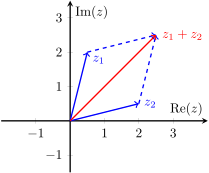
Representing the complex numbers as elements in \({\mathbb{R}}^2\) (called the complex plane) allows a geometric interpretation of the addition of two complex numbers as addition of two vectors in \({\mathbb{R}}^2.\) If \(z_1 = a_1 + b_1\mathrm{i}\in{\mathbb{C}}\) and \(z_2 = a_2 + b_2\mathrm{i}\in {\mathbb{C}},\) then we obtain \(z_1+z_2\) as the diagonal of the parallelogram spanned by \(z_1\) and \(z_2.\) This is illustrated in Figure 5.1.
There is also a geometric interpretation of the multiplication of two complex numbers. However, we will need the so-called polar representation of complex numbers that we will discuss later.
Theorem 5.1
Let \(z,\,z' \in {\mathbb{C}}.\) Then it holds that
\(|z| = 0\quad \Longleftrightarrow \quad z=0,\)
\(|z\cdot z'| = |z|\cdot |z'|,\)
\(|z+z'| \le |z| + |z'|\) (triangle inequality).
Proof.
This statements is trivial.
Using Remark 5.3 iv it holds that \[|z z'|^2 = (zz')\overline{(zz')} = z\overline{z}\cdot z'\overline{z'} = |z|^2 \cdot |z'|^2.\] From this we obtain \(|zz'| = |z|\cdot|z'|\) since the expressions on both sides are real and positve and an equation \(x^2 = y\) with \(y \ge 0\) and \(x \in {\mathbb{R}}\) has only one nonnegative solution.
Similarly as in the previous item we obtain \[\begin{aligned} |z+z'|^2 &= (z+z')\overline{(z+z')} \\ &= z\overline{z} + z\overline{z'} + z'\overline{z} + z'\overline{z'} \\ &= |z|^2 + 2\mathop{\mathrm{Re}}\big(z\overline{z'}\big) + |z'|^2 \\ &\le |z|^2 + 2\big|z\overline{z'}\big| + |z'|^2 \\ &= |z|^2 + 2|z| \cdot \big|\overline{z'}\big| + |z'|^2 = (|z|+|z'|)^2, \end{aligned}\] where we have used Remark 5.3 ii, iv, and vi.
Video 5.2. Properties of complex numbers.
With the geometric interpretation of the addition of two complex numbers in Remark 5.3 vii clarifies the notion of the “triangle inequality”. In Figure 5.1, the length of the edges of the parallelogram in blue are given by \(|z_1|\) and \(|z_2|,\) whereas the length of the diagonal in red is given by \(|z_1+z_2|.\) Hence, as the figure shows, the triangle inequality says that the length of the two shortest edges of a triangle is at least the length of the longest edge.
Since we have introduced the notion of convergence in Definition 2.2 with the help of the absolute value function, we can extend this definition to sequences of complex numbers.
Definition 5.4 • Convergence for sequences of complex numbers, limit
A sequence \({(z_n)}_{n \in {\mathbb{N}}}\) in \({\mathbb{C}}\) is called convergent towards \(z \in {\mathbb{C}}\), if for every \(\varepsilon > 0,\) there exists an \(N_\varepsilon \in {\mathbb{N}}\) such that \[|z_n - z| < \varepsilon \quad \forall\,n \ge N_\varepsilon.\] In this case, \(z\) is called the limit of the sequence \({(z_n)}_{n \in {\mathbb{N}}}.\) We write \(\lim_{n \to \infty} z_n = z.\)
The next theorem allows us to analyze convergence of complex sequences with the help of the convergence criteria we have developed in Chapter 2.
Theorem 5.2
Let \({(z_n)}_{n \in {\mathbb{N}}}\) be a sequence of complex numbers. Then \({(z_n)}_{n \in {\mathbb{N}}}\) is convergent, if and only if the sequences \({(\mathop{\mathrm{Re}}(z_n))}_{n \in {\mathbb{N}}}\) and \({(\mathop{\mathrm{Im}}(z_n))}_{n \in {\mathbb{N}}}\) are convergent. If this is the case, then \[\tag{5.1} \lim_{n \to \infty} z_n = \lim_{n \to \infty} \mathop{\mathrm{Re}}(z_n) + \mathrm{i}\lim_{n \to \infty} \mathop{\mathrm{Im}}(z_n).\]
Proof. Let \(a_n := \mathop{\mathrm{Re}}(z_n)\) and \(b_n := \mathop{\mathrm{Im}}(z_n)\) for all \(n \in {\mathbb{N}},\) i. e., \(z_n = a_n + b_n \mathrm{i}\) for all \(n \in {\mathbb{N}}.\)
“\(\Longrightarrow\)”: Let \({(z_n)}_{n \in {\mathbb{N}}}\) and \[\lim_{n \to \infty} z_n =: z = a+b\mathrm{i}\in {\mathbb{C}}.\] Let \(\varepsilon > 0\) be arbitrary. Then there exists an \(N_\varepsilon \in {\mathbb{N}}\) with \[|z_n - z| < \varepsilon \quad \text{for all } n \ge N_\varepsilon.\] Then with Remark 5.3 vi, we obtain \[\begin{aligned}
|a_n - a| &= |\mathop{\mathrm{Re}}(z_n - z)| \le |z_n - z| < \varepsilon \quad \text{for all } n \ge N_\varepsilon, \\ |b_n - b| &= |\mathop{\mathrm{Im}}(z_n - z)| \le |z_n - z| < \varepsilon \quad \text{for all } n \ge N_\varepsilon.
\end{aligned}\] From this we obtain the convergence of \({(a_n)}_{n \in {\mathbb{N}}}\) and \({(b_n)}_{n \in {\mathbb{N}}}\) with \(\lim_{n \to \infty} a_n = a\) and \(\lim_{n \to \infty} b_n = b,\) hence also (5.1).
“\(\Longleftarrow\)”: Let \({(a_n)}_{n \in {\mathbb{N}}}\) and \({(b_n)}_{n \in {\mathbb{N}}}\) be convergent with limits \(a\) and \(b\) and let \(\varepsilon > 0\) be arbitrary. Then there exists an \(N_\varepsilon \in {\mathbb{N}}\) such that \[|a_n - a| < \frac{\varepsilon}{2}, \quad |b_n - b| < \frac{\varepsilon}{2} \quad \text{for all } n \ge N_\varepsilon.\] With \(z:=a+b\mathrm{i}\) and using the triangle inequality we obtain \[|z_n - z| = |(a_n+b_n\mathrm{i})-(a+b\mathrm{i})| \le |a_n - a| + |\mathrm{i}|\cdot|b_n-b| < \frac{\varepsilon}{2} + \frac{\varepsilon}{2} < \varepsilon \quad \text{for all } n \ge N_\varepsilon.\] Since \(\varepsilon > 0\) is chosen arbitrarily, we get \(\lim_{n \to \infty} z_n = z.\)
Remark 5.4
From Theorem 5.2 we obtain that Theorem 2.4, i. e., the statements about sums, products, and quotients of sequences remain valid for complex sequences as well. Moreover, if \({(z_n)}_{n \in {\mathbb{N}}}\) is a sequence in \({\mathbb{C}},\) then \[\lim_{n \to \infty} z_n = z \quad \Longleftrightarrow \quad \lim_{n \to \infty} \overline{z_n} = \overline{z} \quad \Longleftrightarrow \quad \lim_{n\to \infty}|z_n - z| = 0.\]
Also the definition of a Cauchy sequence can be generalized to the complex case without difficulty.
Definition 5.5 • Cauchy sequence
A sequence \({(z_n)}_{n \in {\mathbb{N}}}\) in \({\mathbb{C}}\) is called Cauchy sequence, if for every \(\varepsilon > 0\) there exists an \(N_\varepsilon \in {\mathbb{N}}\) such that \[|z_n - z_m| < \varepsilon \quad \text{for all } n,\,m \ge N_\varepsilon.\]
With these definitions at hand, we can show that the set \({\mathbb{C}}\) is complete in the following sense.
Theorem 5.3 • Completeness of the complex numbers
Every Cauchy sequence of complex numbers is convergent.
Proof. Analogously to the proof of Theorem 5.2, we show that the sequences \({(\mathop{\mathrm{Re}}(z_n))}_{n \in {\mathbb{N}}}\) and \({(\mathop{\mathrm{Im}}(z_n))}_{n \in {\mathbb{N}}}\) are Cauchy sequences in \({\mathbb{R}}.\) Then the result follows from the completeness of \({\mathbb{R}}\) and Theorem 5.2.
The notion of series can be extended to the complex case in a straight-forward way by defining them as sequences of partial sums.
Definition 5.6 • Complex series, convergence, absolute convergence
Let \({(z_n)}_{n \in {\mathbb{N}}}\) be a sequence of complex numbers.
The sequence \({(s_n)}_{n \in {\mathbb{N}}}\) with \(s_n := \sum_{k=0}^n z_k\) is called a complex series. We write \(\sum_{k=0}^\infty z_n.\)
The series \(\sum_{k=0}^\infty z_k\) is called convergent, if the sequence \(\left(\sum_{k=0}^n z_k\right)_{n \in {\mathbb{N}}}\) is convergent.
The series \(\sum_{k=0}^\infty z_k\) is called absolutely convergent, if the sequence \(\left(\sum_{k=0}^n |z_k|\right)_{n \in {\mathbb{N}}}\) is convergent in \({\mathbb{R}}.\)
Remark 5.5
Exactly as for real series, we can prove convergence criteria for complex series. The proofs are completely analogous to the ones in Chapter 3. In summary, we obtain the necessary convergence criterion (Theorem 3.2), the Cauchy criterion (Theorem 3.3), the majorant criterion (Theorem 3.9) and minorant criterion (Remark 3.3) — where one has to assume that \(b_n\) is real for all \(n \in {\mathbb{N}}\) and only consider the upper inequality in [eq:majorant], the ratio test (Theorem 3.11), the theorem about rearrangements of absolutely convergent series (Theorem 3.7), and the theorem about the convergence of the Cauchy product (Theorem 3.12). Moreover, absolute convergence of a complex series implies its convergence. On the other hand, the Leibniz criterion (Theorem 3.5) is not valid. For this we would have to be able to order the complex numbers which is not the case.
Furthermore, the notion of continuity can be extended to complex functions.
Definition 5.7 • Complex functions, continuity
Let \(D \subset {\mathbb{C}}\) and \(f : D \to {\mathbb{C}}.\)
The function \(f\) is called a complex function.
The function \(f\) is called continuous in \(z\in D\), if for any sequence \({(z_n)}_{n \in {\mathbb{N}}}\) in \(D\) it holds that \[\lim_{n \to \infty} z_n = z \quad \Longrightarrow \quad \lim_{n \to \infty} f(z_n) = f(z).\]
The function \(f\) is called continuous, if it is continuous in all \(z \in D.\)
All results about continuity from Chapter 4 can be extended to complex functions as long as they do not directly or indirectly depend on the ordering axioms (Axiom 1.2). Furthermore, from Theorem 5.2 we obtain the following result.
Theorem 5.4
Let \(D \subset {\mathbb{C}},\) \(f:D \to {\mathbb{C}},\) and \(z_0 \in D.\) Then \(f\) is continuous in \(z_0,\) if the functions \(\mathop{\mathrm{Re}}(f):D \to {\mathbb{C}},\) \(z \mapsto \mathop{\mathrm{Re}}(f(z))\) and \(\mathop{\mathrm{Im}}(f):D \to {\mathbb{C}},\) \(z \mapsto \mathop{\mathrm{Im}}(f(z))\) are continuous in \(z_0.\)
Our preliminary considerations are now helpful to define the complex exponential function in the next theorem. For this, for \(z \in {\mathbb{C}}\) we further define \(z^0:=1,\) \(z^{n+1}:=z\cdot z^n\) for \(n \in {\mathbb{N}}\setminus\{0\}\) as well as \(z^{-n} := \frac{1}{z^n}\) for \(z \neq 0.\)
Theorem 5.5
Let \(z \in {\mathbb{C}}\) be arbitrary. Then the series \[\exp(z) = \sum_{k=0}^\infty \frac{z^k}{k!}\] is absolutely convergent and for all \(n \in {\mathbb{N}}\) with \(n \ge2(|z|-1),\) the estimate \[\left|\sum_{k=n+1}^\infty \frac{z^k}{k!}\right| \le 2 \frac{|z|^{n+1}}{(n+1)!}\] is satisfied.
Proof. The series is absolutely convergent, since \[\sum_{k=0}^\infty \left|\frac{z^k}{k!}\right| = \sum_{k=0}^\infty \frac{|z|^k}{k!}\] is convergent by Example 3.6 ii and by noting that \(|z| \in {\mathbb{R}}.\)
Definition 5.8 • Complex exponential function
The function \(\exp:{\mathbb{C}}\to {\mathbb{C}}\) is called complex exponential function.
At the end of this section, we collect some properties of the complex exponential function.
Theorem 5.6
Let \(z,\,z' \in {\mathbb{C}}.\) Then
\(\exp(z+z') = \exp(z) \cdot \exp(z'),\)
\(\exp(z) \neq 0\) and \(\exp(-z) = \frac{1}{\exp(z)},\)
\(\exp(\overline{z}) = \overline{\exp(z)},\)
\(\exp:{\mathbb{C}}\to {\mathbb{C}}\) is continuous.
Proof. Statements i, ii, and iv can be shown exactly as in the real case. Now we show iii: By using Remark 5.3 we have \[\overline{\exp(z)} = \overline{\lim_{n \to \infty} \sum_{k=0}^n \frac{z^k}{k!}} = \lim_{n \to \infty} \overline{\sum_{k=0}^n \frac{z^k}{k!}} = \lim_{n \to \infty} \sum_{k=0}^n \frac{\overline{z}^k}{k!} = \exp(\overline{z}).\]
In analogy to the notation for exponential functions to the basis \(a > 0\) we define \[\mathrm{e}^z := \exp(z), \quad \text{resp. }\quad a^z:= \exp(z\cdot \ln a) \quad \text{for } a > 0 \text{ and } z \in {\mathbb{C}}.\]