2.2 Convergence Criteria for Sequences
Checking convergence of sequences with the help of the definition is normally a pretty laborious work. Therefore, our goal is to find other simpler criteria that help us to check a sequence for convergence and also to compute their limits if they exist.
Theorem 2.3
Let \({(a_n)}_{n \in {\mathbb{N}}}\) be a null sequence and \({(b_n)}_{n \in {\mathbb{N}}}\) be a bounded sequence of real numbers. Then the sequence \({(a_nb_n)}_{n \in {\mathbb{N}}}\) is a null sequence.
Proof. Let \(\varepsilon > 0\) be arbitrary. Since \({(b_n)}_{n \in {\mathbb{N}}}\) is bounded, there exists a real number \(M > 0\) such that \(|b_n| \le M\) for all \(n \in {\mathbb{N}}.\) Because of the convergence \({(a_n)}_{n \in {\mathbb{N}}},\) for \(\widetilde{\varepsilon} := \frac{\varepsilon}{M}\) there exists an \(N \in {\mathbb{N}}\) with \(|a_n| \le \frac{\varepsilon}{M}\) for all \(n \ge N.\) (For simplicity, from now on we will drop the dependency of \(N\) on \(\varepsilon\) in the notation and simply write \(N\) instead of \(N_{\widetilde{\varepsilon}}.\)) Then we obtain \[|a_nb_n - 0| = |a_n| \cdot |b_n| \le \frac{\varepsilon}{M} \cdot M = \varepsilon\] for all \(n \ge N.\) Since \(\varepsilon > 0\) is arbitrary, it follows that \(\lim_{n \to \infty} a_nb_n = 0.\)
Theorem 2.4
Let \({(a_n)}_{n \in {\mathbb{N}}}\) and \({(b_n)}_{n \in {\mathbb{N}}}\) be convergent sequences of real numbers with the limits \(a\) and \(b,\) respectively. Let further \(c \in {\mathbb{R}}.\) Then it holds that:
The sequence \({(a_n + b_n)}_{n \in {\mathbb{N}}}\) is convergent and \(\lim_{n \to \infty}(a_n + b_n) = a + b.\)
The sequence \({(ca_n)}_{n \in {\mathbb{N}}}\) is convergent and \(\lim_{n \to \infty}(ca_n) = ca.\)
The sequence \({(a_nb_n)}_{n \in {\mathbb{N}}}\) is convergent and \(\lim_{n \to \infty}(a_nb_n) = ab.\)
If, furthermore \(b\neq 0\) and \(b_n\neq 0\) for all \(n \in {\mathbb{N}},\) then also the sequence \(\big( \frac{a_n}{b_n} \big)_{n \in {\mathbb{N}}}\) is convergent and \(\lim_{n \to \infty} \frac{a_n}{b_n} = \frac{a}{b}.\)
Proof.
Let \(\varepsilon > 0\) be arbitrary. Then for \(\widetilde{\varepsilon} = \frac{\varepsilon}{2}\) there exist \(\widehat{N},\,\widetilde{N} \in {\mathbb{N}}\) such that \[\begin{aligned} |a_n - a| &< \frac{\varepsilon}{2} \quad \text{for all } n \ge \widehat{N}, \\ |b_n - b| &< \frac{\varepsilon}{2} \quad \text{for all } n \ge \widetilde{N}. \end{aligned}\] Now set \(N := \max\big\{ \widehat{N},\,\widetilde{N} \big\}.\) Then by the triangle inequality, for all \(n \ge N\) we have \[|(a_n+b_n) - (a+b)| \le |a_n - a| + |b_n - b| \le \frac{\varepsilon}{2} + \frac{\varepsilon}{2} = \varepsilon.\] Since \(\varepsilon > 0\) is arbitrary, it follows that the limit of \({(a_n + b_n)}_{n \in {\mathbb{N}}}\) is \(a+b.\)
Exercise!
Since the sequence \({(a_n-a)}_{n \in {\mathbb{N}}}\) is a null sequence and since \({(b_n)}_{n \in {\mathbb{N}}}\) is bounded by Theorem 2.2, the sequence \({((a_n-a)b_n)}_{n \in {\mathbb{N}}} = {(a_nb_n-ab_n)}_{n \in {\mathbb{N}}}\) is also a null sequence by Theorem 2.3. Together with i and ii we obtain that the sequence \({(a_nb_n)}_{n \in {\mathbb{N}}} = {((a_nb_n - ab_n) + ab_n)}_{n \in {\mathbb{N}}}\) converges. Moreover, we have \[\lim_{n \to \infty} a_n b_n = \lim_{n \to \infty}(a_nb_n - ab_n) + \lim_{n \to \infty} ab_n = 0 + ab = ab.\]
For the proof of this claim, it is sufficient to show that \(\big(\frac{1}{b_n} \big)_{n \in {\mathbb{N}}}\) converges towards \(\frac{1}{b},\) since then we can apply iii to the sequence \(\big(a_n \cdot \frac{1}{b_n} \big)_{n \in {\mathbb{N}}}.\) We have \[\frac{1}{b_n} - \frac{1}{b} = \frac{b-b_n}{b_nb} = (b-b_n) \frac{1}{b_nb}.\] Since \({(b-b_n)}_{n \in {\mathbb{N}}}\) is a null sequence, it remains to show that \(\big(\frac{1}{b_nb}\big)_{n \in {\mathbb{N}}}\) is bounded, because then also \(\big(\frac{1}{b_n} - \frac{1}{b}\big)_{n \in {\mathbb{N}}}\) is a null sequence by Theorem 2.3. Since \({(b_n)}_{n \in {\mathbb{N}}}\) converges towards \(b,\) for \(\varepsilon := \frac{|b|}{2}\) there exists an \(N \in {\mathbb{N}}\) such that \(|b_n-b| < \frac{|b|}{2}\) for all \(n \ge N.\) With this we obtain \[\begin{aligned} |b_n| = |b_n| + \frac{|b|}{2} - \frac{|b|}{2} &> |b_n| + |b-b_n| - \frac{|b|}{2} \\ &\ge |b_n + b - b_n| - \frac{|b|}{2} = \frac{|b|}{2}. \end{aligned}\] From that we obtain \[\frac{1}{|b_n|} < \frac{2}{|b|}, \quad \text{resp.} \quad \frac{1}{|b_nb|} < \frac{2}{|b|^2}\] for all \(n \ge N\) and therefore, \(\big(\frac{1}{b_nb}\big)_{n \in {\mathbb{N}}}\) is bounded. Hence, as desired, \(\big(\frac{1}{b_n} - \frac{1}{b}\big)_{n \in {\mathbb{N}}}\) is a null sequence and \(\big(\frac{1}{b_n} \big)_{n \in {\mathbb{N}}}\) converges towards \(\frac{1}{b}.\)
Video 2.5. Calculation rules for convergent sequences.
An important observation is the following. When a sequence \({(a_n)}_{n \in {\mathbb{N}}}\) is converging, it is not important how the first \(N \in {\mathbb{N}}\) elements look like. It is only important how the (infinitely many) elements \(a_n\) for \(n \ge N+1\) behave. In particular, the first \(N\) elements of a sequence can be arbitrarily changed without influencing convergence of the sequence. This observation is closely related to the following example and two theorems.
Example 2.4
Consider the sequence \({(a_n)}_{n \in {\mathbb{N}}}\) with \[a_n = \frac{3n^2+13n}{n^2-2}.\] By applying the convergence criteria in Theorem 2.4, we obtain \[\lim_{n \to \infty} a_n = \lim_{n \to \infty} \frac{3n^2+13n}{n^2-2} = \lim_{n \to \infty} \frac{3+\frac{13}{n}}{1-\frac{2}{n^2}} = \lim_{n \to \infty} \frac{3+\frac{13}{n}}{1-\frac{1}{n}\cdot \frac{2}{n}} = \frac{3+0}{1-0\cdot 0} = 3.\] Note that there it does not matter that the reformulation of the fraction is only allowed for \(n > 0,\) as we have seen that for convergence of a sequence, it does not matter what its first elements are.
The proofs of the following theorems are an exercise.
Theorem 2.5
Let \({(a_n)}_{n \in {\mathbb{N}}}\) and \({(b_n)}_{n \in {\mathbb{N}}}\) be convergent sequences of real numbers. Further, assume that there exists an \(N \in {\mathbb{N}}\) such that \(a_n \le b_n\) for all \(n \ge N.\) Then we have \(\lim_{n \to \infty} a_n \le \lim_{n \to \infty} b_n.\)
Corollary 2.6
Let \({(a_n)}_{n \in {\mathbb{N}}}\) and \({(b_n)}_{n \in {\mathbb{N}}}\) be convergent sequences of real numbers. Let further \(a,\,b \in {\mathbb{R}}\) with \(a_n \le b\) and \(a \le b_n\) for all \(n \ge N \in {\mathbb{N}}.\) Then we have \[\lim_{n \to \infty} a_n \le b, \quad a \le \lim_{n \to \infty} b_n.\]
Remark 2.2
Even if the inequalities for the sequence elements in Theorem 2.5 or Corollary 2.6 are strict for all \(n \ge N,\) i. e., they hold with “\(<\)” or “\(>\)” instead of “\(\le\)” or “\(\ge\)”, this is in general not true for the inequalites dealing with the limits. For example, \(\frac{1}{n} > 0\) for all \(n \ge 1,\) but \(\lim_{n \to \infty} \frac{1}{n} = 0.\)
Theorem 2.7 • Sandwich theorem
Let \({(a_n)}_{n \in {\mathbb{N}}},\) \({(b_n)}_{n \in {\mathbb{N}}},\) \({(c_n)}_{n \in {\mathbb{N}}}\) be sequences of real numbers with \(\lim_{n \to \infty} a_n = \lim_{n \to \infty} c_n = b \in {\mathbb{R}}.\) If there exists an \(N \in {\mathbb{N}}\) such that \[a_n \le b_n \le c_n \quad \text{for all } n \ge N,\] then \({(b_n)}_{n \in {\mathbb{N}}}\) is convergent and it holds that \(\lim_{n \to \infty} b_n = b.\)
Remark 2.3
It is important to note that in Theorem 2.7 it is not assumed a priori that the sequence \({(b_n)}_{n \in {\mathbb{N}}}\) is convergent. In fact, the theorem gives a condition for testing for convergence of \({(b_n)}_{n \in {\mathbb{N}}}.\)
Example 2.5
Since \(2^n > n\) for all \(n \in {\mathbb{N}},\) it follows \(0 < \frac{1}{2^n} < \frac{1}{n}\) for all \(n \ge 1.\) Since \(\lim_{n \to \infty} \frac{1}{n} = 0,\) we also obtain \(\lim_{n \to \infty} \frac{1}{2^n} = 0\) by Theorem 2.7.
Next we will have a look at monotonic sequences.
Definition 2.4 • Monotonic sequence
A sequence \({(a_n)}_{n \in {\mathbb{N}}}\) of real numbers is called
monotonically increasing, if \(a_{n+1} \ge a_n\) for all \(n \in {\mathbb{N}}\);
strictly monotonically increasing, if \(a_{n+1} > a_n\) for all \(n \in {\mathbb{N}}\);
monotonically decreasing, if \(a_{n+1} \le a_n\) for all \(n \in {\mathbb{N}}\);
strictly monotonically decreasing, if \(a_{n+1} < a_n\) for all \(n \in {\mathbb{N}}\);
(strictly) monotonic, if it is (strictly) monotonically increasing or (strictly) monotonically decreasing.
Theorem 2.8 • Monotone convergence theorem
A monotonic and bounded sequence \({(a_n)}_{n \in {\mathbb{N}}}\) of real numbers is convergent.
Proof. Let \({(a_n)}_{n \in {\mathbb{N}}}\) be monotonic and bounded. Without loss of generality, let \({(a_n)}_{n \in {\mathbb{N}}}\) be monotonically increasing, the other case is completely analogous. Then, the set \[M: = \{a_n \; | \; n \in {\mathbb{N}}\}\] is bounded from above. By the completeness axiom (Axiom 1.3), there exists \(a:= \sup M.\) We show now that \({(a_n)}_{n \in {\mathbb{N}}}\) converges towards \(a\): Therefore, let \(\varepsilon > 0\) be arbitrary. By Theorem 1.2 there exists an \(x \in M\) (or an \(N \in {\mathbb{N}}\) with \(x = a_N\)) and \(a-\varepsilon < a_N \le a.\) Because of the monotonicity of the sequence we obtain \[a-\varepsilon < a_N \le a_n \le a < a+\varepsilon \quad \text{for all } n \ge N.\] But this means that \(|a_n - a| < \varepsilon\) for all \(n \ge N.\) Hence, \(\lim_{n \to \infty} a_n = a,\) because \(\varepsilon > 0\) is arbitrary.
Video 2.6. Monotone convergence theorem.
As an application of this result we can now actually prove the existence of square roots, cf. Example 2.1 v.
Theorem 2.9
Let \(c > 0\) and \(a_0 > 0\) be arbitrary and let \({(a_n)_{n\in {\mathbb{N}}}}\) be defined by the recurrence rule \[a_{n+1} = \frac{1}{2} \left(a_n + \frac{c}{a_n}\right) \quad \text{for } n \in {\mathbb{N}}.\] Then \({(a_n)}_{n \in {\mathbb{N}}}\) is convergent and \(a:= \lim_{n \to \infty} a_n\) is the unique positive solution of the equation \(x^2 = c.\) (In the following we write \(\sqrt{c} := a.\))
Proof. If \({(a_n)}_{n \in {\mathbb{N}}}\) converges and the limit \(a\) is positive, then with Theorem 2.4 we obtain \[a = \lim_{n \to \infty} a_{n+1} = \lim_{n \to \infty} \frac{1}{2} \left(a_n+ \frac{c}{a_n} \right) = \frac{1}{2}a + \frac{1}{2} \frac{c}{a} \quad \Longrightarrow \quad \frac{1}{2}a = \frac{1}{2} \frac{c}{a}.\] This finally gives \(a^2 = c.\) Let us show that \(a\) is the unique positive solution of the equation \(x^2 = c\): Assume that \(b > 0\) also satisfies \(b^2 = c.\) Then \[0 = a^2 - b^2 = (a+b)(a-b) \quad \Longrightarrow \quad a+b = 0 \text{ or } a-b = 0.\] Since \(a,\,b > 0,\) we must have \(a-b = 0,\) hence \(a=b\) and the square root is unique.
We still have to prove that \({(a_n)}_{n \in {\mathbb{N}}}\) indeed converges to a positive limit. By induction one can show that \(a_0 > 0\) implies that \(a_n > 0\) for all \(n \in {\mathbb{N}}\) (exercise!). At this moment this only implies that the sequence \({(a_n)}_{n \in {\mathbb{N}}}\) is well-defined. (Note that there would be a problem if one of the elements \(a_n\) is zero.) Further we have
The sequence \({(a_n)}_{n \ge 1}\) is monotonically decreasing, since for all \(n \ge 1\) we have \[a_n - a_{n+1} = a_n - \frac{1}{2} \left( a_n + \frac{c}{a_n} \right) = \frac{1}{2}a_n - \frac{1}{2a_n}c = \frac{1}{2a_n} \big(a_n^2 - c\big) \ge 0.\] The latter inequality follows from \[\begin{aligned} a_n^2 - c &= \frac{1}{4} \left( a_{n-1} + \frac{c}{a_{n-1}} \right)^2 - c \\ &= \frac{1}{4} \left( a_{n-1}^2 + 2c+ \frac{c^2}{a_{n-1}^2} - 4c \right) \\ &= \frac{1}{4} \left( a_{n-1} - \frac{c}{a_{n-1}} \right)^2 \ge 0. \end{aligned}\]
The sequence \({(a_n)}_{n \in {\mathbb{N}}}\) is bounded, because by the monotonicity we have \[0 < a_n \le a_1 \quad \text{for all } n \ge 1.\]
Together with the monotone convergence theorem Theorem 2.8, the sequence \({(a_n)}_{n \ge 1}\) converges, hence also \({(a_n)}_{n \in {\mathbb{N}}}\) converges and the limit \(a\) exists.
It still remains to show that \(a > 0.\) (This does not follow from \(a_n > 0\) for all \(n \in {\mathbb{N}}\)!). First, by Corollary 2.6 we get \(a \ge 0.\) On the other hand, from i we obtain \[a^2 = \lim_{n \to \infty} a_n^2 \ge c > 0,\] hence also \(a > 0.\)
Remark 2.4
Similarly to Theorem 2.9 we can prove the existence of \(k\)-th roots \(\sqrt[k]{c}\) for \(c > 0\) and \(k \in {\mathbb{N}},\) \(k \ge 3\) as positive solutions of the equation \(x^k = c.\) The corresponding sequence \({(a_n)}_{n \in {\mathbb{N}}}\) is of the form \[a_{n+1} = \frac{1}{k} \left( (k-1)a_n + \frac{c}{a_n^{k-1}} \right), \quad n \in {\mathbb{N}}\] for arbitrary \(a_0 > 0.\)
The \(k\)-th root is monotonic, i. e., for \(a,\,b \in {\mathbb{R}}\) and \(k \in {\mathbb{N}}\) it holds that \[a < b \quad \Longrightarrow \quad \sqrt[k]{a} < \sqrt[k]{b}.\] By contraposition one can equivalently show that \(\sqrt[k]{a} \ge \sqrt[k]{b}\) implies \(a \ge b.\) But this claim can be deduced by making use of the properties in Axiom 1.2.
2.3 Cauchy Sequences and Completeness
As already briefly mentioned, there are alternative pathways for constructing the real numbers. In particular, instead of using the completeness axiom (Axiom 1.3), one can characterize the completeness of the real numbers by Cauchy sequences.
Definition 2.5 • Cauchy sequence
A sequence \({(a_n)}_{n \in {\mathbb{N}}}\) is called Cauchy sequence, if for every \(\varepsilon > 0\) there exists an \(N_\varepsilon \in {\mathbb{N}}\) such that \[|a_n - a_m| < \varepsilon \quad \text{for all } n,\,m \ge N_\varepsilon.\]
This definition strongly reminds us on the definition of a convergent sequence. The question is whether we have actually defined a new term and how Cauchy sequences are related to convergent sequences. In fact, we will see that any sequence of real numbers converges, if and only if it is a Cauchy sequence. It is quite easy to see that every convergent sequence is a Cauchy sequence – however, the converse direction is much more difficult.
Theorem 2.10
Every convergent sequence of real numbers is a Cauchy sequence.
Proof. Let \({(a_n)}_{n \in {\mathbb{N}}}\) be a convergent sequence of real numbers with limit \(a \in {\mathbb{R}}\) and let \(\varepsilon > 0\) be arbitrary. Then for \(\widetilde{\varepsilon} := \frac{\varepsilon}{2},\) there exists an \(N \in {\mathbb{N}}\) such that \(|a_n - a| < \frac{\varepsilon}{2}.\) By applying the triangle inequality we obtain for \(n,\,m \ge N\) that \[|a_n - a_m| = |a_n - a + a - a_m| \le |a_n-a| + |a - a_m| < \frac{\varepsilon}{2} + \frac{\varepsilon}{2} = \varepsilon.\] Since \(\varepsilon > 0\) is arbitrary, this shows that \({(a_n)}_{n \in {\mathbb{N}}}\) is a Cauchy sequence.
Video 2.7. Cauchy sequences.
Let us pursue proving the converse implication. For this we will need a few preliminary considerations.
Definition 2.6 • Subsequence
Let \({(a_n)}_{n \in {\mathbb{N}}}\) be a sequence of real numbers and let \({(n_k)}_{k \in {\mathbb{N}}}\) be a strictly monotonically increasing sequence of natural numbers. Then the sequence \(\big(a_{n_k}\big)_{k \in {\mathbb{N}}}\) is called a subsequence of \({(a_n)}_{n \in {\mathbb{N}}}.\)
Example 2.6
Let the sequences \({(a_n)}_{n \in {\mathbb{N}}}\) and \({(n_k)}_{k \in {\mathbb{N}}}\) be given by \[a_n = (-1)^n \left( 1+ \frac{1}{n+1} \right) \quad \text{and} \quad n_k = 2k.\] Then \({(n_k)}_{k \in {\mathbb{N}}}\) is strictly monotonically increasing and hence, \({(a_{n_k})}_{k \in {\mathbb{N}}}\) is a subsequence of \({(a_n)}_{n \in {\mathbb{N}}}.\) We obtain \[\begin{aligned} {(a_n)}_{n \in {\mathbb{N}}} &= \left( 2,\,-\frac{3}{2},\,\frac{4}{3},\,-\frac{5}{4},\,\frac{6}{5},\,-\frac{7}{6},\,\ldots \right), \\ {(a_{n_k})}_{k \in {\mathbb{N}}} &= \left( 2,\,\frac{4}{3},\,\frac{6}{5},\,\ldots \right). \end{aligned}\] Loosely speaking, a subsequence is obtained by removing some of the original sequence’s elements. Here “some” can mean infinitely many, as long as still infinitely many elements of the original sequence remain in the subsequence.
Remark 2.5
Subsequences of a convergent sequence \({(a_n)}_{n \in {\mathbb{N}}}\) are again convergent and especially have the same limit \(a := \lim_{n \to \infty} a_n.\) Assume that \({(a_{n_k})}_{k \in {\mathbb{N}}}\) is a subsequence of \({(a_n)}_{n \in {\mathbb{N}}}\) and \(\varepsilon > 0\) is arbitrary. Let \(N \in {\mathbb{N}}\) be such that \(|a_n - a| < \varepsilon\) for all \(n \ge N.\) But then it also holds that \[\big|a_{n_k} - a\big| < \varepsilon \quad \text{for all } k \ge N,\] since \(n_k \ge k\) for all \(k \in {\mathbb{N}}.\)
It is also remarkable that even if the original sequence \({(a_n)}_{n \in {\mathbb{N}}}\) is not convergent, subsequences \({(a_{n_k})}_{k \in {\mathbb{N}}}\) may be convergent. The subsequence in Example 2.6 is an example for this.
Note that the \({(a_n)}_{n \in {\mathbb{N}}}\) in Example 2.6 is not monotonic, while the subsequence \({(a_{n_k})}_{k \in {\mathbb{N}}}\) is monotonically decreasing. Indeed, by removing certain sequence elements, it is always possible to construct a monotonically decreasing (or increasing) subsequence.
Lemma 2.11
Every sequence \({(a_n)}_{n \in {\mathbb{N}}}\) of real numbers has a monotonic subsequence.
Proof. Consider the set \[M:=\left\{ n \in {\mathbb{N}}\; | \; a_n = \max\{ a_m \; | \; m \ge n \}\right\}=\left\{ n \in {\mathbb{N}}\; | \; a_n \ge a_m \text{ for all } m\ge n\right\},\] i. e., the set of indices of those sequence elements which do not have a strictly larger successor. We distinguish two cases:
Case 1: \(M\) contains infinitely elements. Then those \(n_k \in {\mathbb{N}}\) with \(n_k \in M\) form a strictly monotonically increasing sequence \({(n_k)}_{k \in {\mathbb{N}}}.\) Thus, \({(a_{n_k})}_{k \in {\mathbb{N}}}\) is a subsequence of \({(a_n)}_{n \in {\mathbb{N}}}\) and because of \(a_{n_k} \ge a_{n_{k+1}}\) for all \(k \in {\mathbb{N}}\) (since \(n_k \in M\)), the subsequence \({(a_{n_k})}_{k \in {\mathbb{N}}}\) is monotonically decreasing.
Case 2: \(M\) contains finitely many elements. Define \[n_0 := \begin{cases}
\max M + 1, & \text{if } M \neq \emptyset, \\
0, & \text{if } M = \emptyset.
\end{cases}\] Since \(n_0 \notin M,\) there exists an \(n_1 > n_0\) such that \(a_{n_0} < a_{n_1}.\) But since also \(n_1 \notin M,\) there exists an \(n_2 > n_1\) with \(a_{n_1} < a_{n_2}.\) Inductively, we can construct a subsequence \({(a_{n_k})}_{k \in {\mathbb{N}}}\) such that \[a_{n_0} < a_{n_1} < a_{n_2} < \ldots,\] i. e., a strictly monotonically increasing subsequence.
The just proven lemma did not make use of the completeness axiom. In contrast to that, the following result makes use of the monotone convergence theorem (Theorem 2.8) which was proven with the completeness axiom.
Theorem 2.12 • Bolzano-Weierstraß theorem
Every bounded sequence \({(a_n)}_{n \in {\mathbb{N}}}\) of real numbers has a convergent subsequence.
Proof. By Lemma 2.11, \({(a_n)}_{n \in {\mathbb{N}}}\) has a monotonic subsequence \({(a_{n_k})}_{k \in {\mathbb{N}}}.\) If \({(a_n)}_{n \in {\mathbb{N}}}\) is bounded then also \({(a_{n_k})}_{k \in {\mathbb{N}}}\) is clearly bounded. Hence, \({(a_{n_k})}_{k \in {\mathbb{N}}}\) is monotonic and bounded, hence it is convergent by Theorem 2.8.
Video 2.8. Bolzano-Weierstraß theorem.
Definition 2.7 • Accumulation point
Let \({(a_n)}_{n \in {\mathbb{N}}}\) be a sequence of real numbers. Then \(a \in {\mathbb{R}}\) is called accumulation point of \({(a_n)}_{n \in {\mathbb{N}}},\) if \({(a_n)}_{n \in {\mathbb{N}}}\) has a subsequence that converges towards \(a.\)
Example 2.7
The sequence \({(a_n)}_{n \in {\mathbb{N}}}\) in Example 2.6 with \(a_n = (-1)^n \left(1 + \frac{1}{n+1}\right)\) has the accumulation points \(-1\) and \(1.\) Corresponding convergent subsequences are for example \[\begin{aligned} {(a_{2k+1})}_{k \in {\mathbb{N}}} &= \left( -\frac{3}{2},\,-\frac{5}{4},\,-\frac{7}{6},\,-\frac{9}{8},\,\ldots \right) \to -1 \quad \text{for } k \to \infty, \\ {(a_{2k})}_{k \in {\mathbb{N}}} &= \left( 2,\,\frac{4}{3},\,\frac{6}{5},\,\frac{8}{7},\,\ldots \right) \to 1 \quad \text{for } k \to \infty. \end{aligned}\]
Lemma 2.13
A Cauchy sequence of real numbers is convergent if it has an accumulation point.
Proof. Let \({(a_n)}_{n \in {\mathbb{N}}}\) be a Cauchy sequence and let \(a \in {\mathbb{R}}\) be an accumulation point of \({(a_n)}_{n \in {\mathbb{N}}}.\) Then by definition there exists a subsequence \({(a_{n_k})}_{k \in {\mathbb{N}}}\) of \({(a_n)}_{n \in {\mathbb{N}}}\) with \(\lim_{k \to \infty} a_{n_k} = a.\) Let \(\varepsilon > 0\) be arbitrary. Then there exists an \(\widetilde{N} \in {\mathbb{N}}\) such that \[\big|a_{n_k} - a\big| < \frac{\varepsilon}{2} \quad \text{for all } k\ge \widetilde{N}.\] Since \({(a_n)}_{n \in {\mathbb{N}}}\) is a Cauchy sequence, there exists an \(\widehat{N} \in {\mathbb{N}}\) such that \[|a_n - a_m| < \frac{\varepsilon}{2} \quad \text{for all } n,\,m \ge \widehat{N}.\] Set \(N:= \max\big\{ \widetilde{N},\,\widehat{N} \big\}.\) Then for all \(n,\,k \ge N\) we get \[|a_n - a| \le \big|a_n - a_{n_k}\big| + \big|a_{n_k} - a\big| < \frac{\varepsilon}{2} + \frac{\varepsilon}{2} = \varepsilon.\] Since \(\varepsilon > 0\) is arbitrary, \({(a_n)}_{n \in {\mathbb{N}}}\) converges towards \(a.\)
Theorem 2.14 • Cauchy’s convergence criterion
Every Cauchy sequence \({(a_n)}_{n \in {\mathbb{N}}}\) of real numbers is convergent.
Proof. Let \({(a_n)}_{n \in {\mathbb{N}}}\) be a Cauchy sequence. Analogously to the proof of Theorem 2.2, one can show that \({(a_n)}_{n \in {\mathbb{N}}}\) is bounded (exercise!). Then by Theorem 2.12, \({(a_n)}_{n \in {\mathbb{N}}}\) has a convergent subsequence, i. e., it has an accumulation point. Now by Lemma 2.13, the sequence \({(a_n)}_{n \in {\mathbb{N}}}\) is convergent.
Video 2.9. Cauchy’s convergence criterion.
Cauchy’s convergence criterion as well as the monotone convergence theorem give us the possibility to test a sequence for convergence without the need (but also without the possibility) to determine its limit. Cauchy’s convergence criterion can be further used to prove an important principle that we will need later (when talking about continuous functions).
Theorem 2.15 • Nested intervals principle
Let \(I_n := [a_n,b_n]\) for \(n \in {\mathbb{N}}\) be intervals with \(a_n < b_n\) for all \(n \in {\mathbb{N}}\) such that \(I_{n+1} \subseteq I_n\) for all \(n \in {\mathbb{N}}.\) If \({(b_n - a_n)}_{n \in {\mathbb{N}}}\) is a null sequence, then there exists exactly one \(a \in {\mathbb{R}}\) such that \[\bigcap_{n \in {\mathbb{N}}} I_n = \{a\}.\] In particular, the sequences \({(a_n)}_{n \in {\mathbb{N}}}\) and \({(b_n)}_{n \in {\mathbb{N}}}\) are convergent and \(\lim_{n \to \infty}a_n = \lim_{n \to \infty} b_n = a.\)
Proof. We prove this results using Cauchy’s convergence criterion (Theorem 2.14). First we show that \({(a_n)}_{n \in {\mathbb{N}}}\) is a Cauchy sequence. Let \(\varepsilon > 0\) be arbitrary. Since \({(b_n - a_n)}_{n \in {\mathbb{N}}}\) is a null sequence, there exists an \(N \in {\mathbb{N}}\) such that \[b_n - a_n = |b_n - a_n| < \varepsilon \quad \text{for all } n \ge N.\] Since \(I_m \subseteq I_n\) for all \(m \ge n,\) we obtain \(a_n \le a_m \le b_n.\) Therefore, for all \(m \ge n \ge N\) we obtain \[|a_m - a_n| = a_m - a_n \le b_n - a_n < \varepsilon.\] This shows that \({(a_n)}_{n \in {\mathbb{N}}}\) is a Cauchy sequence. Similarly, one can show that also \({(b_n)}_{n \in {\mathbb{N}}}\) is a Cauchy sequence. Thus there exist \(a,\,b \in {\mathbb{R}}\) such that \[a:= \lim_{n \to \infty} a_n,\quad b:=\lim_{n \to \infty} b_n.\] Both limits are identical because \[0 = \lim_{n \to \infty} (b_n -a_n) = \lim_{n \to \infty} b_n - \lim_{n \to \infty} a_n = b-a,\] hence \(a=b.\) Since \(a_n < b_n\) for all \(n \in {\mathbb{N}},\) an application of Corollary 2.6 yields \(a \le b_n\) but also \(a_n \le b\) for all \(n \in {\mathbb{N}}.\) Hence we obtain \(a_n \le b = a \le b_n\) for all \(n \in {\mathbb{N}}.\) Hence \(a \in I_n\) for all \(n \in {\mathbb{N}}\) and so \(\bigcap_{n \in {\mathbb{N}}} I_n \supseteq \{a\}.\) The other inclusion \(\bigcap_{n \in {\mathbb{N}}} I_n \subseteq \{a\}\) is then also clear.
Our completeness axiom is sometimes also called “supremum theorem”. However, note that there also other ways to construct the real numbers, since we could have also chosen a different statement as completeness axiom. This is illustrated in Figure 2.1. There the implications between different results we have considered are shown.
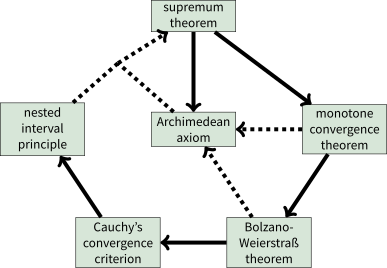
The Archimedean axiom (Theorem 1.5) can also be shown by the monotone convergence theorem (Theorem 2.8) as well as the Bolzano-Weierstraß theorem (Theorem 2.12), but not solely with Cauchy’s convergence criterion (Theorem 2.14) or the nested intervals principle (Theorem 2.15). If one wants to prove the supremum theorem with the nested intervals principle, then the Archimedan axiom is required. In some textbooks, Cauchy’s convergence criterion together with the Archimedean axiom is used to characterize the real numbers. There, essentially the limits of Cauchy sequences of rational numbers (which are not necessarily rational) are taken to form the set of real numbers.
A set that fulfills the field axioms, the ordering axioms, the Archimedean axiom and a completeness axiom is called a complete Archimedean ordered field. One can show that any such set is isomorphic (see the course on Linear Algebra) to the set \({\mathbb{R}}.\) Thus, any such set can be identified with the set of real numbers.
2.4 Limit Superior and Limit Inferior
If a sequence \({(a_n)}_{n \in {\mathbb{N}}}\) is bounded, then by the Bolzano-Weierstraß theorem, \({(a_n)}_{n \in {\mathbb{N}}}\) has at least a convergent subsequence, i. e., an accumulation point. With the help of the limit superior and the limit inferior, special accumulation points can be found, namely the largest and the smallest ones. Consider the sets \[A_k :=\{ a_n \; | \; n \ge k \} = \{a_k,\,a_{k+1},\,a_{k+2},\,\ldots\,\}, \quad k \in {\mathbb{N}},\] that are bounded as well as the sequences \({(g_k)}_{k \in {\mathbb{N}}}\) and \({(h_k)}_{k \in {\mathbb{N}}}\) with \[g_k := \sup_{n \ge k} a_n := \sup A_k, \quad h_k := \inf_{n \ge k} a_n := \inf A_k, \quad k \in {\mathbb{N}}.\] Since \(A_{k+1} \subseteq A_k\) for all \(k \in {\mathbb{N}},\) the sequence \({(g_k)}_{k \in {\mathbb{N}}}\) is monotonically decreasing and the sequence \({(h_k)}_{k \in {\mathbb{N}}}\) is monotonically increasing. Also both sequences are bounded, i. e., they are convergent by the monotone convergence theorem.
Definition 2.8 • Limit superior, limit inferior
Let \({(a_n)}_{n \in {\mathbb{N}}}\) be a bounded sequence.
The limit superior of \({(a_n)}_{n \in {\mathbb{N}}}\) is defined by \[\limsup_{n \to \infty} a_n = \lim_{k \to \infty} \left( \sup_{n \ge k} a_n\right).\]
The limit inferior of \({(a_n)}_{n \in {\mathbb{N}}}\) is defined by \[\liminf_{n \to \infty} a_n = \lim_{k \to \infty} \left( \inf_{n \ge k} a_n\right).\]
Example 2.8
We consider the sequence \({(a_n)}_{n \in {\mathbb{N}}}\) from Example 2.6 with \[a_n = (-1)^n \left(1 + \frac{1}{n+1}\right).\] We obtain \[\sup A_k = \begin{cases} 1 + \frac{1}{k+1}, & \text{if } k \text{ is even}, \\ 1 + \frac{1}{k+2}, & \text{if } k \text{ is odd}. \end{cases}\] Therefore, \(\limsup_{n \to \infty} a_n = 1.\) Analogously, one shows that \(\liminf_{n \to \infty} a_n = -1.\)
Remark 2.6
In the proof of the following theorem we use a trick. For all \(a,\,b \in {\mathbb{R}}\) it holds that \[b \le a + \varepsilon \quad \text{for all } \varepsilon > 0 \quad \Longrightarrow \quad b \le a,\] because then \(b\) is a lower bound of the set \(\{a+\varepsilon\;|\;\varepsilon > 0\}\) and hence, \[b \le \inf\{ a+ \varepsilon\;|\;\varepsilon>0\} = a.\]
Theorem 2.16 • Characterization of the limit superior
Let \({(a_n)}_{n \in {\mathbb{N}}}\) be a bounded sequence and let \(a \in {\mathbb{R}}.\) Then \[\limsup_{n \to \infty} a_n = a,\] if and only if for every \(\varepsilon > 0\) the following conditions are satisfied:
It holds that \(a_n < a + \varepsilon\) for almost all (i. e., all except of finitely many) \(n \in {\mathbb{N}}.\)
It holds that \(a_n > a - \varepsilon\) for infinitely many \(n \in {\mathbb{N}}.\)
Proof. Let \(g_k = \sup_{n \ge k} a_n\) for \(k \in {\mathbb{N}}.\) Next we show the equivalence in the theorem.
“\(\Longrightarrow\)”: Let \(\varepsilon > 0\) be arbitrary. Since \(a = \limsup_{n \to \infty} a_n = \lim_{k \to \infty}g_k\) there exists an \(N \in {\mathbb{N}}\) such that \[a-\varepsilon < g_k < a+\varepsilon \quad \text{for all } k \ge N.\] Since \(a_n \le g_N\) for all \(n \ge N,\) the condition in i follows. Assume ii would not be true. Then \(a_n > a - \varepsilon\) would only hold for finitely many \(n \in {\mathbb{N}}.\) Hence, there exists an \(\widetilde{N} \in {\mathbb{N}}\) such that \(a_n \le a - \varepsilon\) for all \(n \ge \widetilde{N}.\) Thus, also \(g_k \le a-\varepsilon\) for all \(k \ge \widetilde{N}.\) With Corollary 2.6 we obtain the contradiction \(a = \lim_{k \to \infty} g_k \le a - \varepsilon.\) Hence, also ii is satisfied.
“\(\Longleftarrow\)”: Let \(\varepsilon > 0.\) With ii it holds that \(g_k > a - \varepsilon\) for all \(k \in {\mathbb{N}}\) and hence, \(\lim_{k \to \infty} g_k \ge a - \varepsilon.\) Then with Remark 2.6 we get \[\lim_{k \to \infty} g_k \ge a.\] On the other hand, by i, for every \(\varepsilon > 0\) there exists an \(N \in {\mathbb{N}}\) with \(a_n < a+ \varepsilon\) for all \(n \ge N.\) Hence we have \(g_k \le a + \varepsilon\) for all \(k \ge N.\) Then we also get \(\lim_{k \to \infty} g_k \le a + \varepsilon\) and with Remark 2.6 we obtain \[\lim_{k \to \infty} g_k \le a.\] Summarizing we see that \[\limsup_{n \to \infty} a_n = \lim_{k \to \infty} g_k = a.\]
Video 2.10. Limit superior and limit inferior.
Corollary 2.17 • Characterization of the limit inferior
Let \({(a_n)}_{n \in {\mathbb{N}}}\) be a bounded sequence and let \(a \in {\mathbb{R}}.\) Then \[\liminf_{n \to \infty} a_n = a,\] if and only if for every \(\varepsilon > 0\) the following conditions are satisfied:
It holds that \(a_n > a - \varepsilon\) for almost all \(n \in {\mathbb{N}}.\)
It holds that \(a_n < a + \varepsilon\) for infinitely many \(n \in {\mathbb{N}}.\)
From Theorem 2.16 and Corollary 2.17 we obtain the following corollaries.
Corollary 2.18
Let \({(a_n)}_{n \in {\mathbb{N}}}\) be a bounded sequence. Then it holds that \[{(a_n)}_{n \in {\mathbb{N}}} \text{ is convergent} \quad \Longleftrightarrow \quad \limsup_{n \to \infty} a_n = \liminf_{n \to \infty} a_n.\]
Corollary 2.19
Let \({(a_n)}_{n \in {\mathbb{N}}}\) be a bounded sequence. Then we have:
There exist convergent subsequences \({(a_{n_k})}_{k \in {\mathbb{N}}}\) and \({(a_{n_\ell})}_{\ell \in {\mathbb{N}}}\) with \[\limsup_{n \to \infty} a_n = \lim_{k \to \infty} a_{n_k} \quad \text{and} \quad \liminf_{n \to \infty} a_n = \lim_{\ell \to \infty} a_{n_\ell}.\]
Let \(a \in {\mathbb{R}}\) be an accumulation point of \({(a_n)}_{n \in {\mathbb{N}}}.\) Then we have \[\liminf_{n \to \infty} a_n \le a \le \limsup_{n \to \infty} a_n\] In particular, \(\liminf_{n \to \infty} a_n\) is the smallest and \(\limsup_{n \to \infty} a_n\) is the largest accumulation point of \({(a_n)}_{n \in {\mathbb{N}}}.\)
The limit superior and limit inferior often play a role if one does not want to assume a priori that a sequence is convergent. Some statements can be shown under the much weaker assumption that the limit superior and limit inferior exist. We will see a few of such applications of this later in this course.