4.5 First version of the Gauss–Bonnet Theorem
We are now able to answer the question from the previous section.
Theorem 4.31 • First version of the Gauss–Bonnet Theorem
Let \(\gamma : [0,L] \to M\) be a smooth simple closed unit speed curve of length \(L\) whose image is contained in \(F(U)\) for some local parametrisation \(F : U \to M.\) Let \(D\subset M\) denote the region enclosed by \(\gamma\) and assume that \(J\dot{\gamma}(t)\) points into the interior of \(D\) for all \(t \in [0,L].\) Then \[\int_0^L\kappa_g(t)\mathrm{d}t=2\pi-\int_DK\,d A,\] where \(\kappa_g\) denotes the geodesic curvature of \(\gamma\) and \(K\) the Gauss curvature of \(M.\)
The proof of the Gauss–Bonnet Theorem relies on Green’s theorem which we will prove in the study week 13 of this course.
Lemma 4.32 Let \(Y : [0,L] \to M\) be a vector field along the curve \(\gamma : [0,L] \to M\) satisfying \(\langle Y(t),Y(t)\rangle=1\) for all \(t \in [0,L],\) then we have for all \(t \in [0,L]\) \[\tag{4.17}
\frac{\mathrm{D}JY}{\mathrm{d}t}(t)=J_{\gamma(t)}\left(\frac{\mathrm{D}Y}{\mathrm{d}t}(t)\right),\] where \(J_{\gamma(t)}\) is defined as in Remark 4.28
Remark 4.28 ➔
.Let \(p \in M\) and \(\vec{v}_p \in T_pM.\) Having a unit normal field \(N,\) we let \(J_p(\vec{v}_p)\) be the unique vector in \(T_pM\) so that \(\vec{v}_p\times J_p(\vec{v}_p)=N(p).\) The properties of the cross product imply that this defines a linear map \(J_p : T_pM \to T_pM\) which corresponds to “counter clockwise rotation by \(\pi/2\)”. In particular, \(J(\vec{v}_p)\) is orthogonal to \(\vec{v}_p,\) has the same length as \(\vec{v}_p\) and we have the formula \[N(p)\times \vec{v}_p=J(\vec{v}_p).\] In terms of \(J_p,\) the formula for the geodesic curvature thus becomes \[\kappa_g(t)=\left\langle \frac{\mathrm{D}\dot{\gamma}}{\mathrm{d}t}(t),J_{\gamma(t)}(\dot{\gamma}(t))\right\rangle,\] Notice that this precisely corresponds to the signed curvature of a unit speed curve (2.6), where the acceleration \(\ddot{\gamma}\) is replaced with the covariant derivative \(\frac{\mathrm{D}\dot{\gamma}}{\mathrm{d}t}\) of the velocity vector \(\dot{\gamma}.\)
Proof. In what follows, all identities hold for all \(t \in [0,L],\) we will however omit writing \(t\) each time to lighten notation. Since \(1=\langle Y,Y\rangle=\langle JY,JY\rangle,\) taking the time derivative implies \[\tag{4.18} \left\langle \frac{\mathrm{D}Y}{\mathrm{d}t},Y\right\rangle=0 \qquad \text{and} \qquad \left\langle \frac{\mathrm{D}JY}{\mathrm{d}t},JY\right\rangle=0.\] We also have \[\langle Y,JY\rangle=0\] and taking the time derivative again, this implies \[0=\left\langle \frac{\mathrm{D}Y}{\mathrm{d}t},JY\right\rangle+\left\langle Y,\frac{\mathrm{D}JY}{\mathrm{d}t}\right\rangle.\] Applying \(J\) to the left summand, we obtain \[\left\langle Y,\frac{\mathrm{D}JY}{\mathrm{d}t}\right\rangle=-\left\langle J\left(\frac{\mathrm{D}Y}{\mathrm{d}t}\right),J(JY)\right\rangle=\left\langle Y,J\left(\frac{\mathrm{D}Y}{\mathrm{d}t}\right)\right\rangle,\] where we use that \(J(JY)=-Y.\) We thus have \[\tag{4.19} 0=\left\langle Y,\frac{\mathrm{D}JY}{\mathrm{d}t}-J\left(\frac{\mathrm{D}Y}{\mathrm{d}t}\right)\right\rangle.\] Applying \(J\) to the first identity in (4.18) we also have \[0=\left \langle J\left(\frac{\mathrm{D}Y}{\mathrm{d}t}\right),JY\right\rangle\] Using the second identity in (4.18) we conclude \[\tag{4.20} 0=\left\langle JY,\frac{\mathrm{D}JY}{\mathrm{d}t}-J\left(\frac{\mathrm{D}Y}{\mathrm{d}t}\right)\right \rangle\] Since \(\{Y(t),JY(t)\}\) is a basis of \(T_{\gamma(t)}M\) for all \(t \in [0,L],\) (4.19) and (4.20) imply that the vector \[\frac{\mathrm{D}JY}{\mathrm{d}t}(t)-J_{\gamma(t)}\left(\frac{\mathrm{D}Y}{\mathrm{d}t}(t)\right)\] is orthogonal to all vectors of \(T_{\gamma(t)}M.\) Since \(\langle\cdot{,}\cdot\rangle_{\gamma(t)}\) is non-degenerate this implies the claim.
We also need:
Lemma 4.33
Let \(F : U \to M\) be a local parametrisation of the surface \(M\subset \mathbb{R}^3\) with associated vector fields \(B_1,B_2\) on \(F(U)\subset M,\) \(X\) a smooth vector field on \(M\) and \(c : I \to U\) a smooth curve. Writing \(\gamma=F\circ c,\) we have \[\frac{\mathrm{D}X_{\gamma}}{\mathrm{d}t}=\frac{\mathrm{d}c^1}{\mathrm{d}t}(\nabla_{B_1}X)(\gamma)+\frac{\mathrm{d}c^2}{\mathrm{d}t}(\nabla_{B_2}X)(\gamma).\]
Lemma 4.7 ➔
Item (iv) as well as Proposition 4.9Let \(X_1,X_2,Y_1,Y_2 \in \mathfrak{X}(M)\) and \(f : M \to \mathbb{R}\) a smooth function. Then the covariant derivative satisfies:
\(\nabla_{X_1+X_2} Y_1=\nabla_{X_1}Y_1+\nabla_{X_2}Y_1\);
\(\nabla_{X_1}(Y_1+Y_2)=\nabla_{X_1}Y_1+\nabla_{X_2}Y_2\);
\(\nabla_{fX_1}Y_1=f\nabla_{X_1}Y_1\);
\(\nabla_{X_1}(fY_1)=f\nabla_{X_1}Y_{1}+\mathrm{d}f(X_1)Y_1.\)
Proposition 4.9 ➔
and omit writing base points. Consequently, we have \[\begin{aligned}
\frac{\mathrm{d}c^j}{\mathrm{d}t}(t)(\nabla_{B_j}X)(\gamma(t))&=\frac{\mathrm{d}c^j}{\mathrm{d}t}(t)\left(\mathrm{d}X^i(B_j(\gamma(t)))B_i(\gamma(t))+X^i(\gamma(t))\Gamma^k_{ij}(c(t))B_k(\gamma(t))\right)\\
&=\frac{\mathrm{D}X_{\gamma}}{\mathrm{d}t}(t)-B_k(\gamma(t))\left(\frac{\mathrm{d}}{\mathrm{d}t}(X^k\circ \gamma)(t)\right.\\
&\phantom{=}-\left.\frac{\mathrm{d}c^j}{\mathrm{d}t}(t)\mathrm{d}X^k(B_j(\gamma(t))\right)
\end{aligned},\] where we use (4.9). The claim thus follows provided we show that for \(k=1,2\) and all \(t \in I\) we have \[\frac{\mathrm{d}}{\mathrm{d}t}(X^k\circ \gamma)(t)=\mathrm{d}X^k(B_j(\gamma(t)))\frac{\mathrm{d}c^j}{\mathrm{d}t}(t).\] Since \(\gamma=F\circ c,\) the chain rule gives \[\begin{gathered}
\frac{\mathrm{d}}{\mathrm{d}t}\left(X^k\circ F\circ c\right)(t)=\begin{pmatrix}\partial_1 X^k(\gamma(t)) & \partial_2 X^k(\gamma(t)) & \partial_3 X^k(\gamma(t))\end{pmatrix}\\ \begin{pmatrix} \partial_1 F_1(c(t)) & \partial_2 F_1(c(t)) \\ \partial_1 F_2(c(t)) & \partial_2 F_2(c(t)) \\ \partial_1 F_3(c(t)) & \partial_2 F_3(c(t)) \end{pmatrix}\begin{pmatrix} \frac{\mathrm{d}c^1}{\mathrm{d}t}(t) \\ \frac{\mathrm{d}c^2}{\mathrm{d}t}(t)\end{pmatrix}
\end{gathered}\] which agrees with \[\mathrm{d}X^k(B_1(\gamma(t)))\frac{\mathrm{d}c^1}{\mathrm{d}t}(t)+\mathrm{d}X^k(B_2(\gamma(t)))\frac{\mathrm{d}c^2}{\mathrm{d}t}(t)=\mathrm{d}X^k(B_j(\gamma(t)))\frac{\mathrm{d}c^j}{\mathrm{d}t}(t),\] since \(B_j(\gamma(t))=\Big(\partial_jF(c(t))\Big)_{\gamma(t)}.\)Let \(M\subset \mathbb{R}^3\) be a surface and \(F : U \to M\) a local parametrisation of \(M\) with Christoffel symbols \(\Gamma^k_{ij} : U \to \mathbb{R}\) for \(i,j,k=1,2.\) Then on \(\operatorname{Im}(F)\subset M\) we obtain vector fields \(B_i\) for \(i=1,2\) defined by the rule \[B_i(F(q))=\left(\partial_i F(q)\right)_{F(q)}\] for all \(q \in U.\) For these vector fields we have \[(\nabla_{B_i}B_j)(F(q))=\Gamma^k_{ij}(q)B_k(F(q))\] for all \(q \in U\) and where we employ the summation convention.
Theorem 4.31 • First version of the Gauss–Bonnet Theorem ➔
. Let \(Z\) be the vector field defined on \(F(U)\) by the rule \[Z(F(q))=\frac{\partial_1 F(q)}{\sqrt{g_{11}(q)}}_{F(q)}\] for all \(q \in U.\) Notice that \(\langle Z(F(q)),Z(F(q))\rangle=1\) and \[Z(F(q))=\frac{B_1(F(q))}{\sqrt{g_{11}(q)}}\] for all \(q \in U.\)Let \(\gamma : [0,L] \to M\) be a smooth simple closed unit speed curve of length \(L\) whose image is contained in \(F(U)\) for some local parametrisation \(F : U \to M.\) Let \(D\subset M\) denote the region enclosed by \(\gamma\) and assume that \(J\dot{\gamma}(t)\) points into the interior of \(D\) for all \(t \in [0,L].\) Then \[\int_0^L\kappa_g(t)\mathrm{d}t=2\pi-\int_DK\,d A,\] where \(\kappa_g\) denotes the geodesic curvature of \(\gamma\) and \(K\) the Gauss curvature of \(M.\)
Lemma 4.32 ➔
together with \[J\dot{\gamma}=\cos(\phi)JZ_{\gamma}-\sin(\phi)Z_{\gamma},\] We can calculate that \[\begin{aligned}
\kappa_g=\left\langle \frac{\mathrm{D}\dot{\gamma}}{\mathrm{d}t},J\dot{\gamma}\right\rangle=\phi^{\prime}+\left\langle\frac{\mathrm{D}Z_{\gamma}}{\mathrm{d}t},JZ_{\gamma}\right\rangle
\end{aligned}.\] We next want to evaluate \(\frac{\mathrm{D}Z_{\gamma}}{\mathrm{d}t}\) using Lemma 4.33Let \(Y : [0,L] \to M\) be a vector field along the curve \(\gamma : [0,L] \to M\) satisfying \(\langle Y(t),Y(t)\rangle=1\) for all \(t \in [0,L],\) then we have for all \(t \in [0,L]\) \[\tag{4.17} \frac{\mathrm{D}JY}{\mathrm{d}t}(t)=J_{\gamma(t)}\left(\frac{\mathrm{D}Y}{\mathrm{d}t}(t)\right),\] where \(J_{\gamma(t)}\) is defined as in Remark 4.28.
Lemma 4.33 ➔
. For this we need expressions for \(\nabla_{B_i}Z\) for \(i=1,2.\) We obtain \[0=\mathrm{d}\left(\langle Z,Z\rangle\right)=2\langle \nabla_{B_i}Z,Z\rangle,\] where we use (4.11). It follows that \((\nabla_{B_i}Z)(p)\) is orthogonal to \(Z(p)\) for all \(p \in F(U)\) and hence there exist unique functions \(P : U \to \mathbb{R}\) and \(Q : U \to \mathbb{R}\) so that \[(\nabla_{B_1}Z)(F(q))=P(q)JZ(F(q))\qquad \text{and} \qquad (\nabla_{B_2}Z)(F(q))=Q(q)JZ(F(q))\] Let \(c : [0,L] \to U\) be the smooth curve so that \(\gamma=F\circ c.\) Using Lemma 4.33Let \(F : U \to M\) be a local parametrisation of the surface \(M\subset \mathbb{R}^3\) with associated vector fields \(B_1,B_2\) on \(F(U)\subset M,\) \(X\) a smooth vector field on \(M\) and \(c : I \to U\) a smooth curve. Writing \(\gamma=F\circ c,\) we have \[\frac{\mathrm{D}X_{\gamma}}{\mathrm{d}t}=\frac{\mathrm{d}c^1}{\mathrm{d}t}(\nabla_{B_1}X)(\gamma)+\frac{\mathrm{d}c^2}{\mathrm{d}t}(\nabla_{B_2}X)(\gamma).\]
Lemma 4.33 ➔
we thus obtain \[\frac{\mathrm{D}Z_{\gamma}}{\mathrm{d}t}(t)=\frac{\mathrm{d}c^1}{\mathrm{d}t}(t)P(c(t))JZ(\gamma(t))+\frac{\mathrm{d}c^2}{\mathrm{d}t}Q(c(t))JZ(\gamma(t))\] hence we have \[\left\langle\frac{\mathrm{D}Z_{\gamma}}{\mathrm{d}t}(t),JZ_{\gamma}(t)\right\rangle=\frac{\mathrm{d}c^1}{\mathrm{d}t}(t)P(c(t))+\frac{\mathrm{d}c^2}{\mathrm{d}t}(t)Q(c(t)).\] Now Green’s theorem states that \[\int_0^L \left(\frac{\mathrm{d}c^1}{\mathrm{d}t}(t)P(c(t))+\frac{\mathrm{d}c^2}{\mathrm{d}t}(t)Q(c(t))\right)\mathrm{d}t=\int_{D}\partial_1 Q(q)-\partial_2 P(q)d\mu.\] Using the expressions for \(\nabla_{B_i}Z\) we compute \[\begin{aligned}
\left(\nabla_{B_1}(\nabla_{B_2}Z)\right)(F(q))&=\partial_1Q(q)JZ(F(q))+Q(q)J\nabla_{B_1}Z(F(q)),\\
&=\partial_1Q(q)JZ(F(q))-P(q)Q(q)Z(F(q))
\end{aligned}\] and \[\begin{aligned}
\left(\nabla_{B_2}(\nabla_{B_1}Z)\right)(F(q))&=\partial_2P(q)JZ(F(q))+P(q)J\nabla_{B_2}Z(F(q)),\\
&=\partial_2P(q)JZ(F(q))-P(q)Q(q)Z(F(q))
\end{aligned}\] so that \[\begin{aligned}
\partial_1Q(q)-\partial_2P(q)&=\langle \nabla_{B_1}(\nabla_{B_2}Z)-\nabla_{B_1}(\nabla_{B_2}Z),JZ\rangle(F(q))\\
&=\mathcal{R}(B_1,B_2,Z,JZ)(F(q)),
\end{aligned}\] where we use that \([B_1,B_2]=0,\) since the Christoffel symbols satisfy \(\Gamma^i_{jk}=\Gamma^i_{kj}.\)Let \(F : U \to M\) be a local parametrisation of the surface \(M\subset \mathbb{R}^3\) with associated vector fields \(B_1,B_2\) on \(F(U)\subset M,\) \(X\) a smooth vector field on \(M\) and \(c : I \to U\) a smooth curve. Writing \(\gamma=F\circ c,\) we have \[\frac{\mathrm{D}X_{\gamma}}{\mathrm{d}t}=\frac{\mathrm{d}c^1}{\mathrm{d}t}(\nabla_{B_1}X)(\gamma)+\frac{\mathrm{d}c^2}{\mathrm{d}t}(\nabla_{B_2}X)(\gamma).\]
Proposition 4.19 ➔
, Theorem 4.21For a local parametrisation \(F : U \to M\) we have for all \(q \in U\) \[\mathcal{R}(B_i,B_j,B_k,B_r)(F(q))=R_{jikr}(q).\]
Theorem 4.21 • Theorema Egregium ➔
and Exercise 4.22Let \(M\subset \mathbb{R}^3\) be a surface. The Gauss curvature of \(M\) does depend on the first fundamental form only and with respect to a choice of local parametrisation \(F : U \to M\) we have for all \(q \in U\) \[K(F(q))=\frac{R_{1212}(q)}{\det g(q)}.\]
Exercise 4.22 ➔
. In summary, we have calculated that \[\int_0^L\kappa_g(t)\mathrm{d}t=\int_0^L\phi^{\prime}(t)\mathrm{d}t-\int_{D}K d A.\] Since \(J\dot{\gamma}(t)\) points into the interior of \(D\) for all \(t \in [0,L],\) it follows with Theorem 2.39Show that the functions \(R_{ijkl}\) satisfy the following symmetries \[R_{ijkl}=-R_{jikl}=-R_{ijlk}=R_{klij}.\] Hint: Use the Gauss equations (4.4).
Theorem 2.39 ➔
that \(\int_0^L\phi^{\prime}(t)\mathrm{d}t=2\pi.\)Let \(\gamma : [0,L] \to \mathbb{R}^2\) be a smooth unit speed curve that is simple and closed. Then its rotation index is \(\pm 1.\)
4.6 Second version of the Gauss–Bonnet Theorem
Recall that one of the fundamental theorems of elementary geometry states that the sum of the interior angles of a triangle equals \(\pi.\) A triangle consists of three distinct points (often called vertices) in the plane \(\mathbb{R}^2\) which are connected by segments of straight lines (often called edges). In the context of a surface \(M\subset \mathbb{R}^3,\) the notion of a straight line is replaced by the notion of a geodesic. This leads to the notion of a geodesic triangle.
Definition 4.34 • Geodesic triangle
A geodesic triangle \(\partial\Delta\) on an oriented surface \(M\subset \mathbb{R}^3\) consists of three distinct points \(p_1,p_2,p_3 \in M\) connected by segments of geodesics. That is, there exist geodesics \(\gamma_i : [0,\ell_i] \to M\) with \(\gamma_i(0)=p_i\) and \(\gamma_i(\ell_i)=p_{i+1}\) (with the convention that \(p_4=p_1\)). Furthermore, \(\gamma_i : [0,\ell_i] \to M\) is assumed to be injective.
We define the exterior angle at \(p_i\) to be the angle between the vectors \(\dot{\gamma}_{i-1}(\ell_{i-1})\) and \(\dot{\gamma}_{i}(0)\) with the convention \(\gamma_0=\gamma_3\) and \(\ell_0=\ell_3.\) The exterior angle is negative when \(\dot{\gamma}_{i-1}(\ell_{i-1}) \times \dot{\gamma}_i(0)\) is a negative multiple of \(N(p_i).\) Here and henceforth we always assume that \(-\pi<\vartheta_i<\pi.\) The interior angle \(\alpha_i\) at \(p_i\) is then defined to be \(\alpha_i=\pi-\vartheta_i.\)
Example 4.35 • Geodesic triangle on the sphere
On \(S^2\subset \mathbb{R}^3\) we consider a octant, that is, the region enclosed by a geodesic triangle with \(p_1=(1,0,0),\) \(p_2=(0,1,0)\) and \(p_3=(0,0,1).\) Here we may take geodesics \[\begin{aligned} \gamma_1(t) &: [0,\pi/2] \to S^2,\qquad &t&\mapsto \cos(t)p_1+\sin(t)p_2,\\ \gamma_{2}(t) &: [0,\pi/2] \to S^2, \qquad &t&\mapsto \cos(t)p_2+\sin(t)p_3,\\ \gamma_{3}(t)& : [0,\pi/2] \to S^2,\qquad &t& \mapsto\cos(t)p_3+\sin(t)p_1. \end{aligned}\] It follows with a simple calculation that \(\alpha_1=\alpha_2=\alpha_3=\pi/2\) so that \[\alpha_1+\alpha_2+\alpha_3=\frac{3\pi}{2}>\pi.\]
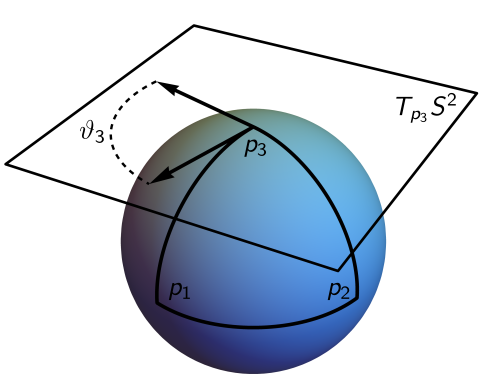
For a geodesic triangle \(\partial \Delta\) it is thus not true anymore that the sum of interior angles is always \(\pi.\) It is natural to guess that the angle deficit between \(\pi\) and the sum of interior angles is related to the curvature of the enclosed region \(\Delta.\) This suggests to look into a version of the Gauss–Bonnet Theorem for curves \(\gamma\) that are only piecewise smooth. Roughly speaking, these are curves that are smooth except for finitely many exception points, called corners.
Definition 4.36 • Piecewise smooth curve
A curve \(\gamma : [a,b] \to M\) is called piecewise smooth if there exists \(k \in \mathbb{N}\) and times \(a=T_0<T_1<\cdots <T_k=b\) so that \(\gamma|_{[T_i,T_{i+1}]} : [T_i,T_{i+1}] \to M\) is smooth.
Notice that if \(\gamma : [a,b] \to M\) is a geodesic and \(\varphi : \mathbb{R}\to \mathbb{R}\) a smooth parameter of the form \(\varphi(t)=st+t_0\) for real numbers \(s,t_0,\) then \(\gamma\circ \varphi\) is also a geodesic.
We define the exterior angle at the corner of a piecewise smooth curve as in the case of a geodesic triangle.
Example 4.37
A geodesic triangle may be thought of as a piecewise smooth curve.
We now have:
Theorem 4.38 • Second version of the Gauss–Bonnet Theorem
Let \(\gamma : [0,L] \to M\) be a simple closed unit speed curve of length \(L\) which is piecewise smooth with exterior angles \(\vartheta_1,\ldots,\vartheta_k\) at the corners \(p_1,\ldots,p_k\) of \(\gamma\) and whose image is contained in \(F(U)\) for some local parametrisation \(F : U \to M.\) Let \(D\) denote the region enclosed by \(\gamma\) and assume that \(J\dot{\gamma}(t)\) points into the interior of \(D\) for all \(t \in [0,L]\) with the exception of the corner points. Then \[\int_0^L k_g(t)\mathrm{d}t+\sum_{i=1}^k \vartheta_i=2\pi-\int_D K d A,\] where \(k_g\) denotes the geodesic curvature of \(\gamma\) and \(K\) the Gauss curvature of \(M.\)
This version of the Gauss–Bonnet Theorem implies:
Corollary 4.39
Let \(\partial\Delta \subset F(U)\) be a geodesic triangle enclosing the region \(D\subset M\) and let \(\alpha_i\) denote the interior angle at the corner \(p_i of \partial \Delta,\) where \(i=1,2,3.\) Then \[\alpha_1+\alpha_2+\alpha_3=\pi+\int_D K dA.\]
Theorem 4.38 • Second version of the Gauss–Bonnet Theorem ➔
are all zero, hence we obtain \[\vartheta_1+\vartheta_2+\vartheta_3=2\pi-\int_D K dA.\] Since the exterior angle \(\alpha_i\) satisfies \(\alpha_i=\pi-\vartheta_i\) we have equivalently \[3\pi-\alpha_1-\alpha_2-\alpha_3=2\pi-\int_D K dA \quad \iff \quad \alpha_1+\alpha_2+\alpha_3=\pi+\int_D K dA.\]Let \(\gamma : [0,L] \to M\) be a simple closed unit speed curve of length \(L\) which is piecewise smooth with exterior angles \(\vartheta_1,\ldots,\vartheta_k\) at the corners \(p_1,\ldots,p_k\) of \(\gamma\) and whose image is contained in \(F(U)\) for some local parametrisation \(F : U \to M.\) Let \(D\) denote the region enclosed by \(\gamma\) and assume that \(J\dot{\gamma}(t)\) points into the interior of \(D\) for all \(t \in [0,L]\) with the exception of the corner points. Then \[\int_0^L k_g(t)\mathrm{d}t+\sum_{i=1}^k \vartheta_i=2\pi-\int_D K d A,\] where \(k_g\) denotes the geodesic curvature of \(\gamma\) and \(K\) the Gauss curvature of \(M.\)
Theorem 4.38 • Second version of the Gauss–Bonnet Theorem ➔
. The curve \(\gamma\) is the image of a piecewise smooth curve \(c : [0,L] \to U.\) Let \(q_1,\ldots,q_k \in U\) denote the corners of \(c.\) We can smoothen the curve \(\gamma\) as follows. For \(\epsilon>0\) sufficiently small we remove the part of \(c\) whose image is contained in a disk of radius \(\epsilon\) around \(q_i\) and glue in a smooth curve piece to obtain a smooth curve \(c_{\epsilon} : [0,L] \to U\) with corresponding smooth image curve \(\gamma_{\epsilon}=F\circ c_{\epsilon}.\) We then apply Theorem 4.31Let \(\gamma : [0,L] \to M\) be a simple closed unit speed curve of length \(L\) which is piecewise smooth with exterior angles \(\vartheta_1,\ldots,\vartheta_k\) at the corners \(p_1,\ldots,p_k\) of \(\gamma\) and whose image is contained in \(F(U)\) for some local parametrisation \(F : U \to M.\) Let \(D\) denote the region enclosed by \(\gamma\) and assume that \(J\dot{\gamma}(t)\) points into the interior of \(D\) for all \(t \in [0,L]\) with the exception of the corner points. Then \[\int_0^L k_g(t)\mathrm{d}t+\sum_{i=1}^k \vartheta_i=2\pi-\int_D K d A,\] where \(k_g\) denotes the geodesic curvature of \(\gamma\) and \(K\) the Gauss curvature of \(M.\)
Theorem 4.31 • First version of the Gauss–Bonnet Theorem ➔
to \(\gamma_{\epsilon}\) and consider the limit as \(\epsilon\) goes to zero. Let \(\phi_{\epsilon} : [0,L] \to \mathbb{R}\) denote the polar angle function of \(\gamma_{\epsilon}\) as defined by (4.21) and \(k_{g,\epsilon} : [0,L] \to \mathbb{R}\) the geodesic curvature of \(\gamma_{\epsilon}.\) Applying Theorem 4.31Let \(\gamma : [0,L] \to M\) be a smooth simple closed unit speed curve of length \(L\) whose image is contained in \(F(U)\) for some local parametrisation \(F : U \to M.\) Let \(D\subset M\) denote the region enclosed by \(\gamma\) and assume that \(J\dot{\gamma}(t)\) points into the interior of \(D\) for all \(t \in [0,L].\) Then \[\int_0^L\kappa_g(t)\mathrm{d}t=2\pi-\int_DK\,d A,\] where \(\kappa_g\) denotes the geodesic curvature of \(\gamma\) and \(K\) the Gauss curvature of \(M.\)
Theorem 4.31 • First version of the Gauss–Bonnet Theorem ➔
we have \[\tag{4.22}
\int_0^L\kappa_{g,\epsilon}(t)\mathrm{d}t=\int_0^L \phi^{\prime}_{\epsilon}(t) \mathrm{d}t-\int_{D_{\epsilon}}K d A,\] where \(D_{\epsilon}\) denote the region enclosed by \(\gamma_{\epsilon}.\) As \(\epsilon\) tends to zero the polar angle function \(\phi_{\epsilon}\) converges to a function which jumps by the exterior angle \(\vartheta_i\) at each corner \(p_i\) and hence misses the contribution of \(\vartheta_i\) at each corner \(p_i.\) Taking the limit as \(\epsilon\) goes to \(0\) in (4.22) we thus arrive at \[\int_0^L \kappa_g(t)\mathrm{d}t=2\pi-\sum_{i=1}^k\vartheta_i-\int_D K dA.\]Let \(\gamma : [0,L] \to M\) be a smooth simple closed unit speed curve of length \(L\) whose image is contained in \(F(U)\) for some local parametrisation \(F : U \to M.\) Let \(D\subset M\) denote the region enclosed by \(\gamma\) and assume that \(J\dot{\gamma}(t)\) points into the interior of \(D\) for all \(t \in [0,L].\) Then \[\int_0^L\kappa_g(t)\mathrm{d}t=2\pi-\int_DK\,d A,\] where \(\kappa_g\) denotes the geodesic curvature of \(\gamma\) and \(K\) the Gauss curvature of \(M.\)
Example 4.40(Example 4.35
Example 4.35 • Geodesic triangle on the sphere ➔
continued). For the \(2\)-sphere \(S^2\) of radius \(1\) we have \(K=1\) and hence for the octant \(\Delta\) from Example 4.35On \(S^2\subset \mathbb{R}^3\) we consider a octant, that is, the region enclosed by a geodesic triangle with \(p_1=(1,0,0),\) \(p_2=(0,1,0)\) and \(p_3=(0,0,1).\) Here we may take geodesics \[\begin{aligned} \gamma_1(t) &: [0,\pi/2] \to S^2,\qquad &t&\mapsto \cos(t)p_1+\sin(t)p_2,\\ \gamma_{2}(t) &: [0,\pi/2] \to S^2, \qquad &t&\mapsto \cos(t)p_2+\sin(t)p_3,\\ \gamma_{3}(t)& : [0,\pi/2] \to S^2,\qquad &t& \mapsto\cos(t)p_3+\sin(t)p_1. \end{aligned}\] It follows with a simple calculation that \(\alpha_1=\alpha_2=\alpha_3=\pi/2\) so that \[\alpha_1+\alpha_2+\alpha_3=\frac{3\pi}{2}>\pi.\]
Example 4.35 • Geodesic triangle on the sphere ➔
we have \[\alpha_1+\alpha_2+\alpha_3=\frac{3\pi}{2}=\pi+\int_{\Delta} K dA=\pi+\int_{\Delta} dA,\] so that \(\int_{\Delta} dA=\pi/2,\) that is, the octant has surface area \(\pi/2\) and hence the whole sphere has surface area \(8\cdot\pi/2=4\pi,\) which is in agreement with the calculation in Example 4.30On \(S^2\subset \mathbb{R}^3\) we consider a octant, that is, the region enclosed by a geodesic triangle with \(p_1=(1,0,0),\) \(p_2=(0,1,0)\) and \(p_3=(0,0,1).\) Here we may take geodesics \[\begin{aligned} \gamma_1(t) &: [0,\pi/2] \to S^2,\qquad &t&\mapsto \cos(t)p_1+\sin(t)p_2,\\ \gamma_{2}(t) &: [0,\pi/2] \to S^2, \qquad &t&\mapsto \cos(t)p_2+\sin(t)p_3,\\ \gamma_{3}(t)& : [0,\pi/2] \to S^2,\qquad &t& \mapsto\cos(t)p_3+\sin(t)p_1. \end{aligned}\] It follows with a simple calculation that \(\alpha_1=\alpha_2=\alpha_3=\pi/2\) so that \[\alpha_1+\alpha_2+\alpha_3=\frac{3\pi}{2}>\pi.\]
Example 4.30 • Surface area of the 2-sphere ➔
.Let \(M=S^2\) be the \(2\)-sphere of radius \(1\) and take \(f : S^2 \to \mathbb{R}\) to be the function assuming the value \(1\) everywhere. For the parametrisation \(F : U \to S^2\subset \mathbb{R}^3\) from Example 3.55 with \(U=(0,2\pi)\times (-\pi/2,\pi/2)\) we computed \[g(q)=\begin{pmatrix} \cos(v)^2 & 0 \\ 0 & 1 \end{pmatrix}.\] where \(q=(u,v).\) Since \(\cos(v)> 0\) for \(v \in (-\pi/2,\pi/2)\) we thus obtain \[\begin{aligned} \int_{F(U)}d A&=\int_U\cos(v)d \mu=\int_0^{2\pi}\left(\int_{-\pi/2}^{\pi/2}\cos(v)\mathrm{d}v\right)\mathrm{d}u\\ &=\int_0^{2\pi}\sin(v)\Big|^{\pi/2}_{-\pi/2}\mathrm{d}u=\int_{0}^{2\pi} 2 \mathrm{d}u=4\pi. \end{aligned}\]
Exercise 4.41
Use the Gauss–Bonnet theorem to conclude that on a surface \(M\) with \(K(p)<0\) two geodesics \(\gamma_1 : [0,L_1] \to M\) and \(\gamma_2 : [0,L_2] \to M\) can intersect in at most one point.