7.4 Integration and Differentiation
In this section we will link the concepts of integration and differentiation that will result in the fundamental theorem of calculus. To show this result we will first make some preliminary considerations.
Theorem 7.8
Let \(f:[a,c] \to {\mathbb{R}}\) and \(b \in (a,c).\) Then \(f\) is integrable if and only if the restrictions \(f{|}_{[a,b]}\) and \(f{|}_{[b,c]}\) are both integrable. Moreover, in this case it holds that \[\tag{7.5} \int_a^c f(x)\,\mathrm{d}x = \int_a^b f(x)\,\mathrm{d}x + \int_b^c f(x)\,\mathrm{d}x.\]
Proof. Exercise!
In the following it will be useful, if (7.5) does not only hold for \(a < b < c\) but for arbitrary \(a,\,b,\,c \in {\mathbb{R}}\) since this will avoid some cumbersome distinctions of cases. Therefore, we make the following definition.
Definition 7.7
Let \(f:[a,b] \to {\mathbb{R}}\) be integrable. Then we set
\(\int_a^a f(x) \,\mathrm{d}x := 0,\)
\(\int_b^a f(x) \,\mathrm{d}x := -\int_a^b f(x) \,\mathrm{d}x.\)
Remark 7.5
With Definition 7.7, formula (7.5) becomes valid for arbitrary \(a,\,b,\,c \in {\mathbb{R}}\) (under the required integrability conditions).
Theorem 7.9 • Mean value theorem for integrals
Let \(f:[a,b] \to {\mathbb{R}}\) be continuous. Then there exists a \(\xi \in [a,b]\) such that \[\int_a^b f(x)\,\mathrm{d}x = f(\xi)\cdot(b-a).\]
Proof. By the extreme value theorem (Theorem 4.9), \(f\) attains its (global) maximum \(M\) and minimum \(m\) in the interval \([a,b].\) In particular, we have \(m \le f \le M.\) This implies \[m(b-a) \le \int_a^b f(x)\,\mathrm{d}x \le M(b-a), \quad \text{resp.} \quad m \le \frac{1}{b-a}\int_a^b f(x)\,\mathrm{d}x \le M.\] Hence, by the intermediate value theorem (Theorem 4.7) we conclude the existence of a \(\xi \in [a,b]\) with \[f(\xi) = \frac{1}{b-a}\int_a^b f(x)\, \mathrm{d}x.\] This gives the claim and concludes the proof.
Video 7.5. Mean value theorem for integrals.
Remark 7.6
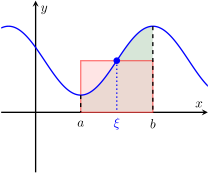
The mean value theorem for integrals can be interpreted as follows: There exists a point \(\xi \in [a,b]\) such that the area between the graph of the function and the \(x\)-axis is as large as the area of the rectangle with the average height \(f(\xi)\) which is \(f(\xi)\cdot(b-a),\) see Figure 7.4 for an illustration. At this point one must again be aware of the fact that here we deal with area balances, i. e., areas below the \(x\)-axis are counted negatively.
Next we formulate the fundamental theorem of calculus which is indeed fundamental in the sense that it shows that integration can be viewed as “inverse operation” of differentiation.
Definition 7.8 • Antiderivative
Let \(D \subseteq {\mathbb{R}}\) and \(f:D \to {\mathbb{R}}.\) A function \(F:D \to {\mathbb{R}}\) is called antiderivative of \(f,\) if \(F\) is differentiable and \(F' = f.\)
Theorem 7.10 • Fundamental theorem of calculus
Let \(I \subseteq {\mathbb{R}}\) be an interval, \(f: I \to {\mathbb{R}}\) be continuous and \(a \in I.\) Then the following statements are satisfied:
The function \[F:I \to {\mathbb{R}}, \quad x \mapsto F(x) = \int_a^x f(t)\,\mathrm{d}t\] is an antiderivative of \(f.\)
If \(G:I \to {\mathbb{R}}\) is another antiderivative of \(f,\) then there exists a \(c \in {\mathbb{R}}\) such that \[G(x) = F(x) + c = \int_a^x f(t)\,\mathrm{d}t + c.\] In particular, it holds that \(c = G(a).\)
Let \(b \in I.\) Then for every antiderivative \(G:I \to {\mathbb{R}}\) of \(f\) it holds that \[\int_a^b f(t)\,\mathrm{d}t = G(b) - G(a).\]
Proof.
Let \(x \in I\) be arbitrary and \(h \neq 0\) such that \(x+h \in I.\) Then \[\frac{F(x+h) - F(x)}{h} = \frac{1}{h} \left( \int_a^{x+h}f(t)\,\mathrm{d}t - \int_a^x f(t)\,\mathrm{d}t \right) = \frac{1}{h} \int_x^{x+h} f(t) \, \mathrm{d}t.\] By the mean value theorem for integrals (Theorem 7.9), for every \(h\) as chosen above there exists a point \(\xi_h \in [x,x+h] \cup [x+h,x]\) such that \[\int_x^{x+h} f(t)\,\mathrm{d}t = f(\xi_h) \cdot h.\] Because of \(\lim_{h \to 0} \xi_h = x\) and the continuity of \(f\) we then obtain \[\lim_{h \to 0} \frac{F(x+h) - F(x)}{h} = \lim_{h \to 0} \left( \frac{1}{h}\cdot f(\xi_h) \cdot h \right) = f(x).\] Hence, \(F\) is differentiable in all \(x \in I\) and \(F' = f.\)
If \(G:I \to {\mathbb{R}}\) is another antiderivative of \(f,\) then \((G-F)' = f - f = 0.\) With the constancy criterion from Theorem 6.12 this implies that there exists a \(c \in {\mathbb{R}}\) such that \(G(x) - F(x) = c\) for all \(x \in I.\) This implies \[G(x) = \int_a^x f(t)\,\mathrm{d}t + c \quad \text{for all } x \in I\] and therefore, \(G(a) = \int_a^a f(t)\,\mathrm{d}t + c = c.\)
From ii we obtain that \[G(b) = \int_a^b f(t)\,\mathrm{d}t + c = \int_a^b f(t)\,\mathrm{d}t + G(a),\] and we can conclude the result.
Video 7.6. Fundamental theorem of calculus.
Remark 7.7
Let \(D \subseteq {\mathbb{R}}\) and \(f:D \to {\mathbb{R}}.\)
If \(F:D \to {\mathbb{R}}\) is an antiderivative of \(f\) and \(([a,b] \cup [b,a]) \subseteq D\) we use the notation \[\int_a^b f(x)\,\mathrm{d}x = F(x)\bigg|_a^b := F(b) - F(a).\]
The set \[\int f(x)\,\mathrm{d}x := \left\{ F:D \to {\mathbb{R}}\; | \; F \text{ is an antiderivative of } f \right\}\] of all antiderivatives of \(f\) is called the indefinite integral of \(f.\) If \(F:D \to {\mathbb{R}}\) is a particular antiderivative of \(f,\) then one usually writes (unprecisely) \[\int f(x)\,\mathrm{d}x = F(x) + c.\] In contrast to that, the integral \[\int_a^b f(x)\,\mathrm{d}x\] for \([a,b] \subseteq D\) is called definite integral of \(f\) over \([a,b].\)
Example 7.4
The function \(\exp:{\mathbb{R}}\to {\mathbb{R}}\) is an antiderivative of \(\exp:{\mathbb{R}}\to {\mathbb{R}}\) because \(\exp' = \exp.\) Hence, for arbitrary \(a,\,b \in {\mathbb{R}}\) we obtain \[\int_a^b \mathrm{e}^x\,\mathrm{d}x = \mathrm{e}^x\bigg|_a^b = \mathrm{e}^b - \mathrm{e}^a.\]
For the function \(f:(0,\infty) \to {\mathbb{R}},\) \(x \mapsto x^\alpha\) with \(\alpha \in {\mathbb{R}}\setminus \{-1\}\) it holds that \[\int f(x)\, \mathrm{d}x = \frac{1}{\alpha+1} x^{\alpha+1} + c,\] since for all \(x \in (0,\infty)\) we have \[\frac{\mathrm{d}}{\mathrm{d}x} \left(\frac{1}{\alpha+1} x^{\alpha+1}\right) = x^\alpha.\] Obviously, for \(\alpha = -1,\) the proposed antiderivative is not well-defined, hence we will consider this case individually in the next item.
An antiderivative of the function \(f:{\mathbb{R}}\setminus \{0\} \to {\mathbb{R}},\) \(x \mapsto x^{-1} = \frac{1}{x}\) is given by \(F: {\mathbb{R}}\setminus \{0\} \to {\mathbb{R}},\) \(x \mapsto \ln |x|\) because for all \(x > 0\) it holds that \(\ln |x| = \ln x\) and we obtain \[F'(x) = \ln' x = \frac{1}{x}.\] On the other hand, for \(x < 0\) we have \(\ln |x| = \ln(-x)\) and with the chain rule we obtain \[F'(x) = \ln'(-x) = \frac{1}{-x} \cdot (-1) = \frac{1}{x}.\] Hence, for all \(a,\,b \in {\mathbb{R}}\) with \(0 \notin I(a,b)\) (\(f\) is undefined for \(x_0=0\)) it holds that \[\int_a^b \frac{1}{x} \,\mathrm{d}x = \ln |x|\bigg|_a^b = \ln |b| - \ln |a| = \ln \frac{|b|}{|a|}.\]
We consider the so-called Heaviside function \[f: {\mathbb{R}}\to {\mathbb{R}}, \quad x \mapsto \begin{cases} 0, & \text{for } x<0, \\ 1, & \text{for } x \ge 0. \end{cases}\] We consider its restriction \(f{|}_{[-b,b]}:[-b,b] \to {\mathbb{R}}\) for some \(b > 0.\) Then as this is a staircase function, \(f{|}_{[-b,b]}\) is integrable and a candidate for an antiderivative is \[F:[-b,b] \to {\mathbb{R}}, \quad x \mapsto \int_b^x f(t)\,\mathrm{d}x = \begin{cases} 0, & \text{for } x<0, \\ x, & \text{for } x \ge 0. \end{cases}\] However, \(F\) is not an antiderivative of \(f{|}_{[-b,b]}\) since it is not differentiable in \(x_0 = 0.\) One can even show that \(f{|}_{[-b,b]}\) has no antiderivative, i. e., there exists no differentiable function \(F\) whose derivative is \(f{|}_{[-b,b]}.\)
7.5 Integration Rules
From the product and chain rule for differentiation and by using the fundamental theorem of calculus we can derive rules for integration that can be used to determine antiderivates for many types of functions.
Theorem 7.11 • Partial integration
Let \(f,\,g: [a,b] \to {\mathbb{R}}\) be continuously differentiable. Then \[\tag{7.6} \int_a^b f(x)g'(x)\,\mathrm{d}x = (f\cdot g)(x) \bigg|_a^b - \int_a^b f'(x)g(x) \,\mathrm{d}x.\]
Proof. By the product rule we have \((f\cdot g)' = f'\cdot g + f\cdot g',\) i. e., \(fg\) is an antiderivative of \(f'g+fg'.\) The formula (7.6) then follows directly from the fundamental theorem of calculus (Theorem 7.10).
Video 7.7. Partial integration.
Equation (7.6) is called partial integration since there remains an integral after applying the rule. This may seem contradictory but the integral on the right-hand side of (7.6) can often be resolved much more easily compared to the integral on the left-hand side.
Example 7.5
We determine an antiderivative of the function \(x \mapsto x\mathrm{e}^x\) by setting \(f(x) = x\) and \(g'(x) = \mathrm{e}^x\) in (7.6). Then for all \(a,\,b \in {\mathbb{R}}\) we obtain \[\int_a^b x\mathrm{e}^x \, \mathrm{d}x = x \mathrm{e}^x\bigg|_a^b - \int_a^b \mathrm{e}^x \, \mathrm{d}x = \mathrm{e}^x(x-1)\bigg|_a^b.\] We could do the same calculation for the indefinite integral by discarding the limits of the integral. However, one should keep in mind that the indefinite integral denotes a set of functions that pairwise differ by a constant. Hence, if after a transformation no integral remains, one should add a constant \(c.\) For our example this means \[\int x\mathrm{e}^x\,\mathrm{d}x = x\mathrm{e}^x - \int \mathrm{e}^x\,\mathrm{d}x = \mathrm{e}^x (x-1) + c.\] Partial integration is the classical integration method for functions of the form \(x \mapsto p(x)\mathrm{e}^x,\) \(x \mapsto p(x)\sin x,\) and \(x \mapsto p(x)\cos x,\) where \(p\) is an arbitrary polynomial function.
Partial integration is also useful to find the antiderivative of the logarithm \(x \mapsto \ln x,\) even though on the first sight, there is no product. By setting \(f = \ln\) and \(g' = 1\) in (7.6), we obtain \[\int \ln x\,\mathrm{d}x = x \ln x - \int \frac{1}{x}\cdot x \,\mathrm{d}x = x(\ln x - 1) + c.\]
With \(f = \cos\) and \(g' = \cos\) in (7.6) we obtain \[\begin{aligned} \int \cos^2 x \, \mathrm{d}x &= \cos x \sin x - \int \sin x \cdot (-\sin x) \, \mathrm{d}x \\ &= \sin x \cos x + \int \sin^2 x \, \mathrm{d}x. \end{aligned}\] By another partial integration of the integral on the right-hand side with \(f = g' = \sin\) in (7.6) we would not gain anything as this results in the original integral on the left-hand side. Therefore, we write \[\begin{aligned} \int \cos^2 x \, \mathrm{d}x &= \sin x \cos x + \int \left(1- \cos^2 x \right) \,\mathrm{d}x \\ &= \sin x \cos x + x - \int \cos^2 x\, \mathrm{d}x. \end{aligned}\] Hence we can resolve the equation for the integral and obtain \[\begin{aligned} &2 \int \cos^2 x\,\mathrm{d}x = \sin x \cos x + x + c \\ \Longrightarrow \quad &\int \cos^2 \, \mathrm{d}x = \frac{1}{2}(\sin x\cos x + x) + c. \end{aligned}\] Note that in the last equation we still write \(c\) instead of \(\frac{c}{2}\) since it just stands for an arbitrary constant. On the other hand, making use of this convention could be dangerous. It is not any longer possible to manipulate \(c\) algebraically since this could lead to false results and contradictions.
Theorem 7.12 • Substitution rule
Let \(I \subseteq {\mathbb{R}}\) be an interval and let \(f: I \to {\mathbb{R}}\) be continuous and \(g:[a,b] \to I\) be continuously differentiable. Then \[\int_a^b f(g(t))\cdot g'(t) \,\mathrm{d}t = \int_{g(a)}^{g(b)} f(x) \,\mathrm{d}x.\]
Proof. Let \(F: I \to {\mathbb{R}}\) be an antiderivative of \(f.\) Then \(F \circ g\) is an antiderivative of \((f \circ g) \cdot g',\) since for all \(t \in [a,b]\) the chain rule implies \[(F \circ g)'(t) = F'(g(t))\cdot g'(t) = f(g(t)) \cdot g'(t) = ((f \circ g)\cdot g')(t).\] Then the fundamental theorem of calculus (Theorem 7.10) yields \[\begin{aligned} \int_a^b f(g(t)) \cdot g'(t)\,\mathrm{d}t &= (F \circ g)(t)\bigg|_a^b \\ &= F(g(b)) - F(g(a)) \\ &= F(x) \bigg|_{g(a)}^{g(b)} = \int_{g(a)}^{g(b)} f(x) \,\mathrm{d}x. \end{aligned}\]
Video 7.8. Substitution rule.
Example 7.6
Let \(g:[a,b] \to {\mathbb{R}}\setminus\{0\}\) be continuously differentiable and \(f:{\mathbb{R}}\setminus\{0\} \to {\mathbb{R}},\) \(x \mapsto \frac{1}{x}.\) Then \[\tag{7.7} \int_a^b \frac{g'(t)}{g(t)}\, \mathrm{d}t = \int_a^b f(g(t))\cdot g'(t) \,\mathrm{d}x = \int_{g(a)}^{g(b)} \frac{1}{x}\,\mathrm{d}x = \ln |x| \bigg|_{g(a)}^{g(b)}.\] If we would like to determine the value of the definite integral, we can simply evaluate the expression on the right-hand side of (7.7). However, if we aim for the indefinite integral, we have to “substitute back” \(x=g(t)\) at the end in order to obtain a function that depends on \(t.\) In our case we get \[\int \frac{g'(t)}{g(t)}\, \mathrm{d}t = \int \frac{1}{x} \,\mathrm{d}x = \ln |x| + c= \ln |g(t)| + c.\]
As a special case of i we can determine an antiderivative of the tangent function, namely \[\int \tan x\,\mathrm{d}x = - \int \frac{-\sin x}{\cos x}\,\mathrm{d}x = -\ln |\cos x| + c.\]
We apply i to determine an antiderivative of the same function in two different ways. We have \[\begin{aligned} \int \frac{4}{1+4x} \,\mathrm{d}x &= \ln |1+4x| + c, \\ \int \frac{4}{1+4x} \,\mathrm{d}x &= \int \frac{1}{\frac{1}{4}+x} \, \mathrm{d}x = \ln \left|\frac{1}{4}+x\right| + c. \end{aligned}\] Did we do anything wrong? Obviously, \(\ln |1+4x|\) and \(\ln\left|\frac{1}{4}+x\right|\) are different in general which can be seen by putting in \(x_0 = 0.\) However, both results are correct since they only differ by a constant. For all \(x \in {\mathbb{R}}\setminus \{-\frac{1}{4}\}\) we have \[\ln |1+4x| = \ln \left( 4\cdot \left|\frac{1}{4}+x\right| \right) = \ln 4+ \ln\left|\frac{1}{4}+x\right|.\]
Remark 7.8
Sometimes the integrand is not given in the form \(f(g(t))\cdot g'(t)\) in which case the following variant of the substitution rule is applied. If the function \(g:[a,b] \to [\alpha,\beta]\) in Theorem 7.12 is bijective, then the substitution rule can also be written as \[\tag{7.8} \int_\alpha^\beta f(x)\,\mathrm{d}x = \int_{g^{-1}(\alpha)}^{g^{-1}(\beta)} f(g(t))\cdot g'(t)\, \mathrm{d}t.\] At this point we also see the usefulness of Leibniz’ notation because formally, for the substitution \(x = g(t)\) we have to replace \(\mathrm{d}x = g'(t)\, \mathrm{d}t\) in the integral. This perfectly fits to the notation of the derivative \[\frac{\mathrm{d}x}{\mathrm{d}t} = \frac{\mathrm{d}g(t)}{\mathrm{d}t} = g'(t).\] It seems that we only have to “multiply both sides” with \(\mathrm{d}t\) to obtain \(\mathrm{d}x = g'(t) \,\mathrm{d}t.\) This is a great rule to memorize.
Example 7.7
We compute the area of the upper half of the unit circle. This corresponds to the area that is enclosed by the graph of the function \(f:[-1,1] \to {\mathbb{R}},\) \(x \mapsto \sqrt{1-x^2}\) and the \(x\)-axis. With the substitution \(x = \sin t\) and our “memory rule” we have \[\frac{\mathrm{d}x}{\mathrm{d}t} = \sin' t = \cos t \quad \Longrightarrow \quad \mathrm{d}x = \cos t \,\mathrm{d}t.\] Using the fact that \(\sin:\left[-\frac{\pi}{2},\frac{\pi}{2}\right] \to [-1,1],\) \(x \mapsto \sin x\) is bijective we obtain \[\begin{aligned} \int_{-1}^1 \sqrt{1-x^2}\,\mathrm{d}x &= \int_{-\frac{\pi}{2}}^{\frac{\pi}{2}} \sqrt{1-\sin^2 t}\cdot \cos t \,\mathrm{d}t \\ &= \int_{-\frac{\pi}{2}}^{\frac{\pi}{2}} \cos^2 t \,\mathrm{d}t \\ &= \frac{1}{2}\left( \sin t \cos t + t \right) \bigg|_{-\frac{\pi}{2}}^{\frac{\pi}{2}} = \frac{\pi}{2}. \end{aligned}\] Here we have used our alternative substitution rule (7.8) as well as our calculations from Example 7.5 iii. In order to obtain an antiderivative of \(f\) we must “substitute back” and use the formulas \(\cos t = \sqrt{1-\sin^2 t} = \sqrt{1-x^2}\) and \(t = \arcsin x.\) Then we obtain \[\int \sqrt{1-x^2} \,\mathrm{d}x = \frac{1}{2}\left( x\cdot\sqrt{1-x^2} + \arcsin x \right) + c.\]
Remark 7.9
Unfortunately, in general the calculation of antiderivatives is much harder than differentiation of a function. The main reason for that is that the set of “elementary functions” (Roughly speaking, these are all functions that can be expressed by sums, products, compositions, and inverses of polynomial, root, logarithm, exponential, and trigonometric functions.) is not closed under antidifferentiation. Typical examples of functions whose antiderivatives are not “elementary” are \[x \mapsto \mathrm{e}^{-x^2}, \quad x \mapsto \frac{\sin x}{x}, \quad x \mapsto x^x\] with appropriate domains, respectively. This fact is sometimes misinterpreted as “these functions do not have an antiderivative” or “the antiderivative cannot be written down”. Both of these statements are false. For instance, the function \(x \mapsto \mathrm{e}^{-x^2}\) is continuous and hence, by the fundamental theorem of calculus, it has an antiderivative. This antiderivative can also be written down, for \(a \in {\mathbb{R}}\) it is \[F: {\mathbb{R}}\to {\mathbb{R}}, \quad x \mapsto \int_a^x \mathrm{e}^{-t^2}\,\mathrm{d}t.\] This function can however not be expressed by elementary functions as indicated above. In this sense we obtain a completely new and unknown type of functions.
7.6 Improper Integrals
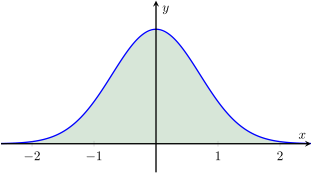
We consider again the function \(f:{\mathbb{R}}\to {\mathbb{R}},\) \(x \mapsto \mathrm{e}^{-x^2}\) and consider its graph which is depicted in Figure 7.5. For \(x \to \infty\) and \(x \to -\infty\) the function asymptotically tends towards the \(x\)-axis and the function values \(f(x)\) tend to become very small very fast. For \(x \in {\mathbb{R}}\setminus [-2,2]\) we almost cannot discriminate the graph of \(f\) from the \(x\)-axis. Therefore, the question may arise whether the area between the graph of \(f\) and the \(x\)-axis is finite, even though the area has an infinite extent for \(x \to \infty\) and \(x \to -\infty.\) We can do this with the help of another limit.
Definition 7.9 • Improper integral of first kind
Let \(f:[a,\infty) \to {\mathbb{R}}\) be integrable over each compact interval \([a,b]\) with \(b > a.\) If the limit \[\int_a^\infty f(x)\,\mathrm{d}x := \lim_{b \to \infty} \int_a^b f(x)\,\mathrm{d}x\] exists, then it is called the improper integral of \(f\) over \([a,\infty)\).
Let \(f:(-\infty,b] \to {\mathbb{R}}\) be integrable over each compact interval \([a,b]\) with \(a < b.\) If the limit \[\int_{-\infty}^b f(x)\,\mathrm{d}x := \lim_{a \to -\infty} \int_a^b f(x)\,\mathrm{d}x\] exists, then it is called the improper integral of \(f\) over \((-\infty,b]\).
Let \(f: {\mathbb{R}}\to {\mathbb{R}}\) be integrable over each compact interval \([a,b] \subseteq {\mathbb{R}}.\) If both integrals of \(f\) over \((-\infty,0]\) and \([0,\infty)\) exist, then \[\int_{-\infty}^\infty f(x)\,\mathrm{d}x := \int_{-\infty}^0 f(x)\,\mathrm{d}x + \int_0^\infty f(x)\,\mathrm{d}x\] is called the improper integral of \(f\) over \({\mathbb{R}}\).
Example 7.8
Let \(s \in {\mathbb{R}}\) and \(f:[1,\infty) \to {\mathbb{R}},\) \(x \mapsto \frac{1}{x^s}.\) We analyze the existence of the improper integral of \(f\) over \([0,\infty)\) in dependence of \(s.\) First of all, for \(s \neq 1\) and \(b \ge 1\) it holds that \[\begin{aligned} \int_1^b f(x)\,\mathrm{d}x &= \int_1^b x^{-s}\,\mathrm{d}x \\ &= \frac{1}{-s+1}x^{-s+1}\bigg|_1^b = -\frac{1}{s-1} \left( b^{1-s} - 1 \right). \end{aligned}\]
Case 1: \(s > 1.\) Because of \(\lim_{b \to \infty} b^{1-s} = \lim_{b \to \infty} \frac{1}{b^{s-1}} = 0\) we obtain \[\int_1^\infty \frac{1}{x^s}\,\mathrm{d}x = \lim_{b \to \infty} \int_1^b \frac{1}{x^s}\,\mathrm{d}x = \frac{1}{s-1}.\]
Case 2: \(s < 1.\) In this case we have \(\lim_{b \to \infty} b^{1-s} = \infty\) such that the improper integral of \(f\) over \([1,\infty)\) does not exist.
Case 3: \(s = 1.\) Because of \[\int_1^b f(x)\,\mathrm{d}x = \int_1^b \frac{1}{x}\,\mathrm{d}x = \ln x \bigg|_1^b = \ln b \to \infty \quad \text{for } b \to \infty,\] also in this case the improper integral of \(f\) over \([1,\infty)\) does not exist.Consider the function \(f:{\mathbb{R}}\to {\mathbb{R}},\) \(x \mapsto \frac{1}{1+x^2}.\) Since this is the derivative of the arctangent (cf. Example 6.10 iii) we obtain \[\begin{aligned} \int_0^\infty \frac{1}{1+x^2} \,\mathrm{d}x &= \lim_{b \to \infty} \int_0^b \frac{1}{1+x^2} \,\mathrm{d}x \\ &= \lim_{b \to \infty} \bigg(\arctan x \bigg|_0^b\bigg) = \lim_{b \to \infty} \arctan b = \frac{\pi}{2}. \end{aligned}\] Analogously we obtain \[\int_{-\infty}^0 \frac{1}{1+x^2} \,\mathrm{d}x = \frac{\pi}{2},\] hence we get \[\int_{-\infty}^\infty \frac{1}{1+x^2}\,\mathrm{d}x = \int_{-\infty}^0 \frac{1}{1+x^2}\,\mathrm{d}x + \int_0^{\infty} \frac{1}{1+x^2} \,\mathrm{d}x = \pi.\]
Remark 7.10
Let \(I \subseteq {\mathbb{R}}\) be an appropriate interval and \(f:I \to {\mathbb{R}}\) be such that \(f\) fulfills the integrability assumptions in the definition of the corresponding improper integrals.
The implication \[\int_{-\infty}^\infty f(x)\,\mathrm{d}x \text{ exists} \quad \Longrightarrow \quad \lim_{b \to \infty} \int_{-b}^{b} f(x)\,\mathrm{d}x \text{ exists}\] is true, but the converse is not true in general! For example, the improper integral of the identity function over \({\mathbb{R}}\) does not exist, since neither \(\int_{-\infty}^0 x\,\mathrm{d}x\) nor \(\int_0^\infty x\,\mathrm{d}x\) exist. On the other hand, it holds that \[\lim_{b \to \infty} \int_{-b}^{b} x\,\mathrm{d}x = \lim_{b \to \infty} \left( \frac{1}{2}b^2 - \frac{1}{2}(-b)^2 \right) = 0.\] For this reason we have not defined the improper integral over \({\mathbb{R}}\) by a single limit.
Let \(a \in {\mathbb{R}}.\) Then for all \(c \in [a,\infty)\) it holds that \[\tag{7.9} \int_a^\infty f(x)\,\mathrm{d}x = \int_a^c f(x)\,\mathrm{d}x + \int_c^\infty f(x)\,\mathrm{d}x.\] More precisely, we should have said: If the improper integral \(\int_a^\infty f(x)\,\mathrm{d}x\) exists, then for each \(c \in [a,\infty)\) also the improper integral \(\int_c^\infty f(x)\,\mathrm{d}x\) exists with (7.9).
Analogously this works for improper integrals over intervals of the form \((-\infty,b].\) Hence, for all \(c \in {\mathbb{R}}\) we obtain \[\int_{-\infty}^\infty f(x)\,\mathrm{d}x = \int_{-\infty}^c f(x)\,\mathrm{d}x + \int_{c}^\infty f(x)\,\mathrm{d}x.\] (Formulating the more precise statement as above is left to the reader.) In particular, this means that in the definition of the improper integral over \({\mathbb{R}}\) we could have also used any point \(c \in {\mathbb{R}}\) instead of \(0\) to split the integral.
Let \(n,\,m \in {\mathbb{N}}.\) If \(f:[n,\infty) \to [0,\infty)\) is monotonically decreasing, then on the interval \([n,m]\) with \(m > n\) we can bound \(f\) from above and below by staircase functions with respect to the partition \(Z: n < n+1 < \ldots < m-1 < m.\) We can achieve this by choosing the function values of \(f\) at the left and right boundaries of the intervals \([k,k+1],\) \(k=n,\,\ldots,\,m-1\) as function values of the staircase functions, respectively (cf. Figure 7.6).
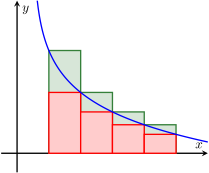
From this we obtain the estimate \[\tag{7.10} \sum_{k = n+1}^m f(k) = \sum_{k = n}^{m-1} f(k+1) \le \int_n^m f(x)\,\mathrm{d}x \le \sum_{k=n}^{m-1} f(k).\]
For \(m \to \infty,\) the sums become a series and the integral becomes an improper integral. This provides us with a new convergence criterion for series. For its proof we need the following lemma.