7 Integration
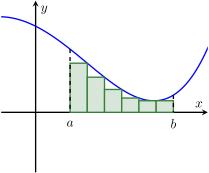
Another central concept in analysis is integration. This concept has been developed for calculating areas and volumes that are bounded by graphs of functions. For functions of one variable we can develop this concept as follows. For a given function \(f:[a,b] \to [0,\infty),\) we would like to determine the area between the graph of \(f\) and the \(x\)-axis (as well as the lines \(x=a\) and \(x=b\)). The central idea is to approximate \(f\) by a staircase function \(\varphi:[a,b] \to [0,\infty),\) i. e., a piecewise constant function, see Figure 7.1. For such functions, the determination of the area between the graph of \(\varphi\) and the \(x\)-axis is simple, because we can decompose this area into rectangles whose area is given as the product of length and width. The original area we are interested in can then be computed by a limit process in which we consider better and better approximations by staircase functions.
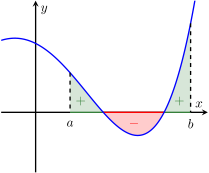
When defining integrals we also allow arbitrary functions \(f:[a,b] \to {\mathbb{R}},\) i. e., we also allow negative function values. In this case, it is useful to view the integral not as area but as area balance. This means that the area above the \(x\)-axis is counted positively and the area below the \(x\)-axis is counted negatively, cf. Figure 7.2. Such an area balance is typically what is to be computed in many applications. But also the problem of computing the area that is covered by the graph of the function and the \(x\)-axis can be solved by integrating the function \(|f|\) instead of \(f.\)
7.1 Staircase Functions
Before we start with the definition of the integral we consider the main tool for its derivation, namely the staircase functions (also often called step functions).
Definition 7.1 • Partition, staircase function, refinement
Let \(a,\,b \in {\mathbb{R}}\) with \(a < b.\)
A partition of \([a,b]\) is a tuple \((x_0,\,x_1,\,\ldots,\,x_n)\) where \(x_0,\,x_1,\,\ldots,\,x_n \in {\mathbb{R}}\) and \(n \in {\mathbb{N}}\) are such that \[a = x_0 < x_1 < \ldots < x_n = b.\] We write \(Z: a = x_0 < \ldots < x_n = b\) (or briefly, \(Z\)).
Let \(Z: a = x_0 < \ldots < x_n = b\) be a partition of \([a,b].\) A function \(\varphi:[a,b] \to {\mathbb{R}}\) is called a staircase function with respect to \(Z\), if there exist \(c_1,\,\ldots,\,c_n \in {\mathbb{R}}\) such that \[\varphi(x) = c_i \quad \text{for all } x \in (x_{i-1},x_i), \quad i=1,\,\ldots,\,n,\] i. e., if \(\varphi{|}_{(x_{i-1},x_i)}\) is constant for all \(i=1,\,\ldots,\,n.\)
A function \(\varphi:[a,b] \to {\mathbb{R}}\) is called staircase function, if there exists a partition \(Z\) of \([a,b]\) such that \(\varphi\) is a staircase function with respect to \(Z.\) The partition \(Z\) is then called compatible with \(\varphi.\)
Let \(Z_1: a = x_0 < \ldots < x_n = b\) and \(Z_2: a = y_0 < \ldots < y_m = b\) be two partitions of \([a,b].\) Then the partition \(Z: a = z_0 < \ldots < z_\ell = b\) which is inductively defined by \[\begin{aligned} z_k := \min\left(\{x_i\;|\;x_i > z_{k-1}\}\cup \{y_j\;|\;y_j > z_{k-1}\} \right) & \\ \text{for } k \ge 1, & \text{ if } z_{k-1} \neq b \end{aligned}\] is called refinement of \(Z_1\) and \(Z_2\).
Example 7.1
Every constant function \(f:[a,b] \to {\mathbb{R}}\) is a staircase function (with respect to any partition \(Z\) of \([a,b]\)).
Assume we have the partition \(Z: 0<1<2\) of the interval \([0,2].\) Then \(\varphi:[0,2] \to {\mathbb{R}}\) with \[\varphi(x) = \begin{cases} 0, & \text{if } x \in [0,1], \\ 1, & \text{if } x \in [1,2] \end{cases}\] is a staircase function with respect to \(Z.\) Another staircase function with respect to \(Z\) is \[\psi(x) = \begin{cases} 0, & \text{if } x \in [0,1), \\ 99, & \text{if } x = 1, \\ 1, & \text{if } x \in (1,2]. \end{cases}\] Note that it is only important for a staircase function to be constant on the open intervals \((x_{i-1},x_i),\) \(i=1,\,\ldots,\,n\) of a partition \(Z: a = x_0 < \ldots < x_n = b.\) At the points \(x_i,\) \(i=1,\,\ldots,\,n,\) the function may attain arbitrary values.
Remark 7.1
If \(\varphi_1:[a,b] \to {\mathbb{R}}\) is a staircase function with respect to a partition \(Z_1\) of \([a,b]\) and if \(\varphi_2:[a,b] \to {\mathbb{R}}\) is a staircase function with respect to a partition \(Z_2\) of \([a,b],\) then \(\varphi_1\) and \(\varphi_2\) are both staircase functions with respect to the refinement \(Z\) of \(Z_1\) and \(Z_2.\)
Statement i implies that sums of staircase functions are again staircase functions (with respect to the refinement). Moreover, if \(\varphi\) is a staircase function and \(c \in {\mathbb{R}},\) then \(c \cdot \varphi\) is also a staircase function. This particularly means that the set of staircase functions \[\left\{ \varphi:[a,b] \to {\mathbb{R}}\; | \; \varphi \text{ is a staircase function} \right\}\] is a subspace of the vector space \(\operatorname{Map}([a,b],{\mathbb{R}})\) of functions mapping from \([a,b]\) to \({\mathbb{R}}.\)
Definition 7.2 • Integral
Let \(\varphi:[a,b] \to {\mathbb{R}}\) be a staircase function with respect to the partition \(Z: a = x_0 < \ldots < x_n = b\) of \([a,b]\) and let \(c_1,\,\ldots,\,c_n \in {\mathbb{R}}\) be such that \(\varphi(x) = c_i\) for \(x \in (x_{i-1},x_i)\) and \(i=1,\,\ldots,\,n.\) Then the integral of \(\varphi\) is defined by \[I(\varphi) := I_Z(\varphi) := \sum_{i=1}^n c_i \cdot (x_i - x_{i-1}).\]
In the above definition we have already used the notation \(I(\varphi)\) that indicates that the intergral is independent of the particular choice of partition \(Z.\) We will show this fact in the next theorem.
Theorem 7.1
Let \(\varphi:[a,b] \to {\mathbb{R}}\) be a staircase function with respect to the partitions \(Z_1: a = x_0 < \ldots < x_n = b\) and \(Z_2: a = y_0 < \ldots < y_n = b\) of \([a,b].\) Then we have \[I_{Z_1}(\varphi) = I_{Z_2}(\varphi),\] i. e., the integral of a staircase function is independent of the choice of partition.
Proof. Let \(c_1,\,\ldots,\,c_n,\,d_1,\,\ldots,\,d_m \in {\mathbb{R}}\) be such that \(\varphi(x) = c_i\) for \(x \in (x_{i-1},\,x_i)\) and \(i=1,\,\ldots,\,n\) as well as \(\varphi(y) = d_j\) for \(y \in (y_{j-1},\,y_j)\) and \(j=1,\,\ldots,\,m.\) We distinguish two cases:
Case 1: Every point \(x_i\) of \(Z_1\) is also in \(Z_2.\) Under this assumption there exist \(k_0 < k_1 < \ldots < k_n\) with \(k_0=0\) and \(k_n = m\) such that \(x_i = y_{k_i}\) for \(i=1,\,\ldots,\,n.\) In particular, for all \(i=1,\,\ldots,\,n\) we have \[\begin{gathered}
x_{i-1} = y_{k_{i-1}} < y_{k_{i-1}+1} < \ldots < y_{k_i-1 } < y_{k_i} = x_i \quad \text{and} \quad d_j = c_i \\ \text{for } j = k_{i-1}+1,\,\ldots,\,k_i.
\end{gathered}\] Then we obtain \[\begin{aligned}
I_{Z_2}(\varphi) &= \sum_{j=1}^m d_j\cdot(y_j-y_{j-1}) \\
&= \sum_{i=1}^n \sum_{j=k_{i-1}+1}^{k_i} c_i\cdot(y_j - y_{j-1}) \\
&= \sum_{i=1}^n c_i\cdot(x_i - x_{i-1}) = I_{Z_1}(\varphi).
\end{aligned}\]
Case 2: The partitions \(Z_1\) and \(Z_2\) are arbitrary. In this case we consider the refinement \(Z\) of \(Z_1\) and \(Z_2.\) Then by using the first case we get \[I_{Z_1}(\varphi) = I_Z(\varphi) = I_{Z_2}(\varphi).\]
Video 7.1. Integrals of staircase functions.
Example 7.2
For the constant staircase function \(\varphi:[a,b] \to {\mathbb{R}},\) \(x \mapsto c\) it holds that \[I(\varphi) = c\cdot(b-a).\]
For the two staircase functions \(\varphi,\,\psi\) in Example 7.1 ii we obtain \[I(\varphi) = 0 \cdot (1-0) + 1 \cdot (2-1) = 1 = I(\psi).\] Note that by the definition of the intergral for staircase functions, only the constant function values in the intervals \((0,1)\) and \((1,2)\) matter in which both \(\varphi\) and \(\psi\) coincide. The function values in the points \(x_i,\) \(i=1,\,\ldots,\,n\) do not have any influence on the integral.
The following theorem summarizes some basic fundamental properties of the integral for staircase functions.
Definition 7.3 • Ordering relations for functions
Let \(X\) be a set and \(f,\,g: X \to {\mathbb{R}}\) be functions. Then we write \(f \le g,\) if \(f(x) \le g(x)\) for all \(x \in X.\) (Analogously we define \(f < g,\) \(f \ge g,\) and \(f > g.\))
Theorem 7.2
Let \(\varphi_1,\,\varphi_2:[a,b] \to {\mathbb{R}}\) be staircase functions and \(\lambda \in {\mathbb{R}}.\) Then
\(I(\varphi_1 + \varphi_2) = I(\varphi_1) + I(\varphi_2)\) and \(I(\lambda\varphi_1) = \lambda I(\varphi_1)\) (linearity of \(I\));
\(\varphi_1 \le \varphi_2\) implies \(I(\varphi_1) \le I(\varphi_2)\) (monotonicity of \(I\)).
Proof.
W. l. o. g. we can assume that \(\varphi_1\) and \(\varphi_2\) are staircase functions with respect to the same partition \(Z: a=x_0 < \ldots < x_n = b,\) otherwise we consider the refinement of the two partitions. Let \(c_1,\,\ldots,\,c_n,\,d_1,\,\ldots,\,d_n \in {\mathbb{R}}\) such that \[\varphi_1(x) = c_i \quad \text{and} \quad \varphi_2(x) = d_i \quad \text{for } x \in (x_{i-1},x_i), \text{ and } i=1,\,\ldots,\,n.\] Then it holds that \[\begin{aligned} I(\varphi_1+ \varphi_2) &= \sum_{i=1}^n(c_i+d_i)(x_i-x_{i-1}) \\ &= \sum_{i=1}^n c_i(x_i-x_{i-1}) + \sum_{i=1}^n d_i(x_i-x_{i-1}) = I(\varphi_1) + I(\varphi_2). \end{aligned}\] Analogously, one shows \(I(\lambda\varphi_1) = \lambda I(\varphi_1).\)
This statement can be shown analogously to i.
7.2 The Riemann Integral
Now we make use of our preliminary considerations on staircase functions to define the (Riemann) integral of more general functions.
Definition 7.4 • Bounded function
Let \(D \subseteq {\mathbb{R}}\) and \(f:D \to {\mathbb{R}}.\) The function \(f\) is called bounded, if the set \(f(D)\) is bounded.
Definition 7.5 • Upper integral, lower integral, Riemann integrable, Riemann integral
Let \(f:[a,b] \to {\mathbb{R}}\) be bounded.
The value \[\overline{\int_a^b} f(x) \,\mathrm{d}x := \inf\left\{ I(\varphi) \; | \; f \le \varphi, \varphi \text{ is a staircase function} \right\}\] is called upper integral of \(f\).
The value \[\underline{\int_a^b} f(x) \,\mathrm{d}x := \sup\left\{ I(\varphi) \; | \; \varphi \le f, \varphi \text{ is a staircase function} \right\}\] is called lower integral of \(f\).
The function \(f\) is (Riemann) integrable, if \[\overline{\int_a^b} f(x) \,\mathrm{d}x = \underline{\int_a^b} f(x) \,\mathrm{d}x.\] In this case, \[\int_a^b f(x) \,\mathrm{d}x := \underline{\int_a^b} f(x) \,\mathrm{d}x\] is called the (Riemann) integral of \(f\).
Remark 7.2
Because of the monotonicity of the integral of staircase functions (cf. Theorem 7.2 ii), for all bounded functions \(f:[a,b] \to {\mathbb{R}}\) it holds that \[\underline{\int_a^b} f(x) \,\mathrm{d}x \le \overline{\int_a^b} f(x) \,\mathrm{d}x.\]
In the following, we call a Riemann integrable function just integrable, since we do not yet know any other integrability concepts. However, in module M07: “Analysis III” we will consider the so-called Lebesgue integral which is nowadays much more widely used than the Riemann integral.
Example 7.3
A staircase function \(\varphi:[a,b] \to {\mathbb{R}}\) is integrable since it holds that \[\underline{\int_a^b} \varphi(x) \,\mathrm{d}x = I(\varphi) = \overline{\int_a^b} \varphi(x) \,\mathrm{d}x.\] In particular, we have \(\int_a^b \varphi(x) \,\mathrm{d}x = I(\varphi).\)
We have already seen in Example 7.2 ii that the function values at the points \(x_i,\) \(i=1,\,\ldots,\,n\) of a partition \(Z: a = x_0 < \ldots < x_n = b\) do not contribute to the value of the integral. More generally, for two functions \(f,\,g:[a,b] \to {\mathbb{R}}\) one can show: If \(f\) is integrable and the set \(\{x \in [a,b] \; | \; f(x) \neq g(x)\}\) is finite, then also \(g\) is integrable and it holds that \[\int_a^b f(x) \,\mathrm{d}x = \int_a^b g(x) \,\mathrm{d}x.\]
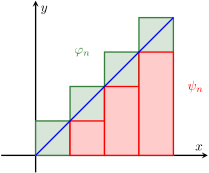
The function \(\operatorname{id}:[0,b] \to [0,b]\) for \(b>0\) is integrable. We consider the partition \(Z: 0 = x_0 < \ldots < x_n = b\) with \(x_n = \frac{b}{n}k\) for \(k = 0,\,\ldots,\,n.\) We consider the staircase functions \(\psi_n,\,\varphi_n : [0,b] \to {\mathbb{R}}\) with \[\psi_n(x) := \frac{b}{n}(k-1) \quad \text{and} \quad \varphi_n(x):= \frac{b}{n}k\] for \(x \in (x_{k-1},x_k),\) \(k=1,\,\ldots,\,n\) and \(\varphi_n(b) = \psi_n(b) = b.\) For the case \(n=4,\) these functions are depicted in Figure 7.3. Then we have \(\psi_n \le \operatorname{id}\le \varphi_n\) and \[\begin{aligned} I(\varphi_n) &= \sum_{k=1}^n \frac{b}{n}k\cdot(x_k - x_{k-1}) \\ &= \frac{b^2}{n^2}\sum_{k=1}^n k \\ &= \frac{b^2}{n^2} \cdot\frac{n(n+1)}{2} = \frac{b^2}{2}\left( 1 + \frac{1}{n} \right). \end{aligned}\] Analogously we obtain \(I(\psi_n) = \frac{b^2}{2}\left( 1 - \frac{1}{n} \right).\) Therefore, we get \[\frac{b^2}{2} = \lim_{n \to \infty} I(\psi_n) \le \underline{\int_a^b} x \,\mathrm{d}x \le \overline{\int_a^b} x \,\mathrm{d}x \le \lim_{n \to \infty} I(\varphi_n) = \frac{b^2}{2}.\] This implies the integrability of \(\operatorname{id}:[0,b] \to {\mathbb{R}}\) as well as \[\int_a^b x \,\mathrm{d}x = \frac{1}{2}b^2.\] This result also matches with the result we would obtain by geometric considerations. The area between the graph of \(\operatorname{id}\) and the \(x\)-axis is simply half of the area of a square with edge length \(b\) which is \(b^2.\)
Consider the Dirichlet function \(f:[0,1] \to {\mathbb{R}}\) with \[f(x) = \begin{cases} 1, & \text{if } x \in {\mathbb{Q}}\cap [0,1], \\ 0, & \text{otherwise}. \end{cases}\] Let \(\varphi:[0,1] \to {\mathbb{R}}\) be a staircase function with \(f \le \varphi,\) \(Z: 0 = x_0 < \ldots < x_n = 1\) a partition conforming to \(\varphi\) and let \(c_1,\,\ldots,\,c_n \in {\mathbb{R}}\) be such that \(\varphi(x) = c_i\) for all \(x \in (x_{i-1},x_i)\) and \(i = 1,\,\ldots,\,n.\) Then for every \(i=1,\,\ldots,\,n\) there exists a \(q_i \in (x_{i-1},x_i) \cap {\mathbb{Q}}.\) Therefore, \[c_i = \varphi(q_i) \ge f(q_i) = 1.\] Then we have \(\varphi(x) \ge 1\) for all \(x \in [0,1] \setminus \{x_0,\,\ldots,\,x_n\}\) and hence \(I(\varphi) \ge 1.\) This implies \[\overline{\int_a^b} f(x) \,\mathrm{d}x = \inf\left\{ I(\varphi) \; | \; f \le \varphi, \varphi \text{ is a staircase function} \right\} = 1,\] since the infimum is attained for the constant staircase function \(\varphi_0:[0,1] \to {\mathbb{R}},\) \(x \mapsto 1,\) i. e., \(I(\varphi_0) = 1.\) Analogously, one shows that \[\underline{\int_a^b} f(x) \,\mathrm{d}x = 0.\] This means that the Dirichlet function is not integrable.
The definition of integrals with upper and lower integrals actually dates back to the French mathematician Jean-Gaston Darboux. Riemann, on the other hand, defined the integral using Riemann sums. For that one uses staircase functions \(\tau:[a,b] \to {\mathbb{R}}\) with respect to a partition \(Z: a = x_0 < \ldots < x_n = b\) where \[\tag{7.1} \tau(x) = f(\xi_i) \quad \text{for all } x \in (x_{i-1},x_i)\] and \(\xi_i \in [x_{i-1},x_i]\) for \(i=1,\,\ldots,\,n\) are arbitrary. Then the integral \[I(\tau) = \sum_{i=1}^n f(\xi_i)\cdot(x_i - x_{i-1})\] is called a Riemann sum. If \(f\) is integrable, then one can show that for every \(\varepsilon > 0\) there exists \(\delta > 0\) such that for every partition \(Z: a = x_0 < \ldots < x_n = b\) it holds that \[\max\{ x_i-x_{i-1} \;|\; i=1,\,\ldots,\,n \} < \delta \quad \Longrightarrow \quad \left| \int_a^b f(x)\,\mathrm{d}x - \sum_{i=1}^n f(\xi_i)\cdot(x_i - x_{i-1})\right| < \varepsilon.\] If we set \(\Delta x_i = x_i - x_{i-1},\) the transition from Riemann sums to the integral is obtained for finer and finer partitions and this also motivates the notation of the integral, i. e., \[\sum_{i=1}^n f(\xi_i)\cdot(x_i - x_{i-1}) = \sum_{i=1}^n f(\xi_i)\Delta x_i \quad \leadsto \quad \int_a^b f(x)\,\mathrm{d}x.\] There, the symbol \(\mathrm{d}x\) is interpreted as interval of “infinitesimal length”.
Next we consider a useful characterization of integrability.
Theorem 7.3
Let \(f:[a,b] \to {\mathbb{R}}\) be bounded. Then \(f\) is integrable, if and only if for every \(\varepsilon > 0\) there exist staircase functions \(\varphi,\,\psi:[a,b] \to {\mathbb{R}}\) such that \(\psi \le f \le \varphi\) and \[\int_a^b \varphi(x)\,\mathrm{d}x - \int_a^b \psi(x)\,\mathrm{d}x = I(\varphi) - I(\psi) \le \varepsilon.\]
Proof. “\(\Longrightarrow\)”: Let \(f\) be integrable and \(\varepsilon > 0.\) Then by the characterization of the infimum and supremum (cf. Theorem 1.2) there exist staircase functions \(\psi,\,\varphi: [a,b] \to {\mathbb{R}}\) with \(\psi \le f \le \varphi\) as well as \[\overline{\int_a^b}f(x)\,\mathrm{d}x \ge I(\varphi) - \frac{\varepsilon}{2} \quad \text{and} \quad \underline{\int_a^b}f(x)\,\mathrm{d}x \le I(\psi) + \frac{\varepsilon}{2}.\] Because of the equality of the upper and lower integral this implies \[I(\varphi) - I(\psi) \le \overline{\int_a^b}f(x)\,\mathrm{d}x + \frac{\varepsilon}{2} - \underline{\int_a^b}f(x)\,\mathrm{d}x + \frac{\varepsilon}{2} = \varepsilon.\]
“\(\Longleftarrow\)”: Let \(\varepsilon > 0\) be arbitrary and let \(\psi,\,\varphi:[a,b] \to {\mathbb{R}}\) be staircase functions such that \(\psi \le f \le \varphi\) and \(I(\varphi) - I(\psi) \le \varepsilon.\) With Remark 7.2 we obtain \[0 \le \overline{\int_a^b}f(x)\,\mathrm{d}x - \underline{\int_a^b}f(x)\,\mathrm{d}x \le I(\varphi) - I(\psi) \le \varepsilon.\] Since \(\varepsilon > 0\) has been chosen arbitrarily, the integrability of \(f\) follows.
Video 7.2. Characterization of integrability.
Theorem 7.4
Let \(f_1,\,f_2:[a,b] \to {\mathbb{R}}\) be integrable and \(\lambda \in{\mathbb{R}}.\) Then also \(f_1+f_2\) and \(\lambda f_1\) are integrable and the following statements are satisfied:
The integral is linear, i. e., \[\begin{aligned} \int_a^b (f_1 + f_2)(x)\,\mathrm{d}x &= \int_a^b f_1(x)\,\mathrm{d}x + \int_a^b f_2(x)\,\mathrm{d}x \quad \text{and} \\ \int_a^b (\lambda f_1)(x)\,\mathrm{d}x &= \lambda \int_a^b f_1(x)\,\mathrm{d}x. \end{aligned}\]
The integral is monotonic, i. e., \[\begin{aligned} f_1 \le f_2 \quad \Longrightarrow \quad \int_a^b f_1(x)\,\mathrm{d}x \le \int_a^b f_2(x)\,\mathrm{d}x. \end{aligned}\]
Proof.
Let \(\varepsilon > 0\) be arbitrary. Then there exist staircase functions \(\varphi_1,\,\psi_1,\,\varphi_2,\,\psi_2:[a,b] \to {\mathbb{R}}\) with \(\psi_1 \le f_1 \le \varphi_1\) and \(\psi_2 \le f_2 \le \varphi_2\) such that \[I(\varphi_1) - I(\psi_1) \le \frac{\varepsilon}{2} \quad \text{and} \quad I(\varphi_2) - I(\psi_2) \le \frac{\varepsilon}{2}.\] This directly implies \(\psi_1+\psi_2 \le f_1+f_2 \le \varphi_1+\varphi_2.\) Because of the linearity of \(I\) (cf. Theorem 7.2) we also obtain \[\begin{aligned} I(\varphi_1+\varphi_2) - I(\psi_1+\psi_2) &= I(\varphi_1) + I(\varphi_2) - I(\psi_1) - I(\psi_2) \\ &\le \frac{\varepsilon}{2} + \frac{\varepsilon}{2} = \varepsilon. \end{aligned}\] Hence, by Theorem 7.3, \(f_1+f_2\) is integrable. The formula for the integral then follows from \[\begin{aligned} \overline{\int_a^b}(f_1+f_2)(x)\,\mathrm{d}x &\le \overline{\int_a^b}f_1(x)\,\mathrm{d}x + \overline{\int_a^b}f_2(x)\,\mathrm{d}x \quad \text{and} \\ \underline{\int_a^b}(f_1+f_2)(x)\,\mathrm{d}x &\ge \underline{\int_a^b}f_1(x)\,\mathrm{d}x + \underline{\int_a^b}f_2(x)\,\mathrm{d}x. \end{aligned}\] The latter follows from Definition 7.5 (exercise!). Analogously, one can show the second condition.
The proof of this statement is analogous to the proof of statement i.
7.3 Integrable Functions
With the help of Theorem 7.3 we can prove the integrability of a large class of functions. In particular, continuous and monotone functions are integrable.
Theorem 7.5
Let \(f:[a,b] \to {\mathbb{R}}\) be continuous. Then \(f\) is integrable.
Proof. By the extreme value theorem (Theorem 4.9), \(f\) is bounded and hence, we can apply Theorem 7.3. Let \(\varepsilon > 0\) be arbitrary. By the Heine-Cantor theorem (Theorem 4.13), \(f\) is uniformly continuous, i. e., for \(\widetilde{\varepsilon} := \frac{\varepsilon}{2(b-a)} > 0\) there exists a \(\delta > 0\) such that for all \(x,\,\widetilde{x} \in [a,b]\) it holds that \[\tag{7.2} \left| x-\widetilde{x}\right| < \delta \quad \Longrightarrow \quad \left|f(x)- f(\widetilde{x})\right| < \widetilde{\varepsilon}.\] Let \(n \in {\mathbb{N}}\) be such that \(\frac{b-a}{n} < \delta\) and consider the partition \(Z: a = x_0 < \ldots < x_n = b\) with \(x_k = a+k \frac{b-a}{n},\) \(k=0,\,\ldots,\,n\) as well as the staircase functions \(\varphi,\,\psi:[a,b] \to {\mathbb{R}}\) with \[\psi(x) := f(x_i)-\widetilde{\varepsilon} \quad \text{and} \quad \varphi(x) := f(x_i)+\widetilde{\varepsilon} \quad \text{for all } x \in (x_{i-1},x_i) \text{ and } i=1,\,\ldots,\,n,\] as well as \[\tag{7.3} \psi(x_i) = \varphi(x_i) = f(x_i) \quad \text{for } i=0,\,\ldots,\,n.\] Since \(|x-x_i| < \delta\) for all \(x \in (x_{i-1},x_i),\) \(i=1,\,\ldots,\,n\) and (7.2), we have \(|f(x)-f(x_i)| < \widetilde{\varepsilon}.\) With this we obtain \[\psi(x) \le f(x) \le \varphi(x)\quad \text{for all } x \in (x_{i-1},x_i) \text{ and } i=1,\,\ldots,\,n.\] Together with (7.3) we get \(\psi \le f \le \varphi.\) Moreover, with \(\varphi(x) - \psi(x) = 2\widetilde{\varepsilon}\) for all \(x \in [a,b] \setminus\{x_0,\,x_1,\,\ldots,\,x_n\}\) we obtain \[I(\varphi) - I(\psi) = I(\varphi-\psi) = 2\widetilde{\varepsilon}(b-a) = \varepsilon.\] Since \(\varepsilon > 0\) was chosen arbitrarily, the integrability of \(f\) follows with Theorem 7.3.
Video 7.3. Integrability of continuous functions.
Theorem 7.6
Let \(f:[a,b] \to {\mathbb{R}}\) be monotonic. Then \(f\) is integrable.
Proof. Exercise.
Definition 7.6 • Maximum of functions, positive and negative part
Let \(D \subseteq {\mathbb{R}}\) and \(f,\,g:D \to {\mathbb{R}}.\)
The maximum of \(f\) and \(g\) is defined as \[\max\{f,g\}:D \to {\mathbb{R}}, \quad x \mapsto \max\{f(x),g(x)\}.\]
The positive part of \(f\) is defined as \(f^+ := \max\{f,0\}.\) The negative part of \(f\) is defined as \(f^- := \max\{-f,0\}.\)
Remark 7.3
Obviously we have \(f^+,\,f^- \ge 0\) as well as \(f=f^+ - f^-\) and \(|f| = f^+ + f^-.\)
Theorem 7.7
Let \(f,\,g:[a,b] \to {\mathbb{R}}\) be integrable. Then the following statements are are satisfied:
The function \(\max\{f,g\}\) is integrable.
The function \(|f|\) is integrable and it holds that \[\tag{7.4} \int_a^b f(x) \,\mathrm{d}x \le \left|\int_a^b f(x) \,\mathrm{d}x\right| \le \int_a^b |f(x)|\,\mathrm{d}x.\]
The function \(|f|^p\) is integrable for all \(p \in [1,\infty).\)
The product \(f\cdot g\) is integrable.
Proof.
Exercise!
The integrability of \(|f|\) follows from the fact that \(|f| = f^+ + f^- = \max\{f,0\} + \max\{-f,0\}\) and statement i. The first inequality in (7.4) is trivial, the second one follows from the monotonicity of the integral and the fact that \(f^- \ge 0.\) Then we get \[\begin{aligned} \left|\int_a^b f(x) \,\mathrm{d}x\right| &= \left|\int_a^b (f^+(x) - f^-(x)) \,\mathrm{d}x\right| \\ &\le \left|\int_a^b (f^+(x) + f^-(x)) \,\mathrm{d}x\right| \\ &= \left|\int_a^b |f(x)| \,\mathrm{d}x\right| = \int_a^b |f(x)| \,\mathrm{d}x. \end{aligned}\]
If \(f\) is bounded, then also \(|f|\) is bounded, i. e., there exists an \(S > 0\) such that \(|f| \le S.\) W. l. o. g. let \(S \le 1\) (otherwise we consider \(\frac{1}{S}\cdot|f|\) instead of \(|f|\)). Then \(0 \le |f| \le 1.\) Because of the integrability of \(|f|,\) Theorem 7.3 implies that for each \(\varepsilon > 0\) there exist staircase function \(\psi,\,\varphi:[a,b] \to {\mathbb{R}}\) with \(0 \le \psi \le |f| \le \varphi \le 1\) such that \[I(\varphi-\psi) = I(\varphi) - I(\psi) \le \frac{\varepsilon}{p}.\] Now consider the function \(h:[0,1] \to {\mathbb{R}},\) \(x \mapsto x^p.\) This function is differentiable with derivative \(h'(x) = px^{p-1}\) for all \(x \in [0,1].\) Theorem 6.11 (see also Remark 6.8) then delivers the estimate \[\left|h(x)-h(y)\right| \le \sup_{\xi \in [0,1]} |h'(\xi)| \cdot |x-y| = p\cdot|x-y|\] for all \(x,\,y \in [0,1].\) With this we obtain \[\begin{aligned} \varphi(x)^p - \psi(x)^p &= \left| h(\varphi(x)) - h(\psi(x)) \right| \\ &\le p \cdot|\varphi(x) - \psi(x)| = p\cdot(\varphi(x)-\psi(x)) \end{aligned}\] for all \(x \in [a,b],\) since \(0 \le \psi \le \varphi \le 1.\) Finally, with the monotonicity of the integral this implies \[I\left(\varphi^p\right) - I\left(\psi^p\right) = I\left(\varphi^p - \psi^p\right) \le p\cdot I(\varphi - \psi) \le \varepsilon.\] Since both \(\varphi^p\) and \(\psi^p\) are staircase functions with \(\psi^p \le |f|^p \le \varphi^p\) and since \(\varepsilon > 0\) was chosen arbitrarily, with Theorem 7.3 we conclude the integrability of \(|f|^p.\)
This statement follows from iii and the observation that \[f\cdot g = \frac{1}{4}\left( (f+g)^2 - (f-g)^2 \right) = \frac{1}{4}\left( |f+g|^2 - |f-g|^2 \right).\]
Remark 7.4
In general, it holds that \[\int_a^b f(x)g(x)\,\mathrm{d}x \neq \int_a^b f(x)\,\mathrm{d}x \cdot \int_a^b g(x)\,\mathrm{d}x.\]
Video 7.4. Integrability of certain function classes.