5.4 Hyperbolic geometry
Hilbert showed in 1901 that there is no surface which is a closed subset of \(\mathbb{R}^3\) and which has constant negative Gauss curvature. In the previous chapter we saw that several geometric constructions can be carried out as long as we have specified the first fundamental form. Once we know the first fundamental form, we can compute the Gauss curvature, the covariant derivative, geodesics and geodesic curvature, among other things. This motivates the study of abstract surfaces which are not embedded in \(\mathbb{R}^3.\) An important example of such a surface is the hyperbolic plane.
5.4.1 The hyperbolic plane
The hyperbolic plane is the upper half plane in \(\mathbb{R}^2\) equipped with a certain family of inner products on the tangent spaces which are allowed to vary from point to point – a so-called Riemannian metric.
Definition 5.21
The hyperbolic plane \(\mathbb{H}\) is defined to be the upper half-plane \(\left\{q=(u,v) \in \mathbb{R}^2\,|\, v > 0 \right\}\) with Riemannian metric \(\langle\!\langle\cdot{,}\cdot\rangle\!\rangle\) defined by the rule \[\langle\!\langle \vec{w}_q,\vec{r}_q\rangle\!\rangle_q=\frac{1}{v^2}\langle \vec{w}_q,\vec{r}_q\rangle_q\] for all \(q \in \mathbb{H}\) and \(\vec{w}_q,\vec{r}_q \in T_q\mathbb{H}.\)
Notice that at \(q=(u,v)\) an orthonormal basis of \((T_q \mathbb{H},\langle\!\langle\cdot{,}\cdot\rangle\!\rangle_q)\) is given by \[[\vec{e}_1]_q=\begin{pmatrix} v \\ 0 \end{pmatrix}_q\qquad \text{and}\qquad [\vec{e}_2]_q=\begin{pmatrix} 0 \\ v \end{pmatrix}_q\qquad.\]
As an exercise in the use of differential forms, we compute the Gauss curvature of \(\mathbb{H}.\) From (5.5) we have \[\omega_1(\vec{w}_q)=\langle\!\langle \vec{w}_p,(\vec{e}_1)_q\rangle\!\rangle_q=\frac{1}{v}w_1 \qquad \text{and} \qquad \omega_2(\vec{w}_q)=\langle\!\langle \vec{w}_p,(\vec{e}_2)_q\rangle\!\rangle_q=\frac{1}{v}w_2\] where we write \[\vec{w}_q=\begin{pmatrix} w_1 \\ w_2 \end{pmatrix}_q\] Since \(\mathrm{d}u(\vec{w}_p)=w_1\) and \(\mathrm{d}v(\vec{w}_p)=w_2,\) we have \[\omega_1=\frac{1}{v}\mathrm{d}u \qquad \text{and} \qquad \omega_2=\frac{1}{v}\mathrm{d}v,\] which gives \[\mathrm{d}\omega_1=\frac{\partial}{\partial u}\left(\frac{1}{v}\right)\mathrm{d}u \wedge \mathrm{d}u+\frac{\partial}{\partial v}\left(\frac{1}{v}\right)\mathrm{d}v \wedge \mathrm{d}u=\frac{1}{v^2}\mathrm{d}u \wedge \mathrm{d}v\] and likewise \[\mathrm{d}\omega_2=-\frac{1}{v^2}\mathrm{d}u \wedge \mathrm{d}v.\] Writing \(\theta=a\mathrm{d}u+b \mathrm{d}v\) for smooth functions \(a,b\) on \(\mathbb{H},\) by the first structure equation (5.10) we must have \[\mathrm{d}\omega_1=-\omega_2\wedge\theta=-\frac{1}{v}\mathrm{d}v \wedge(a\mathrm{d}u+b \mathrm{d}v)=\frac{a}{v}\mathrm{d}u \wedge \mathrm{d}v=\frac{1}{v^2}\mathrm{d}u \wedge \mathrm{d}v.\] It follows that \(a=\frac{1}{v}\) and likewise \(b=0\) so that \[\theta=\frac{1}{v}\mathrm{d}u.\] From this we compute using the third structure equation (5.10) \[\mathrm{d}\theta=\frac{1}{v^2}\mathrm{d}u\wedge \mathrm{d}v=\omega_1\wedge\omega_2=-K\omega_1\wedge\omega_2\] We conclude that \(K(q)=-1\) for all \(q \in \mathbb{H},\) that is, \(\mathbb{H}\) has constant negative Gauss curvature \(-1.\)
Let us also compute the Gauss curvature by using Christoffel symbols. From the definition of \(\mathbb{H}\) we have \[g_{11}(q)=g_{22}(q)=\frac{1}{v^2} \qquad \text{and} \qquad g_{12}(q)=g_{21}(q)=0\] so that \[g(q)=\begin{pmatrix} \frac{1}{v^2} & 0 \\ 0 & \frac{1}{v^2} \end{pmatrix} \qquad \text{and} \quad g^{-1}(q)=\begin{pmatrix} v^2 & 0 \\ 0 & v^2 \end{pmatrix}.\] From which we compute \[\Gamma^1_{11}(q)=\Gamma^1_{22}(q)=\Gamma^2_{12}(q)=\Gamma^2_{21}(q)=0\] as well as \[\Gamma^1_{12}(q)=\Gamma^1_{21}(q)=\Gamma^2_{22}(q)=-\Gamma^2_{11}(q)=-\frac{1}{v}.\] Recall from (4.3) that \[R_{ijkm}=\left(\partial_j\Gamma^l_{ik}-\partial_i\Gamma^l_{jk}+\Gamma^r_{ik}\Gamma^l_{jr}-\Gamma^r_{jk}\Gamma^l_{ir}\right)g_{lm},\] and from the Theorema Egregium Theorem 4.28 we know that \(K=\frac{R_{1212}}{\det g}.\) We obtain \[R_{1212}=\left(\partial_2 \Gamma^l_{11}-\partial_1\Gamma^l_{21}+\Gamma^r_{11}\Gamma^l_{2r}-\Gamma^r_{21}\Gamma^l_{1r}\right)g_{l2},\] where here \(\partial_1\) stands for \(\frac{\partial}{\partial u}\) and \(\partial_2\) stands for \(\frac{\partial}{\partial v}.\) Since \(g_{12}=0\) and \(g_{22}=\frac{1}{v^2}\) we get \[R_{1212}=\frac{1}{v^2}\left(\partial_2 \Gamma^2_{11}-\partial_1\Gamma^2_{21}+\Gamma^r_{11}\Gamma^2_{2r}-\Gamma^r_{21}\Gamma^2_{1r}\right)\] Now \[\Gamma^r_{11}\Gamma^2_{2r}=\Gamma^2_{11}\Gamma^2_{22}=\frac{1}{v^2} \qquad \text{and} \qquad \Gamma^r_{21}\Gamma^2_{1r}=\Gamma^1_{21}\Gamma^2_{11}=\frac{1}{v^2}\] so that \[R_{1212}=\frac{1}{v^2}\partial_2\Gamma^2_{11}=\frac{1}{v^2}\frac{\partial}{\partial v}\left(\frac{1}{v}\right)=-\frac{1}{v^4},\] where we use that \(\Gamma^2_{21}=0.\) We have that \(\det g=1/v^4\) and hence \(K(q)=-1\) for all \(q \in \mathbb{H}.\)
5.4.2 The hyperbolic disc
It turns out that hyperbolic geometry has different models, roughly speaking, abstract surfaces equipped with a Riemannian metric of Gauss curvature \(-1\) that are geometrically equivalent in a sense to be made precise below. Besides the hyperbolic plane there is also the hyperbolic disk:
Definition 5.22
The hyperbolic disk \(\mathbb{D}\) is the open unit disk \(\{q=(u,v) \in \mathbb{R}^2\,|\, u^2+v^2<1\}\) equipped with the Riemannian metric \(\langle\!\langle\cdot{,}\cdot\rangle\!\rangle\) defined by the rule \[\langle\!\langle \vec{w}_q,\vec{r}_q\rangle\!\rangle_q=\left(\frac{2}{1-|q|^2}\right)^2\langle \vec{w}_q,\vec{r}_q\rangle_q\] for all \(q \in \mathbb{D}\) and \(\vec{w}_q,\vec{r}_q \in T_q\mathbb{D}\) and where we write \(|q|^2=u^2+v^2.\)
As above we compute \[\omega_1=\frac{2}{1-|q|^2}\mathrm{d}u \qquad \text{and} \qquad \omega_1=\frac{2}{1-|q|^2}\mathrm{d}v\] so that \[\theta=\frac{2v}{|q|^2-1}\mathrm{d}u-\frac{2u}{|q|^2-1}\mathrm{d}v\] and \[\mathrm{d}\theta=\left(\frac{2}{1-|q|^2}\right)^2\mathrm{d}u \wedge \mathrm{d}v=\omega_1\wedge\omega_2=-K\omega_1\wedge\omega_2.\] We conclude that the hyperbolic disk \(\mathbb{D}\) has Gauss curvature \(-1\) at all of its points.
The geometry of \(\mathbb{H}\) is equivalent to the geometry of \(\mathbb{D}\) in the sense that there exists a diffeomorphism \(\Psi : \mathbb{H}\to \mathbb{D}\) such that for all \(q \in \mathbb{H}\) and all \(\vec{w}_q,\vec{r}_q \in T_q\mathbb{H}\) we have \[\langle\!\langle \Psi_*(\vec{w}_q),\Psi_*(\vec{r}_q)\rangle\!\rangle_{\Psi(q)}^{\mathbb{D}}=\langle\!\langle \vec{w}_q,\vec{r}_q\rangle\!\rangle_{q}^{\mathbb{H}},\] where we use superscripts \(\mathbb{H},\mathbb{D},\) respectively, do denote the different inner products. Recall that the previous condition means that \[\Psi_*|_q : \left(T_q \mathbb{H},\langle\!\langle\cdot{,}\cdot\rangle\!\rangle_q^{\mathbb{H}}\right) \to \left(T_{\Psi(q)}\mathbb{D},\langle\!\langle\cdot{,}\cdot\rangle\!\rangle_{\Psi(q)}^{\mathbb{D}}\right)\] is an orthogonal transformation for all \(q \in \mathbb{H}.\) We say \(\mathbb{H}\) and \(\mathbb{D}\) are isometric and that \(\Psi : \mathbb{H}\to \mathbb{D}\) is an isometry.
Explicitly, the diffeomorphism \(\Psi\) is given by \[\Psi : \mathbb{H}\to \mathbb{D}, \qquad q=(u,v) \mapsto \Psi(q)=\frac{(|q|^2-1,-2u)}{|q|^2+2v+1}\] Notice that if we identify \(\mathbb{R}^2\simeq \mathbb{C}\) via the map \(q=(u,v) \mapsto z=u+\mathrm{i}v,\) then \(\Psi\) takes the nice form \[\Psi(z)=\frac{z-\mathrm{i}}{z+\mathrm{i}}.\]
Exercise 5.23
Show that \(\Psi : \mathbb{H}\to \mathbb{D}\) is a diffeomorphism.
Using the definition of \(\Psi,\) we obtain with a calculation that \[\Psi_*(\vec{w}_q)=\frac{1}{(|q|^2+2v+1)^2}\begin{pmatrix}4u(v+1)w_1+2(-u^2+v^2+2v+1)w_2 \\ (u^2-v^2-2v-1)w_1+2u(v+1)w_2\end{pmatrix}_{\Psi(q)}\] where we write \[\vec{w}_q=\begin{pmatrix} w_1 \\ w_2 \end{pmatrix}_q.\] From this one can compute that \[\langle\Psi_*(\vec{w}_q),\Psi_*(\vec{r}_q)\rangle_{\Psi(q)}=\left(\frac{2}{|q|^2+2v+1}\right)^2\langle\vec{w}_q,\vec{r}_q\rangle_{\Psi(q)}\] so that \[\begin{aligned} \langle\!\langle \Psi_*(\vec{w}_q),\Psi_*(\vec{r}_q)\rangle\!\rangle^{\mathbb{D}}_{\Psi(q)}&=\left(\frac{2}{1-|\Psi(q)|^2}\right)^2\left(\frac{2}{|q|^2+2v+1}\right)^2\langle\vec{w}_q,\vec{r}_q\rangle_q=\frac{1}{v^2}\langle \vec{w}_q,\vec{r}_q\rangle_q\\ &=\langle\!\langle \vec{w}_q,\vec{r}_q\rangle\!\rangle_{q}^{\mathbb{H}} \end{aligned},\] where we use that \[\frac{2}{1-|\Psi(q)|^2}=\frac{|q|^2+2v+1}{2v}.\]
5.4.3 Geodesics
Having the Christoffel symbols, we can compute the geodesic equation for the hyperbolic plane \(\mathbb{H}.\) Thinking of \(u,v\) as functions depending on time \(t,\) we obtain \[\begin{aligned} 0&=\frac{\mathrm{d}^2 u}{\mathrm{d}t^2}(t)-\frac{2}{v(t)}\frac{\mathrm{d}u}{\mathrm{d}t}(t)\frac{\mathrm{d}v}{\mathrm{d}t}(t),\\ 0&=\frac{\mathrm{d}^2 v}{\mathrm{d}t^2}(t)+\frac{1}{v(t)}\left(\left(\frac{\mathrm{d}u}{\mathrm{d}t}(t)\right)^2-\left(\frac{\mathrm{d}v}{\mathrm{d}t}(t)\right)^2\right). \end{aligned}\] Writing \({}^{\prime}\) for time derivatives and omitting \(t,\) we compute with the chain rule \[\frac{\mathrm{d}}{\mathrm{d}t}\left(\frac{u^{\prime}}{v^2}\right)=\frac{u^{\prime\prime}v^2-2u^{\prime}vv^{\prime}}{v^4}=\frac{1}{v^2}\left(u^{\prime\prime}-\frac{2}{v}u^{\prime}v^{\prime}\right)=0,\] where the last equation uses the first geodesic equation. It follows that \[\tag{5.11} u^{\prime}=cv^2\] for some constant \(c.\) We may parametrise the geodesic so that is has unit speed with respect to \(\langle\!\langle\cdot{,}\cdot\rangle\!\rangle,\) this means that \[\tag{5.12} \frac{(u^{\prime})^2+(v^{\prime})^2}{v^2}=1.\] We can now use (5.11) and (5.12) to obtain a complete picture of the geodesics of \(\mathbb{H}.\) In the case where \(c=0,\) (5.11) tells us that \(u(t)\) is independent of \(t,\) say \(u(t)=d\) for some constant \(d \in \mathbb{R}.\) Hence the image of the geodesic is contained in a vertical half line in \(\{(d,v) | v>0\}\subset \mathbb{H}.\) Inserting \(u(t)=d\) into the second equation, we have \[v^{\prime\prime}(t)=\frac{1}{v(t)}\left(v^{\prime}(t)\right)^2\] which is solved by \[v(t)=c_1\mathrm{e}^{c_2t}\] for constants \(c_1,c_2.\)
Let us now assume that \(c\neq 0\) so that \(u^{\prime}\neq 0.\) Using (5.11) and (5.12) we obtain \[\frac{v^{\prime}}{u^{\prime}}=\frac{v^{\prime}}{cv^2}=\pm \sqrt{\frac{v^2-c^2v^4}{c^2v^4}}\] which is equivalent to \[\tag{5.13} \frac{cv}{\sqrt{1-c^2v^2}}v^{\prime}=u^{\prime}.\] Now notice that \[\left(-\frac{1}{c}\sqrt{1-c^2v^2}\right)^{\prime}=\frac{cv}{\sqrt{1-c^2v^2}}v^{\prime}.\] Hence integration of (5.13) implies that there exists a constant \(C\) so that \[-\frac{1}{c}\sqrt{1-c^2v^2}=u-C\] which is equivalent to \[(u-C)^2+v^2=1/c^2\] The points \((u,v) \in \mathbb{H}\) solving the previous equation lie on a semicircle with radius \(1/|c|\) and centre \((C,0) \in \mathbb{R}^2.\)
In summary, we conclude that the image of a geodesic in \(\mathbb{H}\) is either contained in a vertical half line or a semicircle in \(\mathbb{H}\) whose centre lies on the \(u\)-axis.
Exercise 5.24
Show that the image under \(\Psi : \mathbb{H}\to \mathbb{D}\) of a vertical half line or semicircle with centre on the \(u\)-axis is given by a circle segment in \(\mathbb{D}\) which meets the boundary \(\partial \mathbb{D}=\{q \in \mathbb{R}^2 \,|\, |q|=1\}\) of the disk at a right angle with respect to the standard inner product of \(T_q\mathbb{R}^2\) for \(q \in \mathbb{R}^2.\)
Remark 5.25
The isometry \(\Psi : \mathbb{H}\to \mathbb{D}\) maps geodesics onto geodesics, hence the image of a geodesic in \(\mathbb{D}\) is contained in an aforementioned circle segment.
Note that any semicircle intersects each vertical half line in \(\mathbb{H}\) in exactly one point. This allows to conclude that for every two points \(q_1,q_2 \in \mathbb{H}\) there exists a unique geodesic connecting \(q_1,q_2.\) If \(q_1,q_2\) lie on a vertical line the geodesic is given by the line segment of that line connecting \(q_1,q_2.\) If \(q_1,q_2\) don’t lie on a vertical line, the points \(q_1,q_2\) lie on a unique semicircle with centre on the \(u\)-axis whose centre is obtained by intersecting the perpendicular bisector of the straight line connecting \(q_1,q_2\) with the \(u\)-axis.
5.5 Green’s theorem
See for instance Wikipedia.
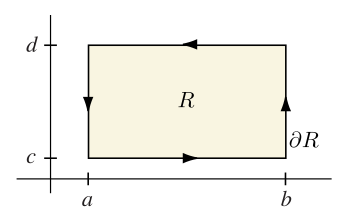
We write \(\partial R\) for the boundary of the rectangle \(R=[a,b]\times [c,d].\) Using the fundamental theorem of calculus in the second equality, we compute \[\tag{5.14} \begin{aligned} \int_R\left(\frac{\partial Q}{\partial u}-\frac{\partial P}{\partial v}\right)d\mu&=\int_c^d \left(\int_a^b\frac{\partial Q}{\partial u}\mathrm{d}u\right)\mathrm{d}v-\int_{a}^b\left(\int_c^d \frac{\partial P}{\partial v}\mathrm{d}v\right)\mathrm{d}u\\ &=\int_c^d \left(Q(b,v)-Q(a,v)\right)\mathrm{d}v-\int_a^b\left(P(u,d)-P(u,c)\right)\mathrm{d}u. \end{aligned}\] We next compute the contribution of the top and bottom part of the boundary integral. The curve \(c=(c^1,c^2) : [a,b] \to \mathbb{R}^2\) defined by the rule \(c(t)=(t,c)\) travels along the bottom of the rectangle from left to right. Here we have \(\frac{\mathrm{d}c^1}{\mathrm{d}t}(t)=1\) and \(\frac{\mathrm{d}c^2}{\mathrm{d}t}(t)=0\) for all \(t \in [a,b].\) From this we compute \[\int_a^b \left(\frac{\mathrm{d}c^1}{\mathrm{d}t}(t)P(c(t))+\frac{\mathrm{d}c^2}{\mathrm{d}t}(t)Q(c(t))\right)\mathrm{d}t=\int_a^b P(t,c)\mathrm{d}t=\int_a^bP(u,c)\mathrm{d}u\] which agrees with the last summand of (5.14). Considering instead the curve \(c=(c^1,c^2) : [a,b] \to \mathbb{R}^2\) defined by the rule \(c(t)=(a+b-t,d)\) which travels along the top of the rectangle from right to left, we have \(\frac{\mathrm{d}c^1}{\mathrm{d}t}(t)=-1\) and \(\frac{\mathrm{d}c^2}{\mathrm{d}t}(t)=0\) for all \(t \in [a,b].\) Hence we obtain \[\int_a^b\left(\frac{\mathrm{d}c^1}{\mathrm{d}t}(t)P(c(t))+\frac{\mathrm{d}c^2}{\mathrm{d}t}(t)Q(c(t))\right)\mathrm{d}t=-\int_a^bP(a+b-t,d)\mathrm{d}t.\] Applying the substitution \(u=a+b-t,\) the substitution rule gives \[-\int_a^bP(a+b-t,d)\mathrm{d}t=\int_b^a P(u,d)\mathrm{d}u=-\int_a^bP(u,d)\mathrm{d}u\] which agrees with the third summand of (5.14).
We can likewise argue for the left and right part of the boundary integral and obtain the first two summands which completes the proof of Green’s theorem for the case of a rectangle.