4.3 Curvature tensor and the Theorema Egregium
In the previous section we saw that the Christoffel symbols \(\Gamma^i_{jk} : U \to \mathbb{R},\) defined with respect to a local parametrisation \(F : U\to \mathbb{R}^3,\) encode the covariant derivative \(\nabla.\) It is natural to ask what object the functions \(R_{ijkl} : U \to \mathbb{R}\) encode. We first define:
Definition 4.23 • Commutator of two vector fields
The commutator of the two vector fields \(X,Y \in \mathfrak{X}(M)\) is the vector field \([X,Y] \in \mathfrak{X}(M)\) defined by \[\tag{4.12} [X,Y]=\nabla_XY-\nabla_YX.\]
Remark 4.24
The previous definition is a pedagogical simplification of the notion of the commutator of two vector fields. The commutator is usually defined in terms of the so-called flows of the vector fields. We refer to the literature for further details.
We let \(C^{\infty}(M)\) denote the smooth functions on a surface \(M,\) that is, \(f \in C^{\infty}(M)\) is a function \(f : M \to \mathbb{R}\) which is smooth. Using the commutator we now define:
Definition 4.25 • Curvature tensor
The map \(\mathcal{R} : \mathfrak{X}(M) \times \mathfrak{X}(M)\times \mathfrak{X}(M)\times \mathfrak{X}(M) \to C^{\infty}(M)\) defined by the rule \[\mathcal{R} : (X,Y,Z,W) \mapsto \langle \nabla_X(\nabla_Y Z)-\nabla_Y(\nabla_X Z)-\nabla_{[X,Y]}Z,W\rangle\] is called the curvature tensor of \(M\).
The curvature tensor satisfies:
Proposition 4.26
For a local parametrisation \(F : U \to M\) we have for all \(q \in U\) \[\mathcal{R}(B_i,B_j,B_k,B_r)(F(q))=R_{jikr}(q).\]
Proof. We first want to compute \(\nabla_{B_i}(\nabla_{B_j}B_k)(F(q))\) for all \(q \in U\) and all \(1\leqslant i,j,k\leqslant 2.\) From Proposition 4.16 we know that \((\nabla_{B_j}B_k)(F(q))=\Gamma^l_{jk}(q)B_l(F(q)).\) In order to compute \(\nabla_{B_i}(\nabla_{B_j}B_k)(F(q))\) we proceed as in the proof of Proposition 4.16 and choose a curve \(\gamma : (-\epsilon,\epsilon) \to M\) so that \(\gamma(0)=q\) and \(\dot{\gamma}(0)=B_i(F(q)).\) We then compute \[\frac{\mathrm{D}}{\mathrm{d}t}\Big(\left(\nabla_{B_j}B_{k}\right)\circ \gamma\Big)(0)\] by using (4.9). Recall that we can choose \(\gamma=F\circ c,\) where \(c : (-\epsilon,\epsilon) \to U\) is given by \(t \mapsto q+te_i\) for \(\epsilon\) sufficiently small. Write \(X=\left(\nabla_{B_j}B_{k}\right)\circ \gamma,\) then \((\nabla_{B_j}B_k)(F(q))=\Gamma^l_{jk}(q)B_l(F(q))\) implies that \[X^l(t)=\Gamma^l_{jk}(c(t))\] and hence \[\frac{\mathrm{d}X^l}{\mathrm{d}t}(0)=\partial_i\Gamma^l_{jk}(q).\] Writing (4.9) as \[\frac{\mathrm{D}X}{\mathrm{d}t}(t)=\left(\frac{\mathrm{d}X^l}{\mathrm{d}t}(t)+\Gamma^l_{rm}(c(t))X^m(t)\frac{\mathrm{d}c^r}{\mathrm{d}t}(t)\right)\Big(\partial_lF(c(t))\Big)_{\gamma(t)},\] we obtain \[\frac{\mathrm{D}X}{\mathrm{d}t}(0)=\left(\partial_i \Gamma^l_{jk}(q)+\Gamma^l_{rm}(q)\Gamma^m_{jk}(q)\delta^r_i\right)\Big(\partial_lF(q)\Big)_{F(q)}\] where we use that \(\frac{\mathrm{d}c^r}{\mathrm{d}t}(0)=\delta^r_i.\) In total, we get \[\tag{4.13} \nabla_{B_i}(\nabla_{B_j}B_k)(F(q))=\Big(\partial_i\Gamma^l_{jk}(q)+\Gamma^l_{im}(q)\Gamma^m_{jk}(q)\Big)B_l(F(q)).\] Since \(\Gamma^l_{jk}=\Gamma^l_{kj},\) it follows that \(\nabla_{B_j}B_k=\nabla_{B_k}B_j\) and hence (4.12) implies \([B_j,B_k]=0.\)
Using the definition of \(\mathcal{R}\) and (4.13) we thus obtain \[\begin{gathered} \mathcal{R}(B_i,B_j,B_k,B_r)(F(q))=\Big\langle \nabla_{B_i}(\nabla_{B_j}B_k)(F(q))-\nabla_{B_j}(\nabla_{B_i}B_k)(F(q)),B_r(F(q))\Big\rangle\\ =\left\langle \Big(\partial_i\Gamma^l_{jk}(q)+\Gamma^l_{im}(q)\Gamma^m_{jk}(q)-\partial_j\Gamma^l_{ik}(q)-\Gamma^l_{jm}(q)\Gamma^m_{ik}(q)\Big)B_l(F(q)),B_r(F(q))\right\rangle. \end{gathered}\] Since \(\langle B_l(F(q)),B_r(F(q))\rangle=g_{lr}(q),\) this becomes \[\begin{aligned} \mathcal{R}(B_i,B_j,B_k,B_r)(F(q))&=\Big(\partial_i\Gamma^l_{jk}(q)+\Gamma^l_{im}(q)\Gamma^m_{jk}(q)-\partial_j\Gamma^l_{ik}(q)-\Gamma^l_{jm}(q)\Gamma^m_{ik}(q)\Big)g_{lr}(q)\\ &=R_{jikr}(q), \end{aligned}\] where we use the definition (4.3) of the functions \(R_{jikr} : U \to \mathbb{R}.\)
Remark 4.27
Proposition 4.26 implies that the functions \(R_{ijkl}\) encode the curvature tensor with respect to a choice of a local parametrisation \(F : U \to M.\)
Notice that \(\mathcal{R}\) does depend on \(\nabla\) and the first fundamental form only, it is thus an object of the intrinsic geometry of a surface.
(\(\heartsuit\) – not examinable) Recall that second partial derivatives of a twice continuously differentiable function \(f : U \to \mathbb{R}\) commute, that is, we have \(\partial^2_{ij}f(q)=\partial^2_{ji}f(q)\) for all \(q \in U\) and all \(1\leqslant i,j\leqslant n.\) This is not true any more for second covariant derivatives. That is, in general we have \(\nabla_X(\nabla_YZ)\neq \nabla_Y(\nabla_X Z).\) The curvature tensor may be thought of as measuring the failure of second order covariant derivatives to commute. The additional term \(-\nabla_{[X,Y]}Z\) in the curvature tensor makes sure that \(\mathcal{R}\) is a multilinear map.
Finally, we have
Theorem 4.28 • Theorema Egregium
Let \(M\subset \mathbb{R}^3\) be a surface. The Gauss curvature of \(M\) does depend on the first fundamental form only and with respect to a choice of local parametrisation \(F : U \to M\) we have for all \(q \in U\) \[K(F(q))=\frac{R_{1212}(q)}{\det g(q)}.\]
Proof. From (3.15) and (4.7) we conclude that \[K(F(q))=\frac{\det A(q)}{\det g(q)}=\frac{A_{11}(q)A_{22}(q)-A_{12}(q)^2}{\det g(q)}=\frac{R_{1212}(q)}{\det g(q)}.\] We can thus express the Gauss curvature of \(M\) in terms of the curvature tensor and the first fundamental form only. Since the curvature tensor is built from \(\nabla\) and \(\nabla\) does depend on the first fundamental form only, the Gauss curvature does depend on the first fundamental form only.
Exercise 4.29
Show that the functions \(R_{ijkl}\) satisfy the following symmetries \[R_{ijkl}=-R_{jikl}=-R_{ijlk}=R_{klij}.\] Hint: Use the Gauss equations (4.4).
From the previous exercise we conclude that \[R_{11kl}(q)=R_{22kl}(q)=R_{ij11}(q)=R_{ij22}(q)=0\] for all \(q \in U\) and all \(1\leqslant i,j,k,l\leqslant 2.\) Theorem 4.28 implies \[R_{1212}(q)=-R_{2112}(q)=-R_{1221}(q)=R_{2121}(q)=K(F(q))\det g(q)\] We thus obtain the formula \[\boxed{R_{ijkl}=K\left(g_{ik}g_{jl}-g_{jk}g_{il}\right)}\] which holds for all \(1\leqslant i,j,k,l\leqslant 2\) and where we omit the base point \(q \in U.\)
For vector fields \(X,W_1,W_2 \in \mathfrak{X}(M)\) and functions \(f_1,f_2 \in C^{\infty}(M),\) we have from the bilinearity of \(\langle\cdot{,}\cdot\rangle_p\) for all \(p \in M\) that \[\langle X,f_1W_1+f_2W_2\rangle=f_1\langle X,W_1\rangle+f_2\langle X,W_2\rangle\] This implies that for all \(X,Y,Z,W_1,W_2 \in \mathfrak{X}(M)\) and \(f_1,f_2 \in C^{\infty}(M)\) we have \[\mathcal{R}(X,Y,Z,f_1W_1+f_2W_2)=f_1\mathcal{R}(X,Y,Z,W_1)+f_2\mathcal{R}(X,Y,Z,W_2)\]
Exercise 4.30
Show that for all \(Z_1,Z_2,W \in \mathfrak{X}(M)\) and all \(f_1,f_2 \in C^{\infty}(M)\) we have \[\mathcal{R}(B_1,B_2,f_1Z_1+f_2Z_2,W)=f_1\mathcal{R}(B_1,B_2,Z_1,W)+f_2\mathcal{R}(B_1,B_2,Z_2,W).\]
Remark 4.31
The statement from the previous exercise is still true if we replace \(B_1,B_2\) with arbitrary vector fields \(X,Y,\) we will however not need this fact.
4.4 Geodesic curvature
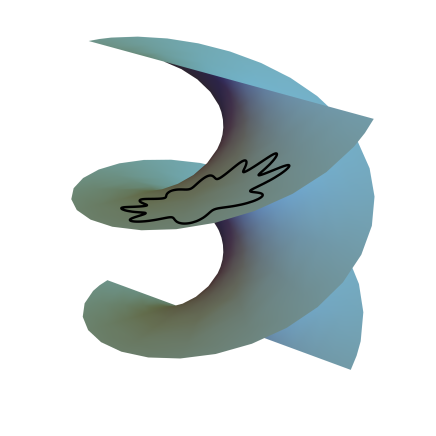
As in the case of a plane curve, a closed curve \(\gamma : [a,b] \to M\) in a surface \(M\) is called simple if the restriction of \(\gamma\) to the half-open interval \([a,b)\) is injective. Recall from Theorem 2.42 that a smooth unit speed curve in \(\mathbb{R}^2\) that is simple and closed has rotation index \(\pm 1\) – or equivalently – total (signed) curvature \(\pm 2\pi.\) It is natural to ask whether this is still true for simple closed curves on a surface \(M.\) In order to turn this into a sensible question we need a notion of curvature for a curve on a surface. This leads to the notion of geodesic curvature.
Let \(M\subset \mathbb{R}^3\) be a surface equipped with a unit normal field \(N : M \to TM^{\perp}.\) We define
Definition 4.32 • Geodesic curvature
Let \(\gamma : I \to M\) be a smooth unit speed curve. The geodesic curvature of \(\gamma\) is the function \[\kappa_g : I \to \mathbb{R}, \qquad t \mapsto \left\langle\frac{\mathrm{D}\dot{\gamma}}{\mathrm{d}t}(t),N(\gamma(t))\times \dot{\gamma}(t)\right\rangle.\]
The geodesic curvature for a curve in a surface \(M\) is indeed a natural replacement for the signed curvature of a plane unit speed curve:
Example 4.33 • Geodesic curvature of a plane curve
Let \(M=\{(x,y,0)\,|\, x,y \in \mathbb{R}\}\) and \(\gamma=(\gamma_1,\gamma_2,0) : I \to M\) be a unit speed curve, where \(\gamma_i : I \to \mathbb{R}\) are smooth functions for \(i=1,2.\) Taking \[N(p)=\begin{pmatrix} 0 \\ 0 \\ 1 \end{pmatrix}_p\] for all \(p \in M,\) we obtain \[N(\gamma(t))\times \dot{\gamma}(t)=\left(\begin{pmatrix} 0 \\ 0 \\ 1 \end{pmatrix} \times \begin{pmatrix} \gamma^{\prime}_1(t) \\ \gamma^{\prime}_2(t) \\ 0 \end{pmatrix}\right)_{\gamma(t)}=\begin{pmatrix} -\gamma_2^{\prime}(t) \\ \gamma^{\prime}_1(t) \\ 0 \end{pmatrix}_{\gamma(t)}\] and \[\frac{\mathrm{D}\dot{\gamma}}{\mathrm{d}t}(t)=\begin{pmatrix} \gamma_1^{\prime\prime}(t) \\ \gamma_2^{\prime\prime}(t) \\ 0 \end{pmatrix}\] so that \[\kappa_g(t)=-\gamma^{\prime\prime}_1(t)\gamma_2^{\prime}(t)+\gamma^{\prime\prime}_2(t)\gamma_1^{\prime}(t)\] which is the signed curvature of the unit speed curve \(\gamma=(\gamma_1,\gamma_2) : I \to \mathbb{R}^2\) (see (2.10)).
Exercise 4.34
Show that \(\gamma : I \to M\) is a geodesic if and only if \(\kappa_g(t)=0\) for all \(t \in I.\)
Remark 4.35
Let \(p \in M\) and \(\vec{v}_p \in T_pM.\) Having a unit normal field \(N,\) we define \[J(\vec{v}_p)=N(p)\times \vec{v}_p.\] The properties of the cross product imply that this defines a linear map \(J_p : T_pM \to T_pM\) which corresponds to “counter clockwise rotation by \(\pi/2\)”. In particular, \(J(\vec{v}_p)\) is orthogonal to \(\vec{v}_p\) and has the same length as \(\vec{v}_p.\) In terms of \(J_p,\) the formula for the geodesic curvature thus becomes \[\kappa_g(t)=\left\langle \frac{\mathrm{D}\dot{\gamma}}{\mathrm{d}t}(t),J_{\gamma(t)}(\dot{\gamma}(t))\right\rangle.\] Notice that this precisely corresponds to the signed curvature of a unit speed curve (2.7), where the acceleration \(\ddot{\gamma}\) is replaced with the covariant derivative \(\frac{\mathrm{D}\dot{\gamma}}{\mathrm{d}t}\) of the velocity vector \(\dot{\gamma}.\)
For what follows it is convenient to slightly simplify notation:
Remark 4.36 • Notation
For a vector field \(X\) on \(M\) we write \(JX\) for the vector field defined by \[JX(p):=J_p(X(p))\] for all \(p \in M.\) Likewise, for a vector field \(Y\) along a curve \(\gamma\) we write \(JY\) for the vector field along \(\gamma\) defined by the rule \[JY(t):=J_{\gamma(t)}(Y(t))\] for all \(t \in I.\)
For a curve \(\gamma : I \to M\) we write \(X_{\gamma}\) for the vector field along \(\gamma\) obtained by restricting \(X\) to \(\gamma(I),\) that is, \[X_{\gamma}(t):=X(\gamma(t))\] for all \(t \in I.\)
Having the notion of geodesic curvature we can ask: Given a simple closed smooth unit speed curve \(\gamma : [0,L] \to M\) of length \(L\) and denoting its geodesic curvature by \(\kappa_g : [0,L] \to \mathbb{R},\) is it still true that \[\int_{0}^L \kappa_g(t)\mathrm{d}t=\pm 2\pi?\]To answer this question we need the notion of integrating a function over a surface \(M.\)
Let \(f : M \to \mathbb{R}\) be a function and \(F : U \to M\) a local parametrisation of \(M.\) Suppose \(\Omega\subset U\) is a subset so that the function defined on \(\Omega\) by the rule \[h(q):=f(F(q))\sqrt{\det(g(q))}\] is measurable in the sense of Lebesgue. Then we define \[\tag{4.14} \int_{F(\Omega)} f\, dA:=\int_\Omega (f\circ F)\sqrt{\det(g)} d \mu,\] provided the right hand side is finite and where integration is carried out with respect to the Lebesgue measure.
The motivation for the factor \(\sqrt{\det g}\) is a follows: Recall that \(\{B_1(p),B_2(p)\}\) is a basis for all \(p \in F(U).\) Consequently, \(B_1(p)\times B_2(p)\) spans \(T_pM^{\perp}\) for all \(p \in F(U).\) Therefore we may take \[N(p)=\left(\frac{B_1(p)\times B_2(p)}{\Vert B_1(p)\times B_2(p)\Vert}\right)_{p}\] as a unit normal field on \(F(U)\subset M.\)
A direct calculation shows that the cross product of two column vectors \(\vec{v},\vec{w} \in M_{3,1}(\mathbb{R})\) satisfies \[\Vert \vec{v}\times \vec{w}\Vert^2=(\vec{v}\times \vec{w})\cdot (\vec{v}\times \vec{w})=(\vec{v}\cdot\vec{v})(\vec{w}\cdot\vec{w})-(\vec{v}\cdot\vec{w})^2.\] which implies that for all \(q \in U\) \[\begin{aligned} \Vert B_1(p)\times B_2(p)\Vert&=\sqrt{\langle B_1(p),B_1(p)\rangle\langle B_2(p),B_2(p)\rangle-\langle B_1(p),B_2(p)\rangle^2}\\ &=\sqrt{\left(\partial_1 F(q)\cdot \partial_1F(q)\right)\left(\partial_2 F(q)\cdot \partial_2F(q)\right)-\left(\partial_1 F(q)\cdot \partial_2F(q)\right)^2}\\ &=\sqrt{g_{11}(q)g_{22}(q)-g_{12}(q)^2}=\sqrt{\det(g(q))}, \end{aligned}\] where we write \(p=F(q).\)
Recall that the quantity \(\Vert \vec{v}\times \vec{w}\Vert\) equals the area of the parallelogram whose sides are given by the vectors \(\vec{v},\vec{w}.\) The factor \(\sqrt{\det(g(q))}\) thus gives the surface area of the parallelogram in \(T_{F(q)}M\) whose sides are given by \(B_1(F(q))\) and \(B_2(F(q)).\)
Example 4.37 • Surface area of the 2-sphere
Let \(M=S^2\) be the \(2\)-sphere of radius \(1\) and take \(f : S^2 \to \mathbb{R}\) to be the function assuming the value \(1\) everywhere. For the parametrisation \(F : U \to S^2\subset \mathbb{R}^3\) from Example 3.48 with \(U=(0,2\pi)\times (-\pi/2,\pi/2)\) we computed \[g(q)=\begin{pmatrix} \cos(v)^2 & 0 \\ 0 & 1 \end{pmatrix}.\] where \(q=(u,v).\) Since \(\cos(v)> 0\) for \(v \in (-\pi/2,\pi/2)\) we thus obtain \[\begin{aligned} \int_{F(U)}d A&=\int_U\cos(v)d \mu=\int_0^{2\pi}\left(\int_{-\pi/2}^{\pi/2}\cos(v)\mathrm{d}v\right)\mathrm{d}u\\ &=\int_0^{2\pi}\sin(v)\Big|^{\pi/2}_{-\pi/2}\mathrm{d}u=\int_{0}^{2\pi} 2 \mathrm{d}u=4\pi. \end{aligned}\]
If \(\tilde{U}\subset \mathbb{R}^2\) is an open set and \(\varphi : \tilde{U} \to U\) a diffeomorphism, then one obtains another parametrisation of \(M\) given by \(\tilde{F}:=F\circ \varphi : \tilde{U} \to M.\) Denoting by \(\tilde{\Omega}\) the subset of \(\tilde{U}\) so that \(\varphi(\tilde{\Omega})=\Omega,\) we have \[\tag{4.15} \int_{\tilde{\Omega}}(f\circ \tilde{F})\sqrt{\det(\tilde{g})}d \mu =\int_{\Omega}(f\circ F)\sqrt{\det(g)}d \mu,\] where \(\tilde{g} : \tilde{U} \to M_{2,2}(\mathbb{R})\) encodes the first fundamental form with respect to \(\tilde{F}.\) For a proof of (4.15) we refer to a book about measure theory. A consequence of (4.15) is that the definition (4.14) is independent of the parametrisation \(F : U \to M\) and we can thus define the integral of a smooth function \(f : M \to \mathbb{R}\) over (sufficiently nice) subsets \(D\subset M.\)