3 Surfaces
3.1 Embedded surfaces
In Linear Algebra I you saw the notion of the kernel of a linear map \(f : V \to W\) between vector spaces \(V,W.\) A related notion is that of a level set. Here, for geometric concreteness, we restrict ourselves to level sets in \(\mathbb{R}^3,\) but the notion makes sense in any dimension.
Definition 3.1
Let \(\mathcal{X}\subset \mathbb{R}^{3}\) be a set and \(f : \mathcal{X} \to \mathbb{R}\) a function. The level set of \(f\) with level \(c \in \mathbb{R}\) is the subset of \(\mathcal{X}\) given by \[f^{-1}\left(\{c\}\right)=\{p \in \mathcal{X} \,|\, f(p)=c\}.\]
Example 3.2 • 2-plane
Let \(f : \mathbb{R}^{3} \to \mathbb{R}\) be a linear function.
The kernel of \(f\) is the level set of \(f\) with level zero, that is, \(\operatorname{Ker}(f)=f^{-1}(\{0\}).\) If \(f\) has rank \(1,\) then \(f^{-1}(\{0\})\) has dimension \(2\) by the rank-nullity theorem and hence is a two-dimensional plane through the origin \(0_{\mathbb{R}^3}.\)
Let \(c\neq 0\) be different from zero. Then \(f^{-1}(\{c\})\) is an affine subspace whose associated vector space is \(f^{-1}\left(\{0\}\right)\) \[f^{-1}\left(\{c\}\right)=f^{-1}\left(\{0\}\right)+q=\left\{p+q\,|\, p \in \operatorname{Ker}(f)\right\},\] where \(q \in \mathbb{R}^3\) satisfies \(f(q)=c.\)
A \(2\)-plane is not a particularly interesting object from the point of view of geometry. However, we obtain more interesting surfaces once we consider level sets arising from non-linear functions.
Example 3.3 • 2-sphere
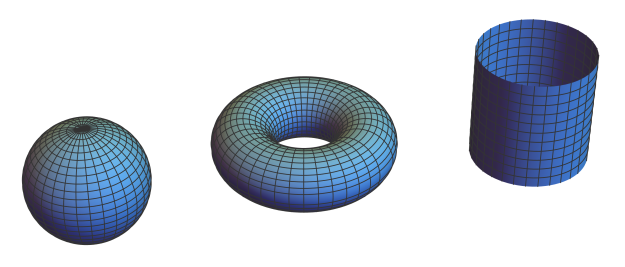
For \(p=(x,y,z)\) we consider \[f : \mathbb{R}^{3} \to \mathbb{R}, \qquad p \mapsto x^2+y^2+z^2.\] Then for all \(r>0\) the level set \(f^{-1}\left(\{r^2\}\right)\) of \(f\) with level \(r^2\) is the \(2\)-sphere of radius \(r\) centred at \(0_{\mathbb{R}^3}\). We will denote it by \(S^2(r)\) with the convention of writing \(S^2\) when \(r=1.\)
Example 3.4 • Torus
Let \(R>0\) and \(f : \mathbb{R}^3 \to \mathbb{R}\) be the function defined by the rule \[p=(x,y,z) \mapsto \left(R-\sqrt{x^2+y^2}\right)^2+z^2.\] Then for \(r < R\) we consider the level set \(f^{-1}\left(\{r^2\}\right)\) of \(f\) with level \(r^2.\) This level set is called a torus.
Example 3.5 • Cylinder
Consider the smooth function \[f : \mathbb{R}^3 \to \mathbb{R}, \qquad p=(x,y,z)\mapsto x^2+y^2\] Then for \(r>0\) the level set \(f^{-1}\left(\{r^2\}\right)\) of \(f\) with level \(r^2\) is an (infinite) cylinder of radius \(r\) and central axis \(\{(0,0,z)\,|\, z\in \mathbb{R}\}.\)
Example 3.6 • Paraboloid
For \(a,b \in \mathbb{R}^+\) and \(p=(x,y,z)\) consider \(f : \mathbb{R}^{3}\to \mathbb{R}\) defined by the rule \[p\mapsto \frac{x^2}{a^2}+\frac{y^2}{b^2}-z.\] The level set \(f^{-1}\left(\{0\}\right)\) of \(f\) with level zero is known as an elliptic paraboloid.
3.2 Tangent planes
For the \(2\)-sphere \(S^2(r)\subset \mathbb{R}^3\) we have an intuitive geometric understanding of what the tangent plane at \(p=(x,y,z) \in S^2(r)\) is, namely the subspace of \(T_p\mathbb{R}^3\) consisting of those vectors \(\vec{v}_p\) where \(\vec{v}\) is orthogonal to the line passing through the points \(p\) and \(0_{\mathbb{R}^3}.\) That is, \[T_{p}S^2(r)=\left\{\vec{v}_p \in T_p\mathbb{R}^3\,|\, v_1x+v_2y+v_3z=0\right\} \subset T_p\mathbb{R}^3,\] where \[\vec{v}_p=\begin{pmatrix} v_1 \\ v_2 \\ v_3 \end{pmatrix}_p\] It is natural to ask how we might define the tangent plane to a point \(p \in f^{-1}\left(\{c\}\right)\) for some level set defined by a function \(f : \mathcal{X} \to \mathbb{R}.\) The following example shows that \(f\) needs to satisfy certain conditions so that we obtain a geometrically natural definition of the tangent plane to a point.
Example 3.7 • Half-cone
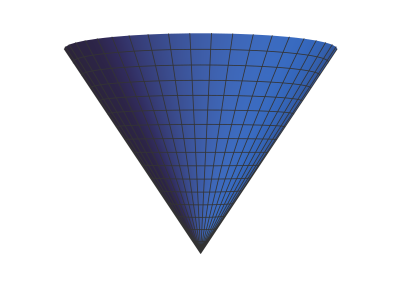
For \(c \in \mathbb{R}^+\) and \(p=(x,y,z)\) consider \(f : \mathbb{R}^{3}\to \mathbb{R}\) defined by the rule \[p\mapsto \frac{x^2}{c^2}+\frac{y^2}{c^2}-z^2.\] Let \(\mathcal{X}=\left\{p=(x,y,z) \in \mathbb{R}^3 \,|\, z\geqslant 0\right\}\) and consider the level set \(C=f^{-1}\left(\{0\}\right) \cap \mathcal{X}.\) Then \(C\) is a cone whose vertex (its tip) is \(0_{\mathbb{R}^3}.\) Clearly, we cannot define a tangent plane at the vertex of the cone in any geometrically natural way. Observe that \(f\) is smooth and \[\mathbf{J}f(p)=\begin{pmatrix} \frac{2x}{c^2} & \frac{2y}{c^2} & -2z \end{pmatrix}\] Therefore \[\operatorname{rank}(f_*|_{p})=\operatorname{rank}\left(\mathbf{J}f(p)\right)=\left\{\begin{array}{ll} 1, & p \neq 0_{\mathbb{R}^3},\\ 0, & p=0_{\mathbb{R}^3}.\end{array}\right.\] The rank of \(f_*|_{p}\) fails to be maximal (i.e. \(1\)) precisely at the vertex, where we cannot define the tangent plane.
This motivates the following definitions:
Definition 3.8 • Regular point and regular value
Let \(f : U \to \mathbb{R}\) be a smooth function on the open set \(U\subset \mathbb{R}^{3}.\)
A point \(p \in U\) is called a regular point of \(f\) if \(\operatorname{rank}(f_*|_{p})=\operatorname{rank}(\mathbf{J}f(p))=1.\)
A real number \(c \in \mathbb{R}\) is called a regular value or a regular level of \(f\) if every point of \(f^{-1}\left(\{c\}\right)\) is a regular point of \(f.\)
Recall that we write \(C^{\infty}(U,\mathbb{R})\) for the smooth functions on \(U.\)
Definition 3.9 • Smoothly embedded surface
Let \(f \in C^{\infty}(U,\mathbb{R})\) and \(c \in \mathbb{R}\) a regular value of \(f.\) Then we call \[M=f^{-1}\left(\{c\}\right)\subset \mathbb{R}^{3}\] a smoothly embedded surface in \(\mathbb{R}^{3}.\)
Remark 3.10
We call the surface embedded since it is a subset of the larger ambient space \(\mathbb{R}^{3}.\)
As we will see later on, we can also consider a notion of a space which does not rely on an ambient space \(\mathbb{R}^{3}.\) Thus, there is a notion of abstract space – usually called a manifold.
We will often drop the adverb smoothly and simply speak of an embedded surface and hence implicitly we always assume that the surface arises as a level set of a smooth function.
Example 3.11 • Example 3.3 continued
For the \(2\)-sphere we have \[\mathbf{J}f(p)=\begin{pmatrix} 2x && 2y && 2z \end{pmatrix}\] so that \(f_*|_{p}\) has rank \(1\) for all points \(p \neq 0_{\mathbb{R}^3}.\) Consequently, all \(r \in \mathbb{R}^+\) are regular values of \(f.\) Since \(f\) is smooth we conclude that \(S^2(r)\) is a smoothly embedded surface for all \(r \in \mathbb{R}^+.\) Observe that in this case we have \[\tag{3.1} T_{p}S^2(r)=\operatorname{Ker}\left(f_*|_{p}\right).\] for all \(p \in S^2(r).\)
We use (3.1) as a motivation for the following definition:
Definition 3.12 • Tangent space and tangent bundle
Let \(M=f^{-1}\left(\{c\}\right)\) be an embedded surface.
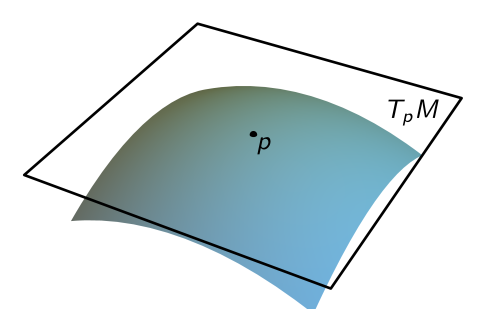
for all \(p \in M\) the tangent space of \(M\) at \(p\) is defined by \[T_{p}M=\operatorname{Ker}(f_*|_{p})\subset T_p\mathbb{R}^{3}.\] The elements of \(T_pM\) are said to be tangent to \(M\) at \(p\).
By definition, for all \(p \in M\) the tangent space \(T_{p}M\) is a subspace of \(T_p\mathbb{R}^{3}\) whose dimension is \[\dim T_pM=\dim T_p\mathbb{R}^{3}-\dim \operatorname{Im}(f_*|_{p})=3-\operatorname{rank}(f_*|_{p})=2,\] by the rank–nullity theorem from Linear Algebra.
The dimension of \(M\) is the dimension of any tangent space of \(M,\) that is, \(2.\)
The union of all tangent spaces is called the tangent bundle of \(M\) \[TM=\bigcup_{p \in M}\left\{\vec{v}_p \in T_p\mathbb{R}^{3}\,|\, \vec{v}_p \in \operatorname{Ker}(f_*|_{p})\right\}.\]
Example 3.13
Write \(p=(x,y,z)\) for a point in \(\mathbb{R}^{3}\) and consider the linear function \[f : \mathbb{R}^{3} \to \mathbb{R}, \qquad p \mapsto z.\] Then \(M=f^{-1}\left(\{0\}\right)\) is an embedded surface, the \(2\)-dimensional vector subspace \[M=\left\{p \in \mathbb{R}^{3}\,|\, z=0\right\}\subset \mathbb{R}^{3}\] which is isomorphic to \(\mathbb{R}^2.\) The tangent space to \(p \in M\) is \[T_pM=\left\{\vec{v}_p \in T_p\mathbb{R}^{3}\,|\, v_{3}=0\right\}.\] Simply forgetting about the third entry, we thus have a vector space isomorphism \[T_pM \simeq T_{\hat{p}}\mathbb{R}^2\] where \(\hat{p}\) arises from \(p\) by deleting the third entry. The notion of the tangent space of \(\mathbb{R}^2\) as defined in the first chapter is thus compatible with Definition 3.12 when we think of \(\mathbb{R}^2\) as the embedded surface of \(\mathbb{R}^{3}\) defined by \(z=0.\)
Example 3.14 • Graph of a function
Let \(U\subset \mathbb{R}^2\) be open and \(h : U \to \mathbb{R}\) a smooth function. Then the graph of \(h\) \[\mathcal{G}_h:=\left\{(q,h(q))\,|\, q \in U\right\}\] is an embedded surface in \(\mathbb{R}^{3}.\) Indeed, consider \(\mathcal{X}=U\times \mathbb{R}\subset \mathbb{R}^{3}\) and \[f : \mathcal{X} \to \mathbb{R}, \qquad p=(q,t) \mapsto h(q)-t.\] for \(q \in U\) and \(t \in \mathbb{R}.\) Then \[f^{-1}\left(\{0\}\right)=\left\{(q,h(q))\,|\, q \in U\right\}=\mathcal{G}_h\] and writing \(p=(q,t)\) with \(q=(u,v),\) we have \[\mathbf{J}f(p)=\begin{pmatrix} \frac{\partial h}{\partial u}(q) & \frac{\partial h}{\partial v}(q) & -1 \end{pmatrix}.\] Therefore, \(f_*|_{p}\) has rank \(1\) for all \(p=(q,t) \in U \times \mathbb{R}\) and \(M=f^{-1}\left(\{0\}\right)\) is an embedded surface. The tangent space at \((q,h(q))\) for \(q \in U\) is given by \[T_{(q,h(q))}M=\left\{\vec{v}_{(q,h(q))} \in T_{(q,h(q))}\mathbb{R}^{3} \ \Big|\, v_{3}=\frac{\partial h}{\partial u}(q)v_1+\frac{\partial h}{\partial v}(q)v_2\right\}.\]
Remark 3.15 • Gradient
Let \(M=f^{-1}\left(\{c\}\right)\) be an embedded surface. Recall that a subspace and its orthogonal complement are in direct sum. This implies that \(\dim (T_pM)^{\perp}=1\) for all \(p \in M\) and since \[0=f_*(\vec{v}_p)=\langle \operatorname{grad}f(p),\vec{v}_p\rangle 1_{f(p)}\] for all \(\vec{v}_p \in T_pM,\) it follows that \(\operatorname{grad}f(p)\) is a basis for \((T_pM)^{\perp}\) for all \(p \in M.\)
Definition 3.16 • Normal space and normal bundle
Let \(M=f^{-1}\left(\{c\}\right)\) be an embedded surface.
For all \(p \in M,\) the orthogonal complement of \(T_pM \subset T_p\mathbb{R}^{3}\) is called the normal space to \(M\) at \(p\) \[T_pM^{\perp}=\operatorname{span}\left\{\operatorname{grad}f(p)\right\}\subset T_p\mathbb{R}^{3}.\]
The union of all normal spaces is called the normal bundle of \(M\) \[TM^{\perp}=\bigcup_{p \in M}T_pM^{\perp}.\]
Remark 3.17 • Velocity vector of curves in a surface
Let \(M=f^{-1}\left(\{c\}\right)\subset \mathbb{R}^{3}\) be an embedded surface. Suppose \(\gamma : I \to \mathbb{R}^{3}\) is a smooth curve contained in \(M,\) that is, \(\gamma(t) \in M\) for all \(t \in I.\) Then \[\dot{\gamma}(t) \in T_{\gamma(t)}M.\] for all \(t \in I.\) Indeed, since \(\gamma(t) \in M\) for all \(t \in M,\) we have \(f(\gamma(t))=c\) for all \(t \in I.\) Computing the differential of \(f\circ \gamma : I \to M\) and using the chain-rule, we get \[0=(c)_*(1_t)=\left(f\circ \gamma\right)_*(1_t)=f_*(\gamma_*(1_t))=f_*(\dot{\gamma}(t))\] for all \(t \in I.\) This implies that \(\dot{\gamma}(t)\) is tangent to \(M\) at \(\gamma(t)\) for all \(t \in I.\)
3.3 Orientation
Definition 3.18 • Vector field and unit normal field
A vector field on \(M\) assigns to every point \(p \in M\) an element of the tangent space \(T_pM\) at \(p,\) that is, it is a map \[X : M \to TM\subset T\mathbb{R}^{3}\] so that \(X(p) \in T_pM\) for all \(p \in M.\)
A map \[N : M \to TM^{\perp}\subset T\mathbb{R}^{3}\] so that \(N(p) \in T_pM^{\perp}\) and so that \(\langle N(p),N(p)\rangle_{p}=1\) for all \(p \in M\) is called a unit normal field on \(M.\)
Writing a vector field or unit normal field on \(M\) as \[X: p \mapsto X(p)=\begin{pmatrix} a(p) \\ b(p) \\ c(p) \end{pmatrix}_p\] for functions \(a,b,c : M \to \mathbb{R},\) the vector field or unit normal field is called smooth if the functions \(a,b,c\) are smooth in the sense of Remark 1.4.
Example 3.19
Let \(M=f^{-1}\left(\{c\}\right)\) be an embedded surface. The map \[N : M \to TM^{\perp}, \qquad p \mapsto =\frac{\operatorname{grad}f(p)}{\Vert \operatorname{grad}f(p)\Vert}\] is a smooth unit normal field on \(M.\)
Definition 3.20 • Orientation
Let \(M=f^{-1}\left(\{c\}\right)\) be an embedded surface. A choice of smooth unit normal vector field \(N : M \to TM^{\perp}\) on \(M\) is called an orientation. An embedded surface equipped with a choice of orientation is called oriented.
3.4 Geodesics
Let \(M=f^{-1}\left(\{c\}\right)\) be an embedded surface.
Definition 3.21 • Geodesic
A smooth curve \(\gamma : I \to M\subset \mathbb{R}^{3}\) is called a geodesic in \(M\) if \[\ddot{\gamma}(t) \in T_{\gamma(t)}M^{\perp}\] for all \(t \in I.\) That is, the acceleration vector \(\ddot{\gamma}(t)\) is orthogonal to \(T_{\gamma(t)}M\) for all \(t\in I.\)
Example 3.22 • Straight lines – Example 3.13 continued
Think of \(\mathbb{R}^2\) as the embedded surface \(M\subset \mathbb{R}^{3}\) consisting of those points \(p=(x,y,z)\) for which \(z=0.\) A curve \(\gamma\) in \(M\) is of the form \[\gamma=(\gamma_1,\gamma_2,0)\] for smooth functions \(\gamma_1,\gamma_2 : I \to \mathbb{R}.\) Clearly \(\ddot{\gamma}(t) \in T_{\gamma(t)}M^{\perp}\) if and only if \(\ddot{\gamma}(t)=0_{\mathbb{R}^3}\) for all \(t \in I.\) Therefore, the geodesics in \(\mathbb{R}^2\) are segments of straight lines.
Example 3.23 • Helix on a cylinder
Consider the cylinder of radius \(r\) and central axis \(\{(0,0,z)\,|\,z\in \mathbb{R}\}\) \[M=\left\{(x,y,z) \in \mathbb{R}^3\,|\, x^2+y^2=r^2\right\}=f^{-1}\left(\{r^2\}\right),\] where \(f : \mathbb{R}^3\to \mathbb{R}\) is given by \(f(p)=x^2+y^2.\) For \(b \in \mathbb{R}\) consider the helix \[\gamma : \mathbb{R}\to M \subset \mathbb{R}^3, \qquad t \mapsto (r\cos(t),r\sin(t),bt).\] Then, writing \(p=(x,y,z)\) we have \[\operatorname{grad}f(p)=\begin{pmatrix} 2x \\ 2y \\ 0 \end{pmatrix}_{p}\] as well as \[\dot{\gamma}(t)=\begin{pmatrix} -r \sin(t) \\r\cos(t) \\ b \end{pmatrix}_{\gamma(t)}\quad \text{and}\quad \ddot{\gamma}(t)=-r\begin{pmatrix}\cos(t) \\ \sin(t) \\ 0 \end{pmatrix}_{\gamma(t)}=-\frac{1}{2} \operatorname{grad}f(\gamma(t)).\] Since \(\operatorname{grad}f(p)\) is a basis of \(T_pM^{\perp}\) for all \(p \in M,\) it follows that \(\ddot{\gamma}(t) \in T_{\gamma(t)}M^{\perp}\) for all \(t \in \mathbb{R},\) hence \(\gamma\) is a geodesic.
Example 3.24 • Great circle on a 2-sphere
The intersection of \(S^2(r)\) with a \(2\)-dimensional vector subspace \(U\subset \mathbb{R}^3\) is called a great circle. Let \(\{w_1,w_2\}\) be an orthonormal basis of \(U.\) Then \(U\cap S^2(r)\) is the image of the curve \[\gamma : \mathbb{R}\to S^2(r)\subset \mathbb{R}^3, \qquad t \mapsto r\cos(t)w_1+r\sin(t)w_2.\] Then \[\ddot{\gamma}(t)=-r\left(\cos(t)\vec{w}_1+\sin(t)\vec{w}_2\right)_{\gamma(t)}\] where here \(\vec{w}_i\) denotes the vector obtained by thinking of \(w_i\) as a column vector. Since \(S^2(r)=f^{-1}\left(\{r^2\}\right)\) for the function \(f : p=(x,y,z) \mapsto f(p)=x^2+y^2+z^2,\) we have \[\operatorname{grad}f(p)=\begin{pmatrix} 2x \\ 2y \\ 2z\end{pmatrix}_p=2\vec{p}_p\] where again \(\vec{p}\) denotes \(p,\) but thought of as a column vector. Consequently, we have \[\operatorname{grad}f(\gamma(t))=2r\left(\cos(t)\vec{w}_1+\sin(t)\vec{w}_2\right)_{\gamma(t)}=-2\ddot{\gamma}(t),\] which shows that \(\gamma\) is a geodesic in \(S^2(r).\)
Geodesics always have constant speed:
Proposition 3.25
Let \(\gamma : I \to M\) be a geodesic. Then \(\Vert\dot{\gamma}(t)\Vert\) is independent of \(t \in I.\)
Proof. For a geodesic \(\ddot{\gamma}(t)\) is always orthogonal to \(\dot{\gamma}(t)\) and hence \[\frac{\mathrm{d}}{\mathrm{d}t}\Vert \dot{\gamma}(t)\Vert^2=\frac{\mathrm{d}}{\mathrm{d}t}\langle \dot{\gamma}(t),\dot{\gamma}(t)\rangle=2\langle \dot{\gamma}(t),\ddot{\gamma}(t)\rangle=0.\]
One can show that geodesics are locally length minimising in the sense that if \(\gamma : I \to M\) is a geodesic and \(p,q \in \gamma(I)\) are points on the image of \(\gamma\) which are sufficiently close to each other, then the segment of the geodesic connecting \(p\) and \(q\) is the shortest curve in \(M\) which connects \(p\) and \(q.\)
Another interpretation of geodesics is in terms of the notion of a free particle. In classical mechanics, a free particle is a massive particle upon which no force acts. By Newton’s second law of motion, a free particle has vanishing acceleration. A geodesic in an embedded surface \(M\) describes the movement of a particle that is not free in Newton’s sense, but the force acting on it merely forces the particle to remain in \(M.\) The particle is free in tangential directions.