10.4 The orthogonal group
Recall that an isomorphism of vector spaces \(V\) and \(W\) is a bijective linear map \(f : V \to W.\) In the case where both \(V\) and \(W\) are equipped with an inner product, we may ask that \(f\) preserves the inner products in the following sense:
Definition 10.32 • Orthogonal transformation
Let \((V,\langle\cdot{,}\cdot\rangle)\) and \((W,\langle\!\langle\cdot{,}\cdot\rangle\!\rangle)\) be Euclidean spaces. An isomorphism \(f : V \to W\) is called an orthogonal transformation if \[\langle u,v\rangle=\langle\!\langle f(u),f(v)\rangle\!\rangle\] for all \(u,v \in V.\)
Definition 10.9 • Angle between two vectors ➔
) and the notion of distance between two vectors (Definition 10.7Let \((V,\langle\cdot{,}\cdot\rangle)\) be a Euclidean space and \(v_1,v_2 \in V\) two non-zero vectors. The angle between the vectors \(v_1\) and \(v_2\) is the unique real number \(\theta \in [0,\pi]\) such that \[\cos\theta=\frac{\langle v_1,v_2\rangle}{\Vert v_1\Vert \Vert v_2\Vert}.\]
Definition 10.7 • Euclidean space ➔
) only depends on the inner product \(\langle\cdot{,}\cdot\rangle.\) Orthogonal transformations thus preserve both angles between vectors and distances between vectors.
A pair \((V,\langle\cdot{,}\cdot\rangle)\) consisting of an \(\mathbb{R}\)-vector space \(V\) and an inner product \(\langle\cdot{,}\cdot\rangle\) on \(V\) is called a Euclidean space.
The mapping \(\Vert \cdot \Vert : V \to \mathbb{R}\) defined by the rule \[v\mapsto \Vert v \Vert=\sqrt{\langle v,v\rangle}\] for all \(v \in V\) is called the norm induced by \(\langle\cdot{,}\cdot\rangle\). Moreover, for any vector \(v \in V,\) the real number \(\Vert v \Vert\) is called the length of the vector \(v\).
The mapping \(d : V \times V \to \mathbb{R}\) defined by the rule \[(v_1,v_2) \mapsto d(v_1,v_2)=\Vert v_1-v_2\Vert\] for all \(v_1,v_2 \in V\) is called the metric induced by \(\langle\cdot{,}\cdot\rangle\) (or also metric induced by the norm \(\Vert\cdot\Vert\)). Furthermore, for any vectors \(v_1,v_2 \in V,\) the real number \(d(v_1,v_2)\) is called the distance from the vector \(v_1\) to the vector \(v_2\).
We can also consider the set of orthogonal transformations from a Euclidean space to itself:
Definition 10.33 • Orthogonal group & orthogonal matrices
Let \((V,\langle\cdot{,}\cdot\rangle)\) be a Euclidean space. The set of orthogonal transformations from \((V,\langle\cdot{,}\cdot\rangle)\) to itself is called the orthogonal group of \((V,\langle\cdot{,}\cdot\rangle)\) and denoted by \(\mathrm{O}(V,\langle\cdot{,}\cdot\rangle).\)
A matrix \(\mathbf{R}\in M_{n,n}(\mathbb{R})\) is called orthogonal if \(f_\mathbf{R}: \mathbb{R}^n \to \mathbb{R}^n\) is an orthogonal transformation of \((\mathbb{R}^n,\langle\cdot{,}\cdot\rangle),\) where \(\langle\cdot{,}\cdot\rangle\) denotes the standard scalar product of \(\mathbb{R}^n.\) The set of orthogonal \(n\times n\)-matrices is denoted by \(\mathrm{O}(n)\) and called the orthogonal group.
The use of the term group in the above definition is indeed justified:
Proposition 10.34 Let \((V,\langle\cdot{,}\cdot\rangle)\) be a Euclidean space. Then the set \(\mathrm{O}(V,\langle\cdot{,}\cdot\rangle)\) is a group in the sense of Definition 8.4
Definition 8.4 • Group ➔
when the group operation is taken to be the composition of mappings. In particular, \(\mathrm{O}(n)\) is a group when the group operation is taken to be matrix multiplication.A group is a pair \((G,*_G)\) consisting of a set \(G\) together with a binary operation \(*_G : G \times G \to G,\) called group operation, so that the following properties hold:
The group operation \(*_G\) is associative, that is, \[(a*_G b)*_G c=a*_G(b*_Gc)\quad \text{for all }a,b,c \in G.\]
There exists an element \(e_G \in G\) such that \[e_G *_G a=a=a*_G e_G \quad \text{for all } a \in G.\] The element \(e_G\) is unique (see below) and is called the identity element of \(G\).
For each \(a \in G\) there exists an element \(b \in G\) such that \[a*_Gb=e_G=b*_G a.\] The element \(b\) is unique (see below) and called the inverse of \(a\) and is commonly denoted by \(a^{-1}.\)
Proof. Let \(G=\mathrm{O}(V,\langle\cdot{,}\cdot\rangle).\) As the group identity element we take \(e_G=\mathrm{Id}_V,\) where \(\mathrm{Id}_V\) denotes the identity mapping on \(V,\) so that \(\mathrm{Id}(v)=v\) for all \(v \in V.\) Clearly \(\mathrm{Id}_V \in G\) and \(f\circ \mathrm{Id}_V=\mathrm{Id}_V\circ f=f\) for all \(f \in G.\) Likewise, if \(f \in G,\) then the inverse mapping \(f^{-1}\) is an element of \(G\) as well. Indeed, for all \(u,v \in V\) we obtain \[\begin{aligned} \langle u,v\rangle&=\langle \mathrm{Id}_V(u),\mathrm{Id}_V(v)\rangle=\langle (f\circ f^{-1})(u),(f\circ f^{-1})(v)\rangle=\langle f(f^{-1}(u)),f(f^{-1}(v))\rangle\\ &=\langle f^{-1}(u),f^{-1}(v)\rangle, \end{aligned}\] where we use that \(f \in G.\) Therefore, for all \(f \in G\) there exists a group element \(b,\) namely \(f^{-1}\) such that \(f\circ b=b\circ f=e_G=\mathrm{Id}_V.\) Since the composition of mappings is associative, it follows that \(\mathrm{O}(V,\langle\cdot{,}\cdot\rangle)\) is a group with respect to the composition of mappings.
Theorem 2.21 ➔
.Let \(\mathbf{A}\in M_{m,n}(\mathbb{K})\) and \(\mathbf{B}\in M_{n,{\tilde{m}}}(\mathbb{K})\) so that \(f_\mathbf{A}: \mathbb{K}^n \to \mathbb{K}^m\) and \(f_\mathbf{B}: \mathbb{K}^{{\tilde{m}}} \to \mathbb{K}^n\) and \(f_{\mathbf{A}\mathbf{B}} : \mathbb{K}^{{\tilde{m}}} \to \mathbb{K}^{m}.\) Then \(f_{\mathbf{A}\mathbf{B}}=f_\mathbf{A}\circ f_\mathbf{B}.\)
Lemma 10.35
For all \(n \in \mathbb{N}\) we have \[\mathrm{O}(n)=\left\{\mathbf{R}\in M_{n,n}(\mathbb{R}) | \mathbf{R}^T\mathbf{R}=\mathbf{1}_{n}\right\}=\left\{\mathbf{R}\in \mathrm{GL}(n,\mathbb{R}) | \mathbf{R}^T=\mathbf{R}^{-1}\right\}.\]
Proof. By definition, \(\mathbf{R}\in M_{n,n}(\mathbb{R})\) is an element of \(\mathrm{O}(n)\) if and only if \[\langle \vec{x},\vec{y}\rangle=\vec{x}^T\vec{y}=\langle \vec{x},\vec{y}\rangle_{\mathbf{1}_{n}}=\langle \mathbf{R}\vec{x},\mathbf{R}\vec{y}\rangle=(\mathbf{R}\vec{x})^T\mathbf{R}\vec{y}=\vec{x}^T\mathbf{R}^T\mathbf{R}\vec{y}=\langle\vec{x},\vec{y}\rangle_{\mathbf{R}^T\mathbf{R}}\] for all vectors \(\vec{x},\vec{y} \in \mathbb{R}^n.\) From the exercises we known that this condition is equivalent to \(\mathbf{R}^T\mathbf{R}=\mathbf{1}_{n},\) as claimed.
Proposition 5.21 • Product rule ➔
gives \[\det(\mathbf{R}^T\mathbf{R})=\det(\mathbf{R}^T)\det(\mathbf{R})=(\det(\mathbf{R}))^2=\det(\mathbf{1}_{n})=1,\] where we also use that \(\det(\mathbf{A}^T)=\det(\mathbf{A})\) for all \(\mathbf{A}\in M_{n,n}(\mathbb{R}).\) Since \(\det \mathbf{R}=\pm 1,\) the matrix \(\mathbf{R}\) is invertible and hence \(\mathbf{R}^T\mathbf{R}=\mathbf{1}_{n}\) implies that \(\mathbf{R}^T=\mathbf{R}^{-1}.\)For matrices \(\mathbf{A},\mathbf{B}\in M_{n,n}(\mathbb{K})\) we have \[\det(\mathbf{A}\mathbf{B})=\det(\mathbf{A})\det(\mathbf{B}).\]
The orthogonal transformations in a finite dimensional Euclidean space \((V,\langle\cdot{,}\cdot\rangle)\) can similarly be characterised in terms of their matrix representation with respect to an orthonormal basis:
Proposition 10.36
Let \(n \in \mathbb{N}\) and \((V,\langle\cdot{,}\cdot\rangle)\) be an \(n\)-dimensional Euclidean space equipped with an orthonormal ordered basis \(\mathbf{b}.\) Then an endomorphism \(f : V \to V\) is an orthogonal transformation if and only if its matrix representation \(\mathbf{R}=\mathbf{M}(f,\mathbf{b},\mathbf{b})\) with respect to \(\mathbf{b}\) is an orthogonal matrix.
Proposition 9.6 ➔
and Proposition 3.98Let \(V\) be a finite dimensional \(\mathbb{K}\)-vector space, \(\mathbf{b}=(v_1,\ldots,v_n)\) an ordered basis of \(V\) with associated linear coordinate system \(\boldsymbol{\beta}: V \to \mathbb{K}^n\) and \(\langle\cdot{,}\cdot\rangle\) a bilinear form on \(V.\) Then
for all \(w_1,w_2 \in V\) we have \[\langle w_1,w_2\rangle=(\boldsymbol{\beta}(w_1))^T\mathbf{M}(\langle\cdot{,}\cdot\rangle,\mathbf{b})\boldsymbol{\beta}(w_2).\]
\(\langle\cdot{,}\cdot\rangle\) is symmetric if and only if \(\mathbf{M}(\langle\cdot{,}\cdot\rangle,\mathbf{b})\) is symmetric;
if \(\mathbf{b}^{\prime}\) is another ordered basis of \(V,\) then \[\mathbf{M}(\langle\cdot{,}\cdot\rangle,\mathbf{b}^{\prime})=\mathbf{C}^T\mathbf{M}(\langle\cdot{,}\cdot\rangle,\mathbf{b})\mathbf{C},\] where \(\mathbf{C}=\mathbf{C}(\mathbf{b}^{\prime},\mathbf{b})\) denotes the change of basis matrix, see Definition 3.104.
Proposition 3.98 ➔
. Since every vector \(\vec{x} \in \mathbb{R}^n\) can be written as \(\vec{x}=\boldsymbol{\beta}(u)\) for some vector \(u \in V,\) the claim follows as in the proof of Lemma 10.35Let \(V,W\) be finite dimensional \(\mathbb{K}\)-vector spaces, \(\mathbf{b}\) an ordered basis of \(V\) with corresponding linear coordinate system \(\boldsymbol{\beta},\) \(\mathbf{c}\) an ordered basis of \(W\) with corresponding linear coordinate system \(\boldsymbol{\gamma}\) and \(g : V \to W\) a linear map. Then for all \(v \in V\) we have \[\boldsymbol{\gamma}(g(v))=\mathbf{M}(g,\mathbf{b},\mathbf{c})\boldsymbol{\beta}(v).\]
Lemma 10.35 ➔
.For all \(n \in \mathbb{N}\) we have \[\mathrm{O}(n)=\left\{\mathbf{R}\in M_{n,n}(\mathbb{R}) | \mathbf{R}^T\mathbf{R}=\mathbf{1}_{n}\right\}=\left\{\mathbf{R}\in \mathrm{GL}(n,\mathbb{R}) | \mathbf{R}^T=\mathbf{R}^{-1}\right\}.\]
Corollary 10.37
Let \(n \in \mathbb{N}\) and \((V,\langle\cdot{,}\cdot\rangle)\) be an \(n\)-dimensional Euclidean space equipped with an orthonormal ordered basis \(\mathbf{b}.\) Then an ordered basis \(\mathbf{b}^{\prime}\) of \(V\) is orthonormal with respect to \(\langle\cdot{,}\cdot\rangle\) if and only if the change of basis matrix \(\mathbf{C}(\mathbf{b}^{\prime},\mathbf{b})\) is orthogonal.
Proposition 10.36 ➔
it is sufficient to show that \(g\) is orthogonal if and only if \(\mathbf{b}^{\prime}\) is orthonormal. By definition, \(g\) satisfies \(g(v_i)=v^{\prime}_i\) for all \(1\leqslant i\leqslant n.\) Suppose the endomorphism \(g\) is orthogonal, then \[\langle v^{\prime}_i,v^{\prime}_j\rangle=\langle g(v_i),g(v_j)\rangle=\langle v_i,v_j\rangle=\delta_{ij},\] where the last equality uses that \(\mathbf{b}\) is orthonormal. We conclude that \(\mathbf{b}^{\prime}\) is orthonormal as well. Conversely, suppose that \(\mathbf{b}^{\prime}\) is orthonormal. Let \(u,v \in V\) and write \(u=\sum_{i=1}^ns_i v_i\) and \(v=\sum_{j=1}^n t_j v_j\) for scalars \(s_i,t_i,\) \(i=1,\ldots,n.\) Then, using the bilinearity of \(\langle\cdot{,}\cdot\rangle,\) we compute \[\begin{aligned}
\langle g(u),g(v)\rangle&=\Big\langle g\Big(\sum_{i=1}^ns_i v_i\Big),g\Big(\sum_{j=1}^n t_j v_j\Big)\Big\rangle=\sum_{i=1}^n\sum_{j=1}^ns_it_j\langle g(v_i),g(v_j)\rangle\\
&=\sum_{i=1}^n\sum_{j=1}^ns_it_j\langle v^{\prime}_i,v^{\prime}_j\rangle=\sum_{i=1}^n\sum_{j=1}^ns_it_j\delta_{ij}=\sum_{i=1}^n\sum_{j=1}^ns_it_j\langle v_i,v_j\rangle\\
&=\Big\langle \sum_{i=1}^ns_i v_i,\sum_{j=1}^nt_j v_j\Big\rangle=\langle u,v\rangle,
\end{aligned}\] so that \(g\) is orthogonal.Let \(n \in \mathbb{N}\) and \((V,\langle\cdot{,}\cdot\rangle)\) be an \(n\)-dimensional Euclidean space equipped with an orthonormal ordered basis \(\mathbf{b}.\) Then an endomorphism \(f : V \to V\) is an orthogonal transformation if and only if its matrix representation \(\mathbf{R}=\mathbf{M}(f,\mathbf{b},\mathbf{b})\) with respect to \(\mathbf{b}\) is an orthogonal matrix.
Example 10.38
A matrix \(\mathbf{A}\in M_{n,n}(\mathbb{R})\) is orthogonal if and only if its column vectors form an orthonormal basis of \(\mathbb{R}^n\) with respect to the standard scalar product \(\langle\cdot{,}\cdot\rangle.\) To this end let \(\hat{\Omega} : (\mathbb{R}^n)^n \to M_{n,n}(\mathbb{K})\) denote the map which forms an \(n\times n\) matrix from \(n\) column vectors of length \(n.\) That is, \(\hat{\Omega}\) satisfies \[[\hat{\Omega}(\vec{a}_1,\ldots,\vec{a}_n)]_{ij}=[\vec{a}_j]_{i}\] for all \(1\leqslant i,j\leqslant n\) and where \([\vec{a}_j]_{i}\) denotes the \(i\)-th entry of the vector \(\vec{a}_j.\) Then, by the definition of matrix multiplication, we have for all \(1\leqslant i,j\leqslant n\) \[\begin{aligned} [\hat{\Omega}(\vec{a}_1,\ldots,\vec{a}_n)^T\hat{\Omega}(\vec{a}_1,\ldots,\vec{a}_n)]_{ij}&=\sum_{k=1}^n[\hat{\Omega}(\vec{a}_1\ldots,\vec{a}_n)^T]_{ik}[\hat{\Omega}(\vec{a}_1\ldots,\vec{a}_n)]_{kj}\\ &=\sum_{k=1}^n[\hat{\Omega}(\vec{a}_1\ldots,\vec{a}_n)]_{ki}[\hat{\Omega}(\vec{a}_1\ldots,\vec{a}_n)]_{kj}\\ &=\sum_{k=1}^n [\vec{a}_i]_k[\vec{a}_j]_k=\langle\vec{a}_i,\vec{a}_j\rangle_{\mathbf{1}_{n}}=\delta_{ij}, \end{aligned}\] as claimed.
The reader is invited to check that a corresponding statement also holds for the rows of an orthogonal matrix.
Example 10.39 • Permutation matrices
Let \(n \in \mathbb{N}\) and \(\sigma \in S_n\) be a permutation. Recall that for \(1\leqslant i\leqslant n,\) the \(i\)-th column of the permutation matrix \(\mathbf{P}_{\sigma}\) of \(\sigma\) is given by \(\vec{e}_{\sigma(i)},\) where \(\mathbf{e}=(\vec{e}_1,\ldots,\vec{e}_n)\) denotes the standard ordered basis of \(\mathbb{R}^n.\) Therefore, the columns of a permutation matrix form an ordered orthonormal basis of \(\mathbb{R}^n\) and hence permutation matrices are orthogonal by the previous remark.
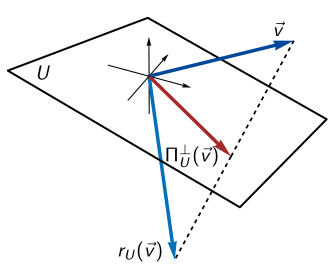
Example 10.40 • Reflection along a hyperplaneWe can reflect a vector orthogonally along a plane in \(\mathbb{E}^3,\) see Figure 10.5. This map generalises to hyperplanes as follows: Let \((V,\langle\cdot{,}\cdot\rangle)\) be a finite dimensional Euclidean space and \(U\subset V\) a hyperplane. Then the orthogonal reflection along \(U\) is the map \(r_U : V \to V\) defined by the rule \[r_U(v)=v-2(v-\Pi^{\perp}_U(v))=2\Pi^{\perp}_U(v)-v\] for all \(v \in V.\) This mapping is indeed an orthogonal transformation. To see this consider an orthonormal basis \(\{u_1,\ldots,u_{n-1}\}\) of \(U.\) By Corollary 10.23
A plane in \(\mathbb{R}^3\) is a subspace \(U\) of dimension \(2=3-1.\) More generally, a hyperplane in an \(n\)-dimensional vector space \(V\) is a subspace \(U\) of dimension \(n-1.\)
Corollary 10.23 ➔
we can extend this to an orthonormal basis \(\{u_1,\ldots,u_{n-1},u_{n}\}\) of \(V.\) Notice that \(\dim U^{\perp}=1\) and that \(U^{\perp}=\operatorname{span}\{u_n\}.\) For \(v \in V\) we write \(v=\sum_{i=1}^n s_iu_i\) for unique real numbers \(s_i,\) \(1\leqslant i\leqslant n.\) Then we obtain \[\begin{aligned}
r_U(v)+v&=2\Pi^{\perp}_{U}\left(\sum_{i=1}^n s_i u_i\right)=2\sum_{j=1}^{n-1}\Big\langle u_j,\sum_{i=1}^n s_i u_i\Big\rangle u_j\\
&=2\sum_{i=1}^{n}\left(\sum_{j=1}^{n}s_i\langle u_j,u_i\rangle u_j-s_i\langle u_{n},u_i\rangle u_n\right)\\
&=2\sum_{i=1}^ns_iu_i-2\Big\langle u_n,\sum_{i=1}^n s_i u_i\Big\rangle u_n=2v-2\langle u_n,v\rangle u_n,
\end{aligned}\] where we use (10.2). Writing \(u_n=e,\) we conclude that for the orthogonal reflection along a hyperplane \(U\subset V\) we have the formula \[r_U(v)=v-2\langle e,v\rangle e,\] where the vector \(e \in V\) satisfies \(\langle e,e\rangle=1\) and \(U^{\perp}=\operatorname{span}\{e\}.\)Let \((V,\langle\cdot{,}\cdot\rangle)\) be a finite dimensional Euclidean space and \(U\subset V\) a subspace. Suppose \(\mathbf{b}\) is an ordered orthonormal basis of \(U,\) then there exists an ordered orthonormal basis of \(V\) which contains \(\mathbf{b}.\)
We can now verify that \(r_U\) is an orthogonal transformation. For all vectors \(u,v \in V\) we have \[\begin{aligned} \langle r_U(u),r_U(v)\rangle&=\langle u-2\langle e,u\rangle e,\langle v-2\langle e,v\rangle e\rangle\\ &=\langle u,v\rangle-2\langle u,e\rangle\langle e,v\rangle-2\langle e,u\rangle \langle e,v\rangle+4\langle e,u\rangle\langle e,v\rangle \langle e,e\rangle\\ &=\langle u,v\rangle, \end{aligned}\] where we use that \(\langle\cdot{,}\cdot\rangle\) is bilinear, symmetric and that \(\langle e,e\rangle=1.\) We conclude that \(r_U\) is an orthogonal transformation.
Finally, observe that with respect to the ordered basis \(\mathbf{b}=(u_1,\ldots,u_{n-1},u_n)\) of \(V\) we have \[\mathbf{M}(r_U,\mathbf{b},\mathbf{b})=\begin{pmatrix} \mathbf{1}_{n-1} & \\ & -1 \end{pmatrix}.\] Indeed, since \(u_{i} \in U\) for all \(1\leqslant i\leqslant n-1,\) we obtain \(r_U(u_i)=2\Pi^{\perp}_U(u_i)-u_i=2u_i-u_i=u_i.\) Furthermore, \(r_U(u_n)=u_n-2\langle u_n,u_n\rangle u_n=-u_n,\) as claimed. We conclude that \(\det r_U=-1.\)
Definition 10.41 • Special orthogonal group & special orthogonal matrices
Let \((V,\langle\cdot{,}\cdot\rangle)\) be a Euclidean space. The subset of \(\mathrm{O}(V,\langle\cdot{,}\cdot\rangle)\) consisting of endomorphisms whose determinant is \(1\) is called the special orthogonal group of \((V,\langle\cdot{,}\cdot\rangle)\) and is denoted by \(\mathrm{SO}(V,\langle\cdot{,}\cdot\rangle).\)
A matrix \(\mathbf{R}\in M_{n,n}(\mathbb{R})\) is called special orthogonal if \(\mathbf{R}\in \mathrm{O}(n)\) and \(\det \mathbf{R}=1.\) The set of special orthogonal \(n\times n\)-matrices is denoted by \(\mathrm{SO}(n)\) and called the special orthogonal group.
Example 10.42
(The group \(\mathrm{O}(2)\)). Recall from the exercises that if a matrix \(\mathbf{R}\in M_{2,2}(\mathbb{R})\) satisfies \(\mathbf{R}^T\mathbf{R}=\mathbf{1}_{2},\) then it is either of the form \[\begin{pmatrix} a & -b \\ b & a \end{pmatrix} \qquad \text{or} \qquad \begin{pmatrix} a & b \\ b & -a \end{pmatrix}\] for some real numbers \(a,b.\) The condition \(\mathbf{R}^T\mathbf{R}=\mathbf{1}_{2}\) implies that \(a^2+b^2=1,\) hence we can write \(a=\cos \alpha\) and \(b=\sin\alpha\) for some \(\alpha \in \mathbb{R}.\) In the second case we have \(\det \mathbf{R}=-a^2-b^2=-1,\) thus \[\mathrm{SO}(2)=\left\{\mathbf{R}_{\alpha}=\begin{pmatrix} \cos \alpha & -\sin \alpha \\ \sin \alpha & \cos \alpha \end{pmatrix} | \alpha \in \mathbb{R}\right\}.\] Recall also that the mapping \(f_{\mathbf{R}_{\alpha}} : \mathbb{R}^2 \to \mathbb{R}^2\) is the counter-clockwise rotation around \(0_{\mathbb{R}^2}\) by the angle \(\alpha.\) In the second case we obtain \[\begin{pmatrix} \cos \alpha & \sin \alpha \\ \sin\alpha & -\cos\alpha\end{pmatrix}=\begin{pmatrix} \cos \alpha & -\sin \alpha \\ \sin \alpha & \cos \alpha \end{pmatrix}\begin{pmatrix} 1 & 0 \\ 0 & -1 \end{pmatrix}.\] The matrix \[\begin{pmatrix} 1 & 0 \\ 0 & -1 \end{pmatrix}\] is the matrix representation of the orthogonal reflection along the \(x\)-axis in \(\mathbb{E}^2\) with respect to the standard ordered basis \(\mathbf{e}\) of \(\mathbb{R}^2.\) We thus obtain a complete picture of all orthogonal transformations of \(\mathbb{E}^2.\) An orthogonal transformation of \(\mathbb{E}^2\) is either a special orthogonal transformation in which case it is a rotation around \(0_{\mathbb{R}^2}\) or else a composition of the orthogonal reflection along the \(x\)-axis and a rotation around \(0_{\mathbb{R}^2}.\)
We will discuss the structure of \(\mathrm{O}(n)\) for \(n>2\) below.
10.5 The adjoint mapping
In this section we discuss what one might consider to be the nicest endomorphisms of a Euclidean space \((V,\langle\cdot{,}\cdot\rangle),\) the so-called self-adjoint endomorphisms. Such endomorphisms are not only diagonalisable, but the basis of eigenvectors can be chosen to consist of orthonormal vectors with respect to \(\langle\cdot{,}\cdot\rangle.\)
Lemma 10.43
Let \((V,\langle\cdot{,}\cdot\rangle)\) and \((W,\langle\!\langle\cdot{,}\cdot\rangle\!\rangle)\) be finite dimensional Euclidean spaces and \(\mathbf{b}=(v_1,\ldots,v_n)\) an orthonormal basis of \((V,\langle\cdot{,}\cdot\rangle)\) and \(\mathbf{c}=(w_1,\ldots,w_m)\) an orthonormal basis of \((W,\langle\!\langle\cdot{,}\cdot\rangle\!\rangle).\) Then the matrix representation of a linear map \(f : V \to W\) satisfies \[[\mathbf{M}(f,\mathbf{b},\mathbf{c})]_{ij}=\langle\!\langle f(v_j),w_i\rangle\!\rangle\] for all \(1\leqslant i \leqslant m\) and for all \(1\leqslant j \leqslant n.\)
Proof. By definition, we have for all \(1\leqslant j \leqslant n\) \[f(v_j)=\sum_{k=1}^m\, [\mathbf{M}(f,\mathbf{b},\mathbf{c})]_{kj}w_{k}.\] Hence for all \(1\leqslant i\leqslant m,\) we obtain \[\begin{aligned} \langle\!\langle f(v_j),w_i\rangle\!\rangle&=\Big\langle\!\!\Big\langle \sum_{k=1}^m\, [\mathbf{M}(f,\mathbf{b},\mathbf{c})]_{kj}w_{k},w_i\Big\rangle\!\!\Big\rangle=\sum_{k=1}^m\, [\mathbf{M}(f,\mathbf{b},\mathbf{c})]_{kj}\,\langle\!\langle w_k,w_i\rangle\!\rangle\\ &=\sum_{k=1}^m [\mathbf{M}(f,\mathbf{b},\mathbf{c})]_{kj}\delta_{ki}=[\mathbf{M}(f,\mathbf{b},\mathbf{c})]_{ij}, \end{aligned}\] as claimed.
Proposition 10.44
Let \((V,\langle\cdot{,}\cdot\rangle)\) and \((W,\langle\!\langle\cdot{,}\cdot\rangle\!\rangle)\) be finite dimensional Euclidean spaces and \(f : V \to W\) a linear map. Then there exists a unique linear map \(f^* : W \to V\) such that \[\langle\!\langle f(v),w\rangle\!\rangle=\langle v,f^*(w)\rangle\] for all \(v \in V\) and \(w \in W.\)
Proof. Let \(\mathbf{b}=(v_1,\ldots,v_n)\) be an orthonormal basis of \((V,\langle\cdot{,}\cdot\rangle)\) and \(\mathbf{c}=(w_1,\ldots,w_m)\) be an orthonormal basis of \((W,\langle\!\langle\cdot{,}\cdot\rangle\!\rangle).\) Let \(f^* : W \to V\) be the unique linear map such that \[\mathbf{M}(f^*,\mathbf{c},\mathbf{b})=\mathbf{M}(f,\mathbf{b},\mathbf{c})^T.\] Since \(\langle\cdot{,}\cdot\rangle\) and \(\langle\!\langle\cdot{,}\cdot\rangle\!\rangle\) are both bilinear it suffices to show that \[\langle\!\langle f(v_j),w_i\rangle\!\rangle=\langle v_j,f^*(w_i)\rangle\] for all \(1\leqslant j\leqslant n\) and all \(1\leqslant i\leqslant m.\) By the previous lemma we have for all \(1\leqslant j\leqslant n\) and all \(1\leqslant i\leqslant m\) \[\langle\!\langle f(v_j),w_i\rangle\!\rangle=[\mathbf{M}(f,\mathbf{b},\mathbf{c})]_{ij}=[\mathbf{M}(f^*,\mathbf{c},\mathbf{b})]_{ji}=\langle f^*(w_i),v_j\rangle=\langle v_j,f^*(w_i)\rangle.\] This shows that \(f^* : W \to V\) exists. Let \(g : W\to V\) be another linear map such that \[\langle\!\langle f(v),w\rangle\!\rangle=\langle v,g(w)\rangle\] for all \(v \in V\) and \(w \in W.\) Then we have for all \(v\in V\) and \(w \in W\) \[\begin{aligned} \langle v,f^*(w)-g(w)\rangle=\langle v,f^*(w)\rangle-\langle v,g(w)\rangle =\langle\!\langle f(v),w\rangle\!\rangle-\langle\!\langle f(v),w\rangle\!\rangle=0. \end{aligned}\] This shows that for all \(w \in W\) the vector \(f^*(w)-g(w) \in V\) is orthogonal to all vectors of \(V.\) Since \(\langle\cdot{,}\cdot\rangle\) is non-degenerate this implies that \(f^*(w)-g(w)=0_V,\) that is, \(f^*(w)=g(w)\) for all \(w \in W\) and hence \(f^*=g.\)
Linear maps for which \(f=f^*\) are of particular importance:
Definition 10.45 • Adjoint mapping, self-adjoint mappings and normal mappings
Let \((V,\langle\cdot{,}\cdot\rangle)\) and \((W,\langle\!\langle\cdot{,}\cdot\rangle\!\rangle)\) be finite dimensional Euclidean spaces and \(f : V \to W\) a linear map. The unique mapping \(f^* : W \to V\) guaranteed to exist by Proposition 10.44 Proposition 10.44 ➔is called the adjoint mapping of \(f.\)Let \((V,\langle\cdot{,}\cdot\rangle)\) and \((W,\langle\!\langle\cdot{,}\cdot\rangle\!\rangle)\) be finite dimensional Euclidean spaces and \(f : V \to W\) a linear map. Then there exists a unique linear map \(f^* : W \to V\) such that \[\langle\!\langle f(v),w\rangle\!\rangle=\langle v,f^*(w)\rangle\] for all \(v \in V\) and \(w \in W.\)
An endomorphism \(f : V\to V\) of a Euclidean space \((V,\langle\cdot{,}\cdot\rangle)\) is called self-adjoint if \(f=f^*\) and normal if \(f\circ f^*=f^*\circ f.\)
Example 10.46
The proof of Proposition 10.44 Proposition 10.44 ➔implies that an endomorphism \(f : V \to V\) of a finite dimensional Euclidean space \((V,\langle\cdot{,}\cdot\rangle)\) is self-adjoint if and only if its matrix representation with respect to an orthonormal basis \(\mathbf{b}\) of \(V\) is symmetric. In particular, in \(\mathbb{R}^n\) equipped with the standard scalar product, a mapping \(f_\mathbf{A}: \mathbb{R}^n \to \mathbb{R}^n\) for \(\mathbf{A}\in M_{n,n}(\mathbb{R})\) is self-adjoint if and only if \(\mathbf{A}\) is symmetric.Let \((V,\langle\cdot{,}\cdot\rangle)\) and \((W,\langle\!\langle\cdot{,}\cdot\rangle\!\rangle)\) be finite dimensional Euclidean spaces and \(f : V \to W\) a linear map. Then there exists a unique linear map \(f^* : W \to V\) such that \[\langle\!\langle f(v),w\rangle\!\rangle=\langle v,f^*(w)\rangle\] for all \(v \in V\) and \(w \in W.\)
Let \((V,\langle\cdot{,}\cdot\rangle)\) be a finite dimensional Euclidean space and \(f : V \to V\) an orthogonal transformation. Then \(f\) is normal. Indeed, using that \(f\) is orthogonal, we obtain for all \(u,v \in V\) \[\langle f^{-1}(u),v\rangle=\langle f(f^{-1}(u)),f(v)\rangle=\langle u,f(v)\rangle\] so that the adjoint mapping of an orthogonal transformation is its inverse mapping, \(f^*=f^{-1}.\) It follows that \(f\circ f^{*}=f\circ f^{-1}=\mathrm{Id}_V=f^{-1}\circ f=f^*\circ f\) so that \(f\) is normal.
Exercises
Exercise 10.47 Verify that \(\mathrm{SO}(V,\langle\cdot{,}\cdot\rangle)\) is a subgroup of \(\mathrm{O}(V,\langle\cdot{,}\cdot\rangle)\) in the sense of Definition 8.8
According to Definition 8.8
Definition 8.8 • Subgroup ➔
. In particular, \(\mathrm{SO}(V,\langle\cdot{,}\cdot\rangle)\) is indeed a group and hence so is \(\mathrm{SO}(n).\)A non-empty subset \(H\) of a group \(G\) is called a subgroup if for all \(a,b \in H,\) we have \(a*_G b \in H\) and for all \(a\in H,\) we have \(a^{-1} \in H.\)
Solution
Definition 8.8 • Subgroup ➔
, we need to show that for all \(f,g\in \mathrm{SO}(V,\langle\cdot{,}\cdot\rangle)\) we have \(f\circ g\in\mathrm{SO}(V,\langle\cdot{,}\cdot\rangle)\) and \(f^{-1}\in\mathrm{SO}(V,\langle\cdot{,}\cdot\rangle).\) We use Proposition 6.21A non-empty subset \(H\) of a group \(G\) is called a subgroup if for all \(a,b \in H,\) we have \(a*_G b \in H\) and for all \(a\in H,\) we have \(a^{-1} \in H.\)
Proposition 6.21 ➔
to compute \(\det(f\circ g) = \det(f)\det(g) = 1 \cdot 1 = 1\) and conclude that \(f\circ g\in\mathrm{SO}(V,\langle\cdot{,}\cdot\rangle).\) Since \(1 = \det(\mathrm{Id}_V) = \det(f\circ f^{-1})=\det(f)\det(f^{-1}) = 1 \cdot \det(f^{-1}),\) we conclude that \(\det(f^{-1})=1\) and hence \(f^{-1}\in\mathrm{SO}(V,\langle\cdot{,}\cdot\rangle).\)Let \(V\) be a finite dimensional \(\mathbb{K}\)-vector space. Then, for all endomorphisms \(f,g :V \to V\) we have
\(\operatorname{Tr}(f\circ g)=\operatorname{Tr}(g\circ f)\);
\(\det(f\circ g)=\det(f)\det(g).\)