1 Fields and complex numbers
1.1 Reminders on sets and mappings
This short section is not new material: all the concepts below are in the modules M01 Algorithmics or M02 Statistics and Discrete Structures. It is just here as a quick reminder that you can refer back to later in these lecture notes if necessary.
Mappings
Recall that for \(\mathcal{X},\) \(\mathcal{Y}\) sets, we have the notion of a mapping (or map or function) \(f : \mathcal{X} \to \mathcal{Y}\); formally this is a subset of \(\mathcal{X} \times \mathcal{Y}\) with certain properties, but we think of it as some kind of “rule” or “recipe” which produces, for each \(x \in \mathcal{X},\) an element \(f(x) \in \mathcal{Y}.\)
Two functions \(f_1, f_2 : \mathcal{X} \to \mathcal{Y}\) are identical if they take the same values, i.e. \(f_1 = f_2\) if and only if \(f_1(x) = f_2(x) \ \forall x \in \mathcal{X}.\)
For any set \(\mathcal{X}\) there is an identity map \(\operatorname{Id}_{\mathcal{X}},\) defined by \(\operatorname{Id}_{\mathcal{X}}(x) = x\ \forall x \in \mathcal{X}.\)
Given \(f : \mathcal{X} \to \mathcal{Y}\) and \(g : \mathcal{Y}\to \mathcal{Z},\) the composition \(g \circ f\) is the function \(\mathcal{X} \to \mathcal{Z}\) defined by \((g \circ f)(x) = g(f(x))\ \forall x \in \mathcal{X}.\)
We say \(f : \mathcal{X} \to \mathcal{Y}\) is injective (or one-to-one) if different elements of \(\mathcal{X}\) go to different elements of \(\mathcal{Y}\); so for \(x_1, x_2 \in \mathcal{X},\) if \(f(x_1) = f(x_2),\) then we must have \(x_1 = x_2.\)
We say \(f : \mathcal{X} \to \mathcal{Y}\) is surjective (or onto) if, given any \(y \in \mathcal{Y},\) there is some \(x \in \mathcal{X}\) with \(f(x) = y.\)
We say \(f\) is bijective if it is both injective and surjective. In this case, for every \(y \in \mathcal{Y}\) there is a unique \(x \in \mathcal{X}\) such that \(f(x) = y\); sending \(y\) to this unique \(x\) defines a map \(f^{-1} : \mathcal{Y}\to \mathcal{X},\) the inverse mapping, with the property that \(f^{-1} \circ f = \operatorname{Id}_{\mathcal{X}}\) and \(f \circ f^{-1} = \operatorname{Id}_{\mathcal{Y}}.\)
Images and preimages
We’ll also need the notion of images and preimages. Recall, if \(\mathcal{X},\mathcal{W}\) are sets, \(\mathcal{Y}\subset \mathcal{X},\) \(\mathcal{Z}\subset \mathcal{W}\) subsets and \(f : \mathcal{X} \to \mathcal{W}\) a mapping, then the image of \(\mathcal{Y}\) under \(f\) is the set \[f(\mathcal{Y})=\left\{w \in \mathcal{W}\,:\, \text{there exists an element}\; y \in \mathcal{Y}\;\text{with}\; f(y)=w\right\} \subset \mathcal{W},\] consisting of all the elements in \(\mathcal{W}\) which are hit by an element of \(\mathcal{Y}\) under the mapping \(f.\) In the special case where \(\mathcal{Y}\) is all of \(\mathcal{X},\) that is, \(\mathcal{Y}=\mathcal{X},\) it is also customary to write \(\operatorname{Im}(f)\) instead of \(f(\mathcal{X})\) and simply speak of the image of \(f\).
Similarly, the preimage of \(\mathcal{Z}\) under \(f\) is the set \[f^{-1}(\mathcal{Z})=\left\{x \in \mathcal{X}\,|\,f(x) \in \mathcal{Z}\right\} \subset \mathcal{X},\] consisting of all the elements in \(\mathcal{X}\) which are mapped onto elements of \(\mathcal{Z}\) under \(f.\)
Remark 1.1
Notice that \(f\) is not assumed to be bijective, hence the inverse mapping \(f^{-1} : \mathcal{W} \to \mathcal{X}\) does not need to exist (and in fact the definition of the preimage does not involve the inverse mapping). Nonetheless the notation \(f^{-1}(\mathcal{Z})\) for the preimage is customary (and it agrees with “the image of \(\mathcal{Z}\) under \(f^{-1}\)” when a function \(f^{-1}\) does exist).
Exercises
Optional, for review purposes. See website https://apptest.fernuni.ch/ for worked solutions
Exercise 1.1
Which of the following functions are injective? Which are surjective? Give a simple justification (detailed proofs are not required).
The function \(\mathbb{N}\to \mathbb{N}\) given by \(f(x) = x + 1.\)
The function \(\mathbb{R}\to \mathbb{R}\) given by \(f(x) = x + 1.\)
The function \(\mathbb{R}\to \mathbb{R}\) given by \(f(x) = x^2.\)
The function \(\mathbb{R}\to \mathbb{R}\) given by \(f(x) = x^3.\)
The function \(\mathbb{Q}\to \mathbb{Q}\) given by \(f(x) = x^3.\)
Solution
This function is injective, since if \(x \ne y,\) then \(x + 1 \ne y + 1.\) It is not surjective, since \(0\) is not in the image.
Injective and surjective, since \(x \mapsto x - 1\) is an inverse.
Neither injective nor surjective: it is not injective since \(f(-1) = f(1),\) and it is not surjective since \(x^2 \geqslant 0\) for all \(x\) and hence \(-1\) is not in the image.
Bijective: if \(x \ne y,\) then \(x < y\) or \(x > y\); in the former case we have \(x ^3 < y ^ 3\) so \(f(x) \ne f(y),\) and similarly in the latter case. It is also surjective since the cube root function is defined for all real values.
Injective but not surjective: injectivity follows by the same argument as (iv); and it is not surjective since \(2\) is not in the image [this last fact takes a little bit of work to prove].
Exercise 1.2
Let \(f : \mathcal{X} \to \mathcal{Y}\) be any function.
Show that if there exists \(g : \mathcal{Y} \to \mathcal{X}\) with \(g \circ f = \operatorname{Id}_{\mathcal{X}},\) then \(f\) is injective. Give an example to show that \(f\) need not be surjective.
Show that if there exists \(g : \mathcal{Y} \to \mathcal{X}\) with \(f \circ g = \operatorname{Id}_{\mathcal{Y}},\) then \(f\) is surjective. Give an example to show that \(f\) need not be injective.
If \(f : \mathcal{X} \to \mathcal{Y}\) is injective, and \(g_1, g_2 : \mathcal{Y} \to \mathcal{X}\) are functions with \(g_1 \circ f = g_2 \circ f = \operatorname{Id}_{\mathcal{X}},\) does it follow that \(g_1 = g_2\)? Give a proof or counterexample as appropriate.
Solution
Suppose that such a \(g\) exists, and let \(x_1, x_2 \in \mathcal{X}.\) If \(f(x_1) = f(x_2),\) then \(x_1 = g(f(x_1)) = g(f(x_2)) = x_2.\) For a counterexample to surjectivity, let \(\mathcal{X}= \mathcal{Y}= \mathbb{N}\) and \(f(x) = x + 1,\) and let \(g(x) = x - 1\) for \(x > 0\) and \(g(0) = 2024.\) Then \(g \circ f = \mathrm{Id},\) but \(f\) is not surjective.
Suppose such a \(g\) exists, and let \(y \in \mathcal{Y}.\) Then \(y = f(g(y)),\) so \(y\) is in the image. For a counterexample, let \(f : \mathbb{N}\to \mathbb{N}\) be defined by \(f(n) = \sqrt{n}\) if \(n\) is a square, and \(f(n) = 0\) otherwise; then \(f\) is hugely not injective (since \(f(0) = f(2) = f(3) = \dots\)) but \(f \circ g = \mathrm{id}\) where \(g(n) = n ^ 2.\)
This does not follow: in the example from (i), we could have chosen any value we liked for \(g(0)\) (mathematically speaking there is nothing special about 2024!)
Exercise 1.3
Suppose \(f : \mathcal{X} \to \mathcal{Y}\) is a function.
If \(f\) is injective, does there always exist a \(g : \mathcal{Y} \to \mathcal{X}\) with \(g \circ f = \operatorname{Id}_{\mathcal{X}}\)?
If \(f\) is surjective, does there always exist a \(g\) with \(f \circ g = \operatorname{Id}_{\mathcal{Y}}\)?
(Warning: there is a trap for the unwary here!)
Solution
The answer is, surprisingly, “no” – but it is “yes” if we add the assumption that \(\mathcal{X}\) is not empty! If \(\mathcal{X}\) is empty, and \(\mathcal{Y}\) is any non-empty set, then there is a unique function \(\mathcal{X}\to \mathcal{Y}\) (the empty function), but there are no functions \(\mathcal{Y}\to \mathcal{X}.\) Since the empty function is (vacously) injective, this gives a counterexample. However, if \(\mathcal{X}\) is non-empty, and \(x_0\) is any choice of element, then we can define a function \(g\) as follows: for \(y \in \mathcal{Y},\) if \(y \in \operatorname{Im}(f),\) then then there is a unique \(x\) with \(f(x) = y\) (since \(f\) is injective) and we set \(g(y)\) to be this \(x\); if not, we set \(g(y) = x_0.\)
Yes, this is always true. If \(f\) is surjective, then we define \(g\) as follows. For every \(y \in \mathcal{Y},\) we choose arbitrarily an \(x\) such that \(f(x) = y\) (which is always possible, by surjectivity), and we define \(g(y) = x.\)
1.2 Fields
Definitions
A field \(\mathbb{K}\) is roughly speaking a number system in which we can add, subtract, multiply and divide, so that the expected properties hold. We will only briefly state the definition and some basic facts about fields. For a more detailed account, we refer to the Algebra module.
Definition 1.2
A field consists of a set \(\mathbb{K}\) containing distinguished elements \(0_{\mathbb{K}}\neq 1_{\mathbb{K}},\) as well as two binary operations, addition \(+_{\mathbb{K}} : \mathbb{K}\times \mathbb{K}\to \mathbb{K}\) and multiplication \(\cdot_{\mathbb{K}} : \mathbb{K}\times \mathbb{K}\to \mathbb{K},\) so that the following properties hold:
Commutativity of addition \[\tag{1.1} x+_{\mathbb{K}}y=y+_{\mathbb{K}}x \quad \text{for all }x,y \in \mathbb{K}.\]
Commutativity of multiplication \[\tag{1.2} x\cdot_{\mathbb{K}}y=y\cdot_{\mathbb{K}}x \quad \text{for all }x,y \in \mathbb{K}.\]
Associativity of addition \[\tag{1.3} (x+_{\mathbb{K}}y)+_{\mathbb{K}} z=x+_{\mathbb{K}}(y+_{\mathbb{K}}z) \quad \text{for all }x,y,z \in \mathbb{K}.\]
Associativity of multiplication \[\tag{1.4} (x\cdot_{\mathbb{K}}y)\cdot_{\mathbb{K}} z=x\cdot_{\mathbb{K}}(y\cdot_{\mathbb{K}}z) \quad \text{for all }x,y,z \in \mathbb{K}.\]
\(0_\mathbb{K}\) is the identity element of addition \[\tag{1.5} x+_{\mathbb{K}}0_{\mathbb{K}}=0_{\mathbb{K}}+_{\mathbb{K}}x=x \quad \text{for all }x \in \mathbb{K}.\]
\(1_\mathbb{K}\) is the identity element of multiplication \[\tag{1.6} x\cdot_{\mathbb{K}}1_{\mathbb{K}}=1_{\mathbb{K}}\cdot_{\mathbb{K}}x=x \quad \text{for all }x \in \mathbb{K}.\]
For any \(x \in \mathbb{K}\) there exists an element \(y \in \mathbb{K}\) such that \[\tag{1.7} x+_{\mathbb{K}} y =0_\mathbb{K}.\] It follows that there is a unique such element, for any given \(x\); and we denote it by \((-x),\) the additive inverse of \(x.\)
For any \(x \in \mathbb{K}\setminus\{0_\mathbb{K}\}\) there exists an element \(y\) such that \[\tag{1.8} x\cdot_{\mathbb{K}}y=y\cdot_{\mathbb{K}}x=1_\mathbb{K}.\] Again, this element is necessarily uniquely determined and we denote it by \(x^{-1}\) or \(\frac{1}{x},\) the multiplicative inverse of \(x,\)
Distributivity of multiplication over addition \[\tag{1.9} (x+_{\mathbb{K}}y)\cdot_{\mathbb{K}}z=x\cdot_{\mathbb{K}}z+_\mathbb{K}y\cdot_{\mathbb{K}}z \quad \text{for all }x,y,z \in \mathbb{K}.\]
Remark 1.3
It is customary to simply speak of a field \(\mathbb{K},\) without explicitly mentioning \(0_\mathbb{K},\) \(1_\mathbb{K},\) \(+_\mathbb{K}\) and \(\cdot_{\mathbb{K}}.\)
When \(\mathbb{K}\) is clear from the context, we often simply write \(0\) and \(1\) instead of \(0_{\mathbb{K}}\) and \(1_{\mathbb{K}}.\) Likewise, it is customary to write \(+\) instead of \(+_{\mathbb{K}}\) and \(\cdot\) instead of \(\cdot_{\mathbb{K}}.\) Often \(\cdot_{\mathbb{K}}\) is omitted entirely so that we write \(xy\) instead of \(x\cdot_{\mathbb{K}}y.\)
We refer to the elements of a field as scalars.
The set \(\mathbb{K}\setminus\{0_\mathbb{K}\}\) is usually denoted by \(\mathbb{K}^{*}.\)
For all \(x,y \in \mathbb{K}\) we write \(x-y= x+_{\mathbb{K}}(-y)\) and for all \(x \in \mathbb{K}\) and \(y \in \mathbb{K}^*\) we write \(\frac{x}{y}=x\cdot_{\mathbb{K}}\frac{1}{y}=x\cdot_{\mathbb{K}}y^{-1}.\)
A field \(\mathbb{K}\) containing only finitely many elements is called finite. Algorithms in cryptography are typically based on finite fields.
Example 1.4
The rational numbers or quotients \(\mathbb{Q},\) and the real numbers \(\mathbb{R},\) are both fields (equipped with the usual addition and multiplication). The same is true of the complex numbers \(\mathbb{C},\) which we will study more carefully below.
The integers \(\mathbb{Z}\) (with usual addition and multiplication) are not a field, as only \(1\) and \(-1\) admit a multiplicative inverse.
Considering a set \(\mathbb{F}_2\) consisting of only two elements that we may denote by \(0\) and \(1,\) we define \(+_{\mathbb{F}_2}\) and \(\cdot_{\mathbb{F}_2}\) via the following tables \[\begin{array}{c|c|c}+_{\mathbb{F}_2} & 0 & 1 \\ \hline 0 & 0 & 1 \\ \hline 1 & 1 & 0\end{array} \qquad \text{and} \qquad \begin{array}{c|c|c}\cdot_{\mathbb{F}_2} & 0 & 1 \\ \hline 0 & 0 & 0 \\ \hline 1 & 0 & 1\end{array}\] For instance, we have \(1+_{\mathbb{F}_2}1=0\) and \(1\cdot_{\mathbb{F}_2}1=1.\) Then, one can check that \(\mathbb{F}_2\) equipped with these operations is indeed a field.
(A way to remember these tables is to think of \(0\) as representing the even numbers, while \(1\) represents the odd numbers. So for instance, a sum of two odd numbers is even and a product of two odd numbers is odd. Alternatively, we may think of \(0\) and \(1\) representing the boolean values FALSE and TRUE. In doing so, \(+_{\mathbb{F}_2}\) corresponds to the logical XOR and \(\cdot_{\mathbb{F}_2}\) corresponds to the logical AND.)
Considering a set \(\mathbb{F}_4\) consisting of four elements, say \(\{0,1,a,b\},\) we define \(+_{\mathbb{F}_4}\) and \(\cdot_{\mathbb{F}_4}\) via the following tables \[\begin{array}{c|c|c|c|c}+_{\mathbb{F}_4} & 0 & 1 & a & b \\ \hline 0 & 0 & 1 & a & b \\ \hline 1 & 1 & 0 & b & a \\ \hline a & a & b & 0 & 1 \\ \hline b & b & a & 1 & 0 \end{array}\qquad \text{and} \qquad \begin{array}{c|c|c|c|c}\cdot_{\mathbb{F}_4} & 0 & 1 & a & b \\ \hline 0 & 0 & 0 & 0 & 0 \\ \hline 1 & 0 & 1 & a & b \\ \hline a & 0 & a & b & 1 \\ \hline b & 0 & b & 1 & a \end{array}\] Again one can check that \(\mathbb{F}_4\) equipped with these operations is indeed a field.
First properties
Lemma 1.5 • Field properties
In a field \(\mathbb{K}\) we have the following properties:
\(0_{\mathbb{K}}\cdot_{\mathbb{K}} x=0_{\mathbb{K}}\) for all \(x \in \mathbb{K}.\)
\(-x=(-1_\mathbb{K})\cdot_{\mathbb{K}}x\) for all \(x \in \mathbb{K}.\)
For all \(x,y \in \mathbb{K},\) if \(x\cdot_{\mathbb{K}}y=0_\mathbb{K},\) then \(x=0_\mathbb{K}\) or \(y=0_{\mathbb{K}}.\)
\(-0_{\mathbb{K}}=0_{\mathbb{K}}.\)
\((1_{\mathbb{K}})^{-1}=1_{\mathbb{K}}.\)
\((-(-x))=x\) for all \(x \in \mathbb{K}.\)
\((-x)\cdot_{\mathbb{K}}y=x\cdot_{\mathbb{K}}(-y)=-(x\cdot_{\mathbb{K}}y).\)
\((x^{-1})^{-1}=x\) for all \(x \in \mathbb{K}^*.\)
Proof. We will only prove some of the items, the rest are an exercise for the reader.
(i) Using (1.5), we obtain \(0_\mathbb{K}+_{\mathbb{K}}0_{\mathbb{K}}=0_{\mathbb{K}}.\) Hence for all \(x \in \mathbb{K}\) we have \[x\cdot_{\mathbb{K}}0_\mathbb{K}=x\cdot_{\mathbb{K}}(0_\mathbb{K}+0_\mathbb{K})=x\cdot_{\mathbb{K}}0_\mathbb{K}+_{\mathbb{K}}x\cdot_{\mathbb{K}}0_\mathbb{K},\] where the second equality uses (1.9). Adding the additive inverse of \(x\cdot_{\mathbb{K}}0_{\mathbb{K}},\) we get \[x\cdot_{\mathbb{K}}0_{\mathbb{K}}-x\cdot_{\mathbb{K}}0_{\mathbb{K}}=(x\cdot_{\mathbb{K}}0_{\mathbb{K}}+_{\mathbb{K}}x\cdot_{\mathbb{K}}0_{\mathbb{K}})-x\cdot_{\mathbb{K}}0_{\mathbb{K}}\] using the associativity of addition (1.3) and (1.7), this last equation is equivalent to \[0_{\mathbb{K}}=x\cdot_{\mathbb{K}}0_{\mathbb{K}}\] as claimed.
(iii) Let \(x,y \in \mathbb{K}\) such that \(x\cdot_{\mathbb{K}}y=0_{\mathbb{K}}.\) If \(x=0_{\mathbb{K}}\) then we are done, so suppose \(x\neq 0_{\mathbb{K}}.\) Using (1.8), we have \(1_{\mathbb{K}}=x^{-1}\cdot_{\mathbb{K}} x.\) Multiplying this equation with \(y\) we obtain \[y=y\cdot_{\mathbb{K}}1_{\mathbb{K}}=y\cdot_{\mathbb{K}}(x\cdot_{\mathbb{K}} x^{-1})=(y\cdot_\mathbb{K}x)\cdot_{\mathbb{K}} x^{-1}=0_{\mathbb{K}}\cdot_{\mathbb{K}} x^{-1}=0_{\mathbb{K}}\] where we have used (1.6), the commutativity (1.2) and associativity (1.4) of multiplication as well as (i) from above.
(v) By (1.6), we have \(1_{\mathbb{K}}\cdot_{\mathbb{K}}1_{\mathbb{K}}=1_{\mathbb{K}},\) hence \(1_{\mathbb{K}}\) is the multiplicative inverse of \(1_{\mathbb{K}}\) and since the multiplicative inverse is unique, it follows that \((1_{\mathbb{K}})^{-1}=1_{\mathbb{K}}.\)
Remark 1.6 • Characteristic of a field
For \(n \in \mathbb{N}\) and an element \(x\) of a field \(\mathbb{K},\) we write \[nx=\underbrace{x+_{\mathbb{K}}x+_{\mathbb{K}}x+_{\mathbb{K}}\cdots+_{\mathbb{K}}x}_{n\text{ summands}}.\] (We understand this as \(n x = 0_{\mathbb{K}}\) if \(n = 0.\)) Note that the field \(\mathbb{F}_2\) has the property that \(2x=0\) for all \(x \in \mathbb{F}_{2}.\)
For a field \(\mathbb{K},\) we define the characteristic of \(\mathbb{K}\) to be the smallest positive integer \(p\) such that \(px=0_{\mathbb{K}}\) for all \(x \in \mathbb{K},\) if such an integer exists. If no such integer exists the field is said to have characteristic \(0.\)
So \(\mathbb{Q},\mathbb{R},\mathbb{C}\) are fields of characteristic \(0,\) while \(\mathbb{F}_2\) and \(\mathbb{F}_4\) both have characteristic 2. It can be shown that the characteristic of any field is either \(0\) or a prime number.
A subset \(\mathbb{F}\) of a field \(\mathbb{K}\) that is itself a field, when equipped with the multiplication and addition of \(\mathbb{K},\) is called a subfield of \(\mathbb{K}\).
Example 1.7
The rational numbers \(\mathbb{Q}\) form a subfield of the real numbers \(\mathbb{R}.\) Furthermore, as we will see below, the real numbers \(\mathbb{R}\) can be interpreted as a subfield of the complex numbers \(\mathbb{C}.\)
\(\mathbb{F}_2\) may be thought of as the subfield of \(\mathbb{F}_4\) consisting of \(\{0,1\}.\)
Mappings between fields
Generally, whenever we define some kind of ‘set with extra structure’ – like a group or a field – it’s interesting to look at mappings which preserve these structures. This leads to the notion of a field embedding:
Definition 1.8 • Field embedding
Let \(\mathbb{F}\) and \(\mathbb{K}\) be fields. A field embedding is a mapping \(\iota : \mathbb{F}\to \mathbb{K}\) satisfying the conditions \(\iota(1_\mathbb{F})=1_\mathbb{K},\) \(\iota(0_\mathbb{F}) = 0_\mathbb{K},\) and \[\iota(x+_{\mathbb{F}}y)=\iota(x)+_{\mathbb{K}}\iota(y)\qquad \text{and}\qquad \iota(x\cdot_{\mathbb{F}}y)=\iota(x)\cdot_{\mathbb{K}}\iota(y)\] for all \(x,y \in \mathbb{F}.\)
Example 1.9
The obvious inclusion of \(\mathbb{Q}\) inside \(\mathbb{R}\) is a field embedding.
From the above tables we see that \(\iota : \mathbb{F}_2 \to \mathbb{F}_4\) defined by \(\iota(1_{\mathbb{F}_2})=1_{\mathbb{F}_4}\) and \(\iota(0_{\mathbb{F}_2})=0_{\mathbb{F}_4}\) is a field embedding.
Remark 1.10
It turns out that we don’t actually need to require the condition \(\iota(0_\mathbb{F}) = 0_\mathbb{K}\) in the definition of a field embedding; it is implied by the other three conditions. Indeed, if \(\iota\) satisfies the other conditions, then we have \[\iota(0_\mathbb{F})=\iota(0_\mathbb{F}+_\mathbb{F}0_\mathbb{F})=\iota(0_\mathbb{F})+_{\mathbb{K}}\iota(0_\mathbb{F}).\] Adding the additive inverse of \(\iota(0_{\mathbb{F}})\) in \(\mathbb{K},\) we conclude that \(0_{\mathbb{K}}=\iota(0_{\mathbb{F}}).\)
1.3 Complex numbers
Motivation
You’ve almost certainly encountered the complex numbers, defined as something like “numbers of the form \(a + b \cdot i,\) where \(a, b \in \mathbb{R}\) and \(i ^2 = -1\)”. However, if you think formally about this, it’s problematic as a definition: what does the “\(+\)” in \(a + b i\) mean? We haven’t defined the operations yet! So if we want to define the complex numbers, we’re going to have to take a slightly different approach.
Definitions
A complex number is an ordered pair \((x,y)\) of real numbers \(x,y \in \mathbb{R}.\) We denote the set of complex numbers by \(\mathbb{C}.\) We equip \(\mathbb{C}\) with the addition defined by the rule \[(x_1,y_1)+_{\mathbb{C}}(x_2,y_2)=(x_1+x_2,y_1+y_2)\] for all \((x_1,y_1)\) and \((x_2,y_2) \in \mathbb{C}\) and where \(+\) on the right denotes the usual addition \(+_{\mathbb{R}}\) of real numbers. Furthermore, we equip \(\mathbb{C}\) with the multiplication defined by the rule \[\tag{1.10} (x_1,y_1)\cdot_{\mathbb{C}}(x_2,y_2)=(x_1\cdot x_2-y_1\cdot y_2,x_1\cdot y_2+y_1\cdot x_2).\] for all \((x_1,y_1)\) and \((x_2,y_2) \in \mathbb{C}\) and where \(\cdot\) on the right denotes the usual multiplication \(\cdot_{\mathbb{R}}\) of real numbers.
Definition 1.11 • Complex numbers
The set \(\mathbb{C}\) together with the operations \(+_{\mathbb{C}},\cdot_{\mathbb{C}}\) and \(0_{\mathbb{C}}=(0,0)\) and \(1_{\mathbb{C}}=(1,0)\) is called the field of complex numbers.
Let’s verify that this really is a field, by verifying the field axioms are satisfied. Most of these are easy: for example, commutativity of addition – if \(x = (x_1, x_2)\) and \(y = (y_1, y_2),\) then we compute \[x +_{\mathbb{C}} y = (x_1 +_\mathbb{R}y_1, x_2 +_\mathbb{R}y_2) = (y_1 +_\mathbb{R}x_1, y_2 +_\mathbb{R}x_2) = y +_{\mathbb{C}} x.\] Here we’ve used the commutativity-of-addition axiom for \(\mathbb{R},\) which is OK, since we already know \(\mathbb{R}\) is a field. We can check almost all the other axioms by similar routine calculations (exercise!).
The one which is not routine is existence of inverses. The trick is to notice that if \((x, y) \in \mathbb{C}\setminus \{0_{\mathbb{C}}\},\) then \(x\) and \(y\) aren’t both zero; so \(x^2 + y^2 > 0\) (strictly) and hence \(x ^2 + y ^2 \ne 0\) in \(\mathbb{R}.\) So \((\tfrac{x}{x^2 + y^2}, \tfrac{-y}{x^2 + y^2})\) is a well-defined element of \(\mathbb{C},\) and we can compute \[(x, y) \cdot_{\mathbb{C}} (\tfrac{x}{x^2 + y^2}, \tfrac{-y}{x^2 + y^2}) = (1, 0),\] and \((\frac{x}{x^2 + y^2}, \tfrac{-y}{x^2 + y^2})\) is an inverse of \((x, y).\)
Putting \(\mathbb{R}\) inside \(\mathbb{C}\)
The mapping \(\iota : \mathbb{R}\to \mathbb{C},\) \(x \mapsto (x,0)\) is a field embedding. Indeed, \[\begin{aligned} \iota(x_1+_\mathbb{R}x_2)&=(x_1+_\mathbb{R}x_2,0)=(x_1,0)+_{\mathbb{C}}(x_2,0)=\iota(x_1)+_{\mathbb{C}}\iota(x_2),\\ \iota(x_1\cdot_\mathbb{R}x_2)&=(x_1\cdot_\mathbb{R}x_2,0)=(x_1,0)\cdot_{\mathbb{C}}(x_2,0)=\iota(x_1)\cdot_{\mathbb{C}}\iota(x_2), \end{aligned}\] for all \(x_1,x_2 \in \mathbb{R}\) and \(\iota(1)=(1,0)=1_{\mathbb{C}}.\)
We can’t completely forget, though, that \(\mathbb{R}\) has its own separate definition: if we tried to define \(\mathbb{R}\) as a subfield of \(\mathbb{C},\) and to define \(\mathbb{C}\) as the set of ordered pairs of elements of \(\mathbb{R},\) then that would be circular logic.
Notice that \((0,1)\) satisfies \((0,1)\cdot_{\mathbb{C}}(0,1)=(-1,0)\) and hence is a square root of the real number \((-1,0)=-1.\) The number \((0,1)\) is called the imaginary unit and usually denoted by \(\mathrm{i}.\) Sometimes the notation \(\sqrt{-1}\) is also used. Every complex number \((x,y)\in \mathbb{C}\) can now be written as \[(x,y)=(x,0)+_{\mathbb{C}}(0,y)=(x,0)+_{\mathbb{C}}\mathrm{i}\cdot_{\mathbb{C}}(y,0)=x+\mathrm{i}y,\] where we follow the usual custom of omitting \(\cdot_{\mathbb{C}}\) and writing \(+\) instead of \(+_{\mathbb{C}}\) on the right hand side.
With this convention, complex numbers can be manipulated as real numbers, we just need to keep in mind that \(\mathrm{i}\) satisfies \(\mathrm{i}^2=-1.\) For instance, the multiplication of complex numbers \(x_1+\mathrm{i}y_1\) and \(x_2+\mathrm{i}y_2\) gives \[(x_1+\mathrm{i}y_1)(x_2+\mathrm{i}y_2)=x_1x_2+\mathrm{i}^2 y_1y_2+\mathrm{i}(x_1y_2+y_1x_2)=x_1x_2-y_1y_2+\mathrm{i}(x_1y_2+y_1x_2)\] in agreement with (1.10). Here we also follow the usual custom of omitting \(\cdot_{\mathbb{R}}\) on the right hand side. We can now understand where the funny formula for inverses came from: \[\frac{1}{x + iy} = \frac{x - iy}{(x + iy)(x - iy)} = \frac{x - iy}{x^2 + y^2}.\]
Remark 1.12
This last manipulation is a good way of remembering the formula for inverses, but it’s not a proof in itself: we need to prove that inverses exist in \(\mathbb{C}\) before we can legally write down a fraction!
Definition 1.13
For a complex number \(z=x+\mathrm{i}y \in \mathbb{C}\) with \(x,y \in \mathbb{R}\) we call
\(\operatorname{Re}(z)=x\) its real part;
\(\operatorname{Im}(z)=y\) its imaginary part;
\(\bar z=x-\mathrm{i}y\) the complex conjugate of \(z\);
\(|z|=\sqrt{z\overline{z}}=\sqrt{x^2+y^2}\) the absolute value or modulus of \(z\).
The mapping \(z \mapsto \bar z\) is called complex conjugation.
Remark 1.14
For \(z \in \mathbb{C}\) the following statements are equivalent \[z \in \mathbb{R}\quad \iff \quad \operatorname{Re}(z)=z \quad \iff \quad \operatorname{Im}(z)=0 \quad \iff \quad z=\overline{z}.\]
We have \(|z|=0\) if and only if \(z=0.\)
Example 1.15
Let \(z=\frac{2+5\mathrm{i}}{6-\mathrm{i}}.\) Then \[z=\frac{(2+5\mathrm{i})\overline{(6-\mathrm{i})}}{(6-\mathrm{i})\overline{(6-\mathrm{i})}}=\frac{(2+5\mathrm{i})(6+\mathrm{i})}{|6-\mathrm{i}|^2}=\frac{1}{37}(7+32\mathrm{i}),\] so that \(\operatorname{Re}(z)=\frac{7}{37}\) and \(\operatorname{Im}(z)=\frac{32}{37}.\) Moreover, \[|z|=\sqrt{\left(\frac{7}{37}\right)^2+\left(\frac{32}{37}\right)^2}=\sqrt{\frac{29}{37}}.\]
Remark 1.16
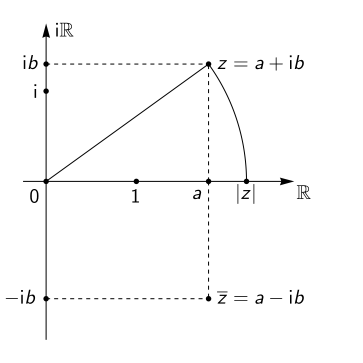
We may think of a complex number \(z=a+\mathrm{i}b\) as a point or a vector in the plane \(\mathbb{R}^2\) with \(x\)-coordinate \(a\) and \(y\)-coordinate \(b.\)
The real numbers form the horizontal coordinate axis (the real axis) and the purely imaginary complex numbers \(\{\mathrm{i}y : y \in \mathbb{R}\}\) form the vertical coordinate axis (the imaginary axis).
The point \(\overline{z}\) is obtained by reflecting \(z\) along the real axis.
\(|z|\) is the distance of \(z\) to the origin \(0_{\mathbb{C}}=(0,0) \in \mathbb{C}\)
The addition of complex numbers corresponds to the usual vector addition.
For the geometric significance of the multiplication, we refer the reader to the Calculus module.
We have the following elementary facts about complex numbers:
Proposition 1.17
For all \(z, w\in \mathbb{C}\) we have
\(\operatorname{Re}(z)=\frac{z+\overline{z}}{2},\) \(\operatorname{Im}(z)=\frac{z-\overline{z}}{2\mathrm{i}}\);
\(\operatorname{Re}(z+w)=\operatorname{Re}(z)+\operatorname{Re}(w),\) \(\operatorname{Im}(z+w)=\operatorname{Im}(z)+\operatorname{Im}(w)\);
\(\overline{z+w}=\overline{z}+\overline{w},\) \(\overline{zw}=\overline{z}\,\overline{w},\) \(\overline{\overline{z}}=z\);
\(|z|^2=|\overline{z}|^2=z\overline{z}=\operatorname{Re}(z)^2+\operatorname{Im}(z)^2\);
\(|zw|=|z||w|.\)
Proof. Exercise.
Exercises
See website https://apptest.fernuni.ch/ for worked solutions
Exercise 1.4
Check that \(\mathbb{C}\) is indeed a field.
Solution
We need to check that all field axioms are verified: Here \(+\) and \(\cdot\) denote addition and multiplication of real numbers respectively and we will use the usual notations \(xy=x\cdot y,\) \(x^2 = x\cdot x,\) \(\frac1x=x^{-1}\) for the multiplicative inverse of \(x\) and also \(x-y\) to denote \(x+(-y).\) Let \((x,y)\in\mathbb{C}\) and \(z_i=(x_i,y_i)\in\mathbb{C}\) for \(i=1,2,3\):
Commutativity of \(+_\mathbb{C}\): Using the commutativity of \(+\) we have \[\begin{aligned} (x_1,y_1)+_\mathbb{C}(x_2,y_2) & = (x_1+x_2,y_1+y_2) = (x_2+x_1,y_2+y_1) \\ & = (x_2,y_2)+_\mathbb{C}(x_1,y_1).\end{aligned}\]
Commutativity of \(\cdot_\mathbb{C}\): Using the commutativity of \(\cdot\) and \(+\) we have \[\begin{aligned}(x_1,y_1)\cdot_\mathbb{C}(x_2,y_2) & = (x_1 x_2-y_1 y_2,x_1 y_2+y_1 x_2) \\ &=(x_2 x_1-y_2 y_1,x_2 y_1+y_2 x_1)\\ & =(x_2,y_2)\cdot_\mathbb{C}(x_1,y_1).\end{aligned}\]
Associativity of \(+_\mathbb{C}\): Using the associativity of \(+\) we have \[\begin{aligned}((x_1,y_1)+_\mathbb{C}(x_2,y_2))+_\mathbb{C}(x_3,y_3) & = (x_1+x_2,y_1+y_2)+_\mathbb{C}(x_3,y_3) \\ & = ((x_1+x_2)+x_3,(y_1+y_2)+y_3) \\ & = (x_1+(x_2+x_3),y_1+(y_2+y_3))\\ & = (x_1,y_1)+_\mathbb{C}((x_2,y_2)+_\mathbb{C}(x_3,y_3)).\end{aligned}\]
Associativity of \(\cdot_\mathbb{C}\): Denoting \(z=(z_1\cdot_\mathbb{C}z_2)\cdot_\mathbb{C}z_3\) we have \[\begin{aligned} z & = (x_1 x_2-y_1 y_2,x_1 y_2+y_1 x_2)\cdot_\mathbb{C}z_3 \\ & = ((x_1 x_2-y_1 y_2)x_3-(x_1 y_2+y_1 x_2)y_3,(x_1 x_2-y_1 y_2)y_3+(x_1 y_2+y_1 x_2)x_3)\\ & = (x_1(x_2x_3-y_2y_3)-y_1(x_2y_3+y_2x_3),x_1(x_2y_3+y_2x_3)+y_1(x_2x_3-y_2y_3))\\ & = z_1\cdot_\mathbb{C}(z_2\cdot_\mathbb{C}z_3). \end{aligned}\]
Identity element of addition: \((x,y) +_\mathbb{C}(0,0) = (x+0,y+0) = (x,y)\)
Identity element of multiplication: \[(x,y) \cdot_\mathbb{C}(1,0) = (x\cdot 1 - y\cdot 0, x\cdot 0 + y\cdot 1) = (x,y)\]
The additive inverse of \((x,y)\) is given by \((-x,-y),\) since \[(x,y)+_\mathbb{C}(-x,-y) = (x+(-x),y+(-y)) = (0,0).\] Suppose \(z\in \mathbb{C}\) had two additive inverses \(z_1,z_2\in\mathbb{C}.\) Then one has \[z_1 = z_1 + 0_\mathbb{C}= z_1 +_\mathbb{C}(z +_\mathbb{C}z_2) = (z_1+_\mathbb{C}z) +_\mathbb{C}z_2 = 0_\mathbb{C}+_\mathbb{C}z_2 = z_2,\] which shows that the additive inverse is unique.
Let \((x,y)\ne(0,0).\) We claim that the multiplicative inverse of \((x,y)\) is given by \(\left(\frac{x}{x^2+y^2},\frac{-y}{x^2+y^2}\right).\) Indeed, we have \[\begin{gathered} (x,y)\cdot_\mathbb{C}\left(\frac{x}{x^2+y^2},\frac{-y}{x^2+y^2}\right)\\ = \left(\frac{x^2}{x^2+y^2}-\frac{y(-y)}{x^2+y^2},\frac{x(-y)}{x^2+y^2}+\frac{x y}{x^2+y^2}\right) = (1,0). \end{gathered}\] Again, the multiplicative inverse is unique: Suppose \(z\in\mathbb{C}\setminus\{0_\mathbb{C}\}\) had the multiplicative inverses \(z_1\) and \(z_2.\) Then \[z_1 = z_1\cdot_\mathbb{C}1_\mathbb{C}= z_1\cdot_\mathbb{C}(z\cdot_\mathbb{C}z_2) = (z_1\cdot_\mathbb{C}z)\cdot_\mathbb{C}z_2 = 1_\mathbb{C}\cdot_\mathbb{C}z_2 = z_2.\]
Distributivity of \(\cdot_\mathbb{C}\) over \(+_\mathbb{C}\): \[\begin{aligned} \left(z_1 +_\mathbb{C}z_2\right)\cdot_\mathbb{C}z_3 & = (x_1+x_2,y_1+y_2)\cdot_\mathbb{C}(x_3,y_3) \\ & = ((x_1+x_2) x_3-(y_1+y_2) y_3,(x_1+x_2) y_3 + x_3 (y_1+y_2))\\ & = (x_1 x_3 - y_1 y_3 + x_2 x_3 -y_2 y_3, x_1 y_3 + y_1 x_3 + x_2 y_3 + y_2 x_3 ) \\ &= (x_1,y_1)\cdot_\mathbb{C}(x_3,y_3) +_\mathbb{C}(x_2,y_2)\cdot_\mathbb{C}(x_3,y_3)\\ & = z_1\cdot_\mathbb{C}z_3 +_\mathbb{C}z_2 \cdot_\mathbb{C}z_3 \end{aligned}\]
Exercise 1.5
Show that the set of pairs \((x, y)\) with \(x, y \in \mathbb{F}_2,\) and addition and multiplication defined as in (1.10) above, is not a field.
Solution
Consider the element \((1, 1).\) This is not the zero element. However, it does not have an inverse, since for any \(a, b \in \mathbb{F}_2\) we have \[(a, b) \cdot (1, 1) = (a - b, a + b) = (a + b, a + b)\] (since \(-b = b\)), and this can never be equal to \((1, 0).\)
Exercise 1.6
Let \(z \in \mathbb{C}\) with \(|z| = 1.\) Show that there is a unique \(\theta \in [0, 2\pi)\) such that \(z = \cos \theta + \mathrm{i}\sin \theta.\)
Solution
Let \(z = x + iy.\) Then \(-1 \leqslant x \leqslant 1,\) and similarly for \(y\); and \(x^2 + y^2 = 1.\)
The cosine function is strictly decreasing on \([0, \pi],\) from \(+1\) to \(-1\); so there is exactly one \(\alpha \in [0, \pi]\) with \(\cos \alpha = x.\) Hence the only solutions to \(\cos \theta = x\) with \(\theta \in [0, 2\pi]\) are \(\alpha\) and \(2\pi - \alpha.\)
We have \(\cos^2 \alpha + \sin^2 \alpha = 1,\) so \(\sin \alpha\) must be either \(y\) or \(-y.\) In the first case, we take \(\theta = \alpha\); in the second case we take \(\theta = 2\pi - \alpha.\) (If \(y = 0\) the two cases occur simultaneously; but then \(x = \pm 1,\) and if \(x = +1\) then one of \(\alpha = 0\) and \(2\pi - \alpha = 2\pi\) is ruled out by the assumption \(\theta \in [0, 2\pi),\) and if \(y = -1\) then \(\alpha = 2\pi - \alpha\) anyway, so the uniqueness still holds.)
Exercise 1.7
Prove that there is no complex number \(z\) with \(|z|=z+\mathrm{i}.\)
Solution
Suppose such a \(z\) exists. Let \(t = |z|,\) which is a non-negative real number. Since \(z + i = t,\) we have \(z = -\mathrm{i}+ t,\) and thus \[t = |-\mathrm{i}+ t|.\] Squaring both sides we deduce \[t^2 = |-\mathrm{i}+ t|^2 = t^2 + 1,\] which is clearly impossible. So no solution exists.
MCQ 1.1
The natural numbers \(\mathbb{N}\) are a field.
- True
- False
MCQ 1.2
The integers \(\mathbb{Z}\) are a field.
- True
- False
MCQ 1.3
The set \(\{p + \mathrm i q : p,q \in \mathbb Q\}\subset \mathbb C\) equipped with complex addition and multiplication is a field.
- True
- False
MCQ 1.4
Let \(\mathbb F\) be a field and \(x,y \in \mathbb F.\) If \(xy=0,\) then \(x=0\) or \(y=0.\)
- True
- False
MCQ 1.5
Given fields \(\mathbb{F}\) and \(\mathbb{K},\) the zero function \(o :\mathbb{F}\rightarrow\mathbb{K},\) which sends all elements of \(\mathbb{F}\) to \(0_{\mathbb{K}},\) is a field embedding.
- True
- False
MCQ 1.6
If \(\chi:\mathbb F\to\mathbb K\) is a field embedding, then \(\chi(x)=0_{\mathbb K}\) implies \(x=0_{\mathbb F}.\)
- True
- False
MCQ 1.7
There is a field embedding from \(\mathbb{F}_4\) to \(\mathbb{F}_2.\)
- True
- False
MCQ 1.8
The least value of \(n\in \mathbb N\) such that \(\operatorname{Im}((1+\mathrm i\sqrt 3)^n)=0\) equals \(n=3.\)
- True
- False
MCQ 1.9
\(\operatorname{Im}(z)+\mathrm i \operatorname{Re}(z) = \mathrm i \bar z\) for all \(z\in\mathbb C.\)
- True
- False
MCQ 1.10
\(\mathrm i^{1291}=\mathrm i.\)
- True
- False
MCQ 1.11
If \(z\in\mathbb{C}\) is such that \(\operatorname{Re}\left(\frac{z-1}{z+1}\right)=0,\) then \(|z|=1.\)
- True
- False
MCQ 1.12
If \(z\in\mathbb{C}\) is such that \(\operatorname{Im}\left(\frac{z-1}{z+1}\right)=0,\) then \(\operatorname{Im}(z) = 0.\)
- True
- False
MCQ 1.13
If \(z=(\mathrm i-\mathrm i^2)^3,\) then \(\bar z=2+2\mathrm i.\)
- True
- False
MCQ 1.14
A complex number \(z\) is purely imaginary if and only if \(\bar z = -z.\)
- True
- False
MCQ 1.15
If \(n\) is an odd natural number, then \(\mathrm i^2+\mathrm i^4 + \ldots +\mathrm i^{2n} = 0.\)
- True
- False